

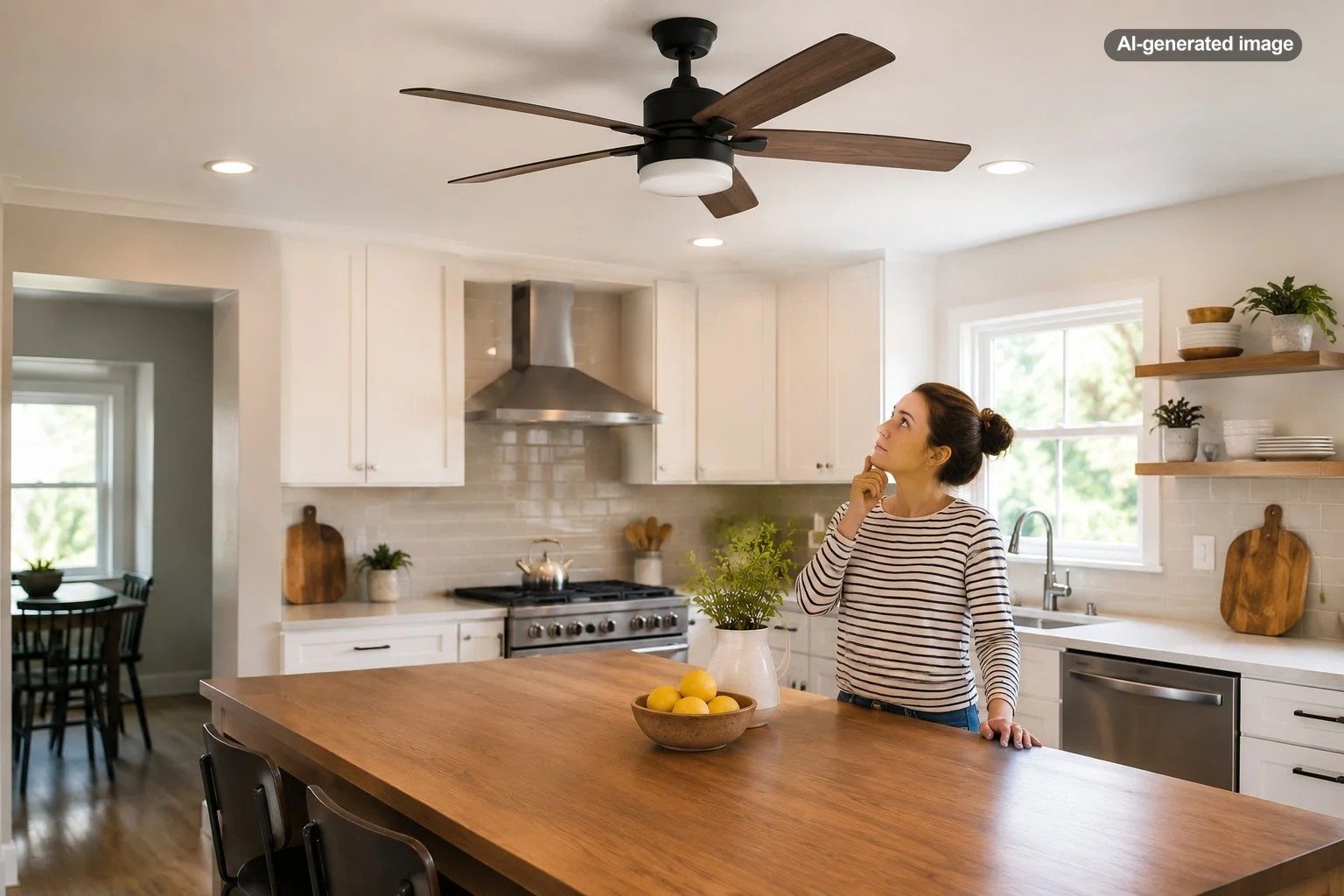
Can You Put a Ceiling Fan in a Kitchen?
Yes, you can put a ceiling fan in a kitchen, provided the room has enough ceiling height, the fan has safe clearance from cabinets and fixtures, and the mounting location does not interfere with cooking ventilation. In a warm or open kitchen, a fan can make the room feel more comfortable by moving air across the people in it.
A ceiling fan is not, however, a replacement for a range hood or other exhaust ventilation. It circulates air within the room; it does not reliably remove cooking smoke, steam, grease, odors, or combustion byproducts from the home.
When a Ceiling Fan Makes Sense in a Kitchen
Kitchens often feel warmer than adjoining rooms because ovens, cooktops, dishwashers, lighting, and direct sunlight all add heat. A ceiling fan can improve comfort during meal preparation, cleanup, or casual dining by creating a breeze.
The idea is especially practical in an open-concept kitchen, a large eat-in kitchen, or a room with limited cross-ventilation. It can also help distribute conditioned air through a kitchen that sits at the far end of an HVAC zone.
Remember that a fan cools people rather than lowering the room’s temperature. The U.S. Department of Energy describes ceiling fans as a supplement to natural or mechanical cooling, not as a system that removes heat from the house. Turn the fan off when the room is empty unless it is serving another specific purpose recommended by the manufacturer.
Advantages
- Creates a cooling breeze while cooking or cleaning
- Can improve comfort in large or open kitchens
- May help distribute heated or cooled air
- Can provide useful overhead lighting when fitted with a light kit
Tradeoffs
- Blades collect grease and dust
- Airflow may disturb a gas burner or spread cooking vapors
- The fixture needs adequate ceiling and wall clearance
- It cannot replace an exhaust hood
Do Not Treat It as Kitchen Exhaust Ventilation
A range hood and a ceiling fan perform different jobs. A vented range hood captures contaminants near the cooking surface and sends them outdoors. A ceiling fan simply moves room air around, which may spread steam, odors, and airborne grease instead of removing them.
For that reason, placing a fan directly over or very close to a cooktop is usually a poor arrangement. Strong airflow can disrupt the capture area of a range hood. Around an open gas flame, it may also affect flame behavior. Keep the fan away from the cooking zone and follow the clearance and location requirements supplied with the cooking appliance, hood, and fan.
Where Should the Fan Go?
The best location is normally over an open section of floor where people gather or walk, not over the cooking surface. In a large kitchen, that might be the space between the island and perimeter cabinets, the center of an eat-in area, or the midpoint of an open kitchen-and-dining zone.
ENERGY STAR guidance says ceiling fans should generally be mounted at least 7 feet above the floor and 18 inches from walls, with a height of about 8 to 9 feet preferred when the ceiling allows it. These are useful planning benchmarks, but the fan manufacturer’s instructions and applicable local requirements should govern the actual installation.
Over a Kitchen Island
A fan can sometimes work over an island when the island is used mainly for seating, preparation, or serving. It is less suitable when the island contains the main cooktop. Even over a non-cooking island, check whether the blades will conflict visually or physically with pendant lights.
A fan and several pendants can make the same ceiling plane feel crowded. One restrained fan with an integrated light may create a cleaner composition than a fan surrounded by multiple hanging fixtures.
Near Cabinets and Tall Storage
Measure the full blade sweep, not merely the diameter of the motor housing. Cabinet doors, pantry doors, open shelving, ceiling-mounted pot racks, and tall decorative objects must remain outside that sweep. Also consider whether a door could be left open accidentally while the fan is running.
Choose the Right Size and Mounting Style
Bigger is not automatically better. A fan that overwhelms a modest kitchen can create uncomfortable drafts, compete with lighting, and reduce practical clearance. A fan that is too small may contribute little beyond visual clutter.
ENERGY STAR’s general sizing guidance pairs fans approximately 29 to 36 inches wide with rooms up to 75 square feet, 36 to 42 inches with rooms from 76 to 144 square feet, 44 inches with rooms from 144 to 225 square feet, and 50 to 54 inches with rooms from 225 to 400 square feet. Treat those ranges as a starting point. Kitchen layout, mounting height, blade design, airflow performance, and obstructions also affect the result.
For an 8-foot ceiling, a low-profile or hugger-style fan may be the most workable choice. A taller ceiling may accommodate a downrod that places the blades closer to the preferred operating height. Do not improvise by omitting mounting components unless the fan is specifically designed for that configuration.
Before you decide
- Measure the kitchen’s length, width, and ceiling height.
- Mark the proposed blade sweep on a floor plan.
- Check clearance from walls, cabinets, doors, pendants, and shelving.
- Confirm that the location is away from the cooktop and hood capture area.
- Choose a finish that can be wiped clean without delicate treatment.
- Verify that the ceiling box and support are approved for fan mounting.
- Review the manufacturer’s instructions before installation begins.
Look for Kitchen-Friendly Materials and Controls
Kitchen fans need more cleaning than fans in many bedrooms or living rooms. Airborne grease can combine with dust and form a stubborn film on blade edges and upper surfaces. Smooth, nonporous blades and a simple motor housing are generally easier to maintain than deeply textured wood, woven inserts, or ornate details.
A reversible motor can be useful in a room that needs seasonal air circulation, while several speed settings make it easier to choose a gentle breeze that does not disturb papers, napkins, or lightweight ingredients. A wall control is often more convenient than a pull chain above an island or table. Remote controls are useful too, but they need a sensible storage spot to avoid joining the kitchen’s collection of mysteriously vanishing objects.
If the fan includes a light, consider whether it provides enough general illumination and whether its color quality suits food preparation. A fan light should complement task lighting under cabinets and over work surfaces rather than serve as the kitchen’s only light source.
Installation Is More Than Swapping a Light Fixture
A ceiling fan creates movement and ongoing mechanical loads that an ordinary light fixture does not. The electrical box and structural support must be suitable for a fan. Do not assume an existing light box can safely carry one simply because the fan canopy covers the opening.
The power should be shut off and verified before electrical work begins. Wiring, controls, grounding, structural support, and any required local approvals should be handled according to the manufacturer’s directions and the rules that apply where the home is located. The National Electrical Code is a widely adopted model code, but local adoption and amendments vary.
If you cannot confirm the box rating, support method, wiring condition, or required clearances, use a qualified electrician or fan installer. Professional help is also sensible for high ceilings, sloped ceilings, older wiring, new control wiring, or a location where framing must be added.
Keeping a Kitchen Ceiling Fan Clean
Turn the fan off and allow it to stop completely before cleaning. Use a stable method of access, follow the care instructions for the blade material, and avoid saturating the motor housing or controls. A lightly damp microfiber cloth is often sufficient for routine dust, while greasy buildup may require a manufacturer-approved mild cleaning solution.
Frequent light cleaning is easier than an occasional battle with a sticky layer. During cleaning, look for loose hardware, blade damage, wobbling, unusual noises, or movement at the ceiling canopy. Stop using the fan and arrange an evaluation if anything appears unstable or electrically damaged.
When Another Option Is Better
A ceiling fan may not be the right answer in a kitchen with a low ceiling, tightly packed upper cabinets, numerous pendant lights, or no clear mounting position outside the cooking zone. It can also feel excessive in a very small kitchen where a quieter range hood, improved HVAC balancing, solar shading, or a compact portable fan used safely away from water and heat would address the actual problem more directly.
A kitchen ceiling fan succeeds when it improves comfort without interfering with ventilation, lighting, storage, or safe movement.
Frequently Asked Questions
Can you install a ceiling fan directly above a stove?
It is generally better to keep a ceiling fan away from the stove. Airflow may interfere with a range hood’s ability to capture contaminants and may affect an open gas flame. Follow the appliance, hood, and fan manufacturers’ location requirements.
Will a ceiling fan remove cooking smells?
No. It may disperse odors through a larger area, but it does not exhaust them outdoors. A properly designed and operated kitchen exhaust system is the more relevant tool.
Is a low-profile fan better for a kitchen?
It can be a good choice for a standard-height ceiling because it preserves more headroom. It still needs to meet minimum clearance guidance and must be installed exactly as its manufacturer specifies.
Can a kitchen ceiling fan have a light?
Yes. An integrated light can provide useful ambient illumination, but most kitchens still benefit from dedicated task lighting over counters, sinks, islands, and cooking surfaces.
What is the best finish for a kitchen fan?
A smooth, durable, wipeable finish is usually the most practical. Intricate carvings, porous materials, and heavy texture can hold grease and dust, making routine cleaning more difficult.