
What Temperature Should You Set a Condo Thermostat While Away?
If you are leaving a condo for more than a few hours, the best thermostat setting depends on the season, climate, humidity, plumbing, HVAC system, and how long the unit will be empty. As a practical starting point, raise the cooling temperature about 7 to 10�F above your normal occupied setting during shorter warm-weather absences. For an extended absence in a hot, humid climate, an air-conditioning setting around 80 to 85�F can be appropriate when the system is also controlling moisture. In cold weather, do not simply turn the heat off; the American Red Cross advises leaving an unattended home’s heat at no lower than 55�F to help protect plumbing from freezing.
Start with how long you will actually be away
A thermostat setting for an afternoon away does not need to be the same as a setting for a three-week trip. The U.S. Department of Energy notes that reducing heating or cooling demand while a home is unoccupied can save energy, and it commonly uses a 7 to 10�F setback for eight hours as an example. In cooling season, that means raising the setpoint; in heating season, it means lowering it.
For a normal workday or weekend trip, a modest setback is generally the simplest approach. If you normally cool your condo to 74�F, for example, an away setting around 81�F represents a 7�F adjustment. A programmable or smart thermostat can restore your preferred occupied temperature before you return instead of maintaining it throughout your absence.
Extended travel requires a different calculation. Once a condo will sit empty for days or weeks, indoor humidity, plumbing protection, weather extremes, equipment reliability, and the condition of the building become more important than squeezing another degree of energy savings from the thermostat.
For summer trips, do not confuse warmer with off
Turning air conditioning completely off can be a poor strategy in a humid climate. Air conditioners do more than lower temperature: while operating properly, they also remove moisture from indoor air. That matters in an unoccupied condo because there may be nobody present to notice condensation, a musty room, a leaking window, or rising humidity.
University of Florida IFAS Extension guidance for closing a Florida home recommends leaving the air conditioner in working order and, when using a thermostat rather than a timer-based strategy, setting it around 80 to 85�F. That range is particularly relevant to seasonally vacant homes in warm, humid environments. It should not be treated as a universal requirement for every condo or climate.
If your condo is in a relatively dry climate, you may be able to tolerate a larger cooling setback than someone in coastal Florida. Conversely, a unit with known moisture problems, large areas of exterior glass, previous water intrusion, sensitive wood furnishings, or poor air circulation may justify a more conservative setting. The goal is not to discover how hot the condo can become. It is to reduce unnecessary cooling while maintaining reasonable environmental control.
In winter, protect the plumbing first
Cold-weather thermostat decisions have a clearer lower boundary. The American Red Cross recommends that people leaving home during cold weather keep the heat on and set the thermostat no lower than 55�F. This guidance is intended to reduce the risk of water pipes freezing.
A condo does gain some thermal buffering from neighboring units, shared walls, and conditioned common areas, but that is not a reason to assume your plumbing cannot freeze. Pipes may run through exterior walls, cabinets, utility spaces, or other colder locations. Corner units and top-floor units can also have substantially different exposure from interior units.
If severe cold is forecast, consider whether 55�F gives your particular unit enough margin. Older buildings, poorly insulated exterior walls, plumbing near outside surfaces, and a history of frozen pipes are all reasons to be more cautious. Your condominium association or building manager may also have cold-weather procedures that apply to vacant units.
Condo living adds a few variables a detached house does not have
A condominium is part of a larger building, which can make thermostat advice less straightforward. Your unit may share walls, floors, ceilings, plumbing chases, ventilation pathways, or central mechanical equipment with other units. Some buildings provide individual HVAC systems while others use central or partially shared systems.
Before you decide
- Check whether your condo association specifies minimum or maximum temperatures for vacant units.
- Find out whether your HVAC equipment is entirely inside your unit or part of a shared building system.
- Consider whether pets, plants, artwork, wine, electronics, musical instruments, or other temperature-sensitive belongings will remain inside.
- Look at humidity as well as temperature if you live in a damp or coastal climate.
- Confirm that the HVAC filter, condensate drainage, and equipment are in normal working condition before a long absence.
- Make sure someone can access the condo if remote monitoring shows an unusual temperature or system failure.
Condo owners should also resist the temptation to close every supply register in an effort to save more energy. HVAC systems are designed around particular airflow conditions, and aggressively restricting airflow can create operational problems. If you have unusual zoning or want to condition only part of the condo, ask a qualified HVAC professional what your specific system supports.
A smart thermostat is useful when plans or weather change
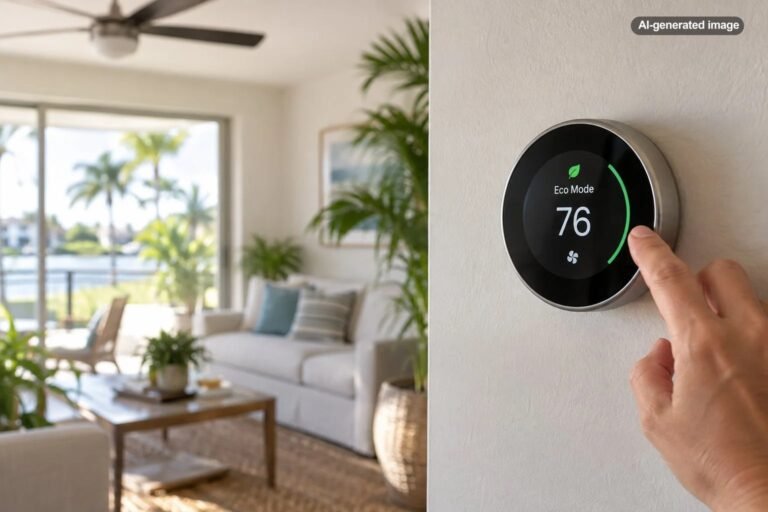
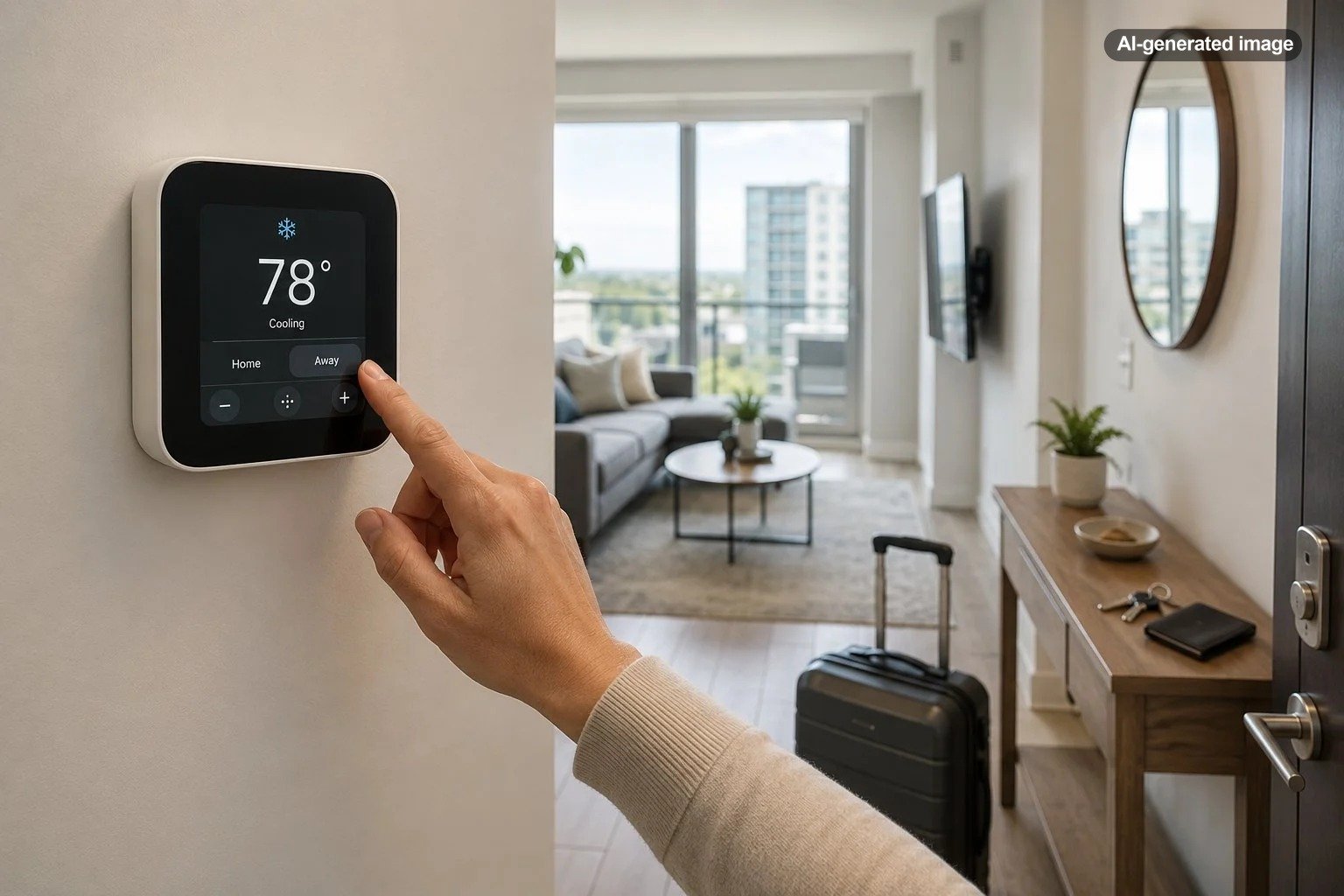
The biggest advantage of a connected thermostat during travel is not simply automation. It is visibility and control. ENERGY STAR notes that smart thermostats can provide remote temperature adjustment, away modes, scheduling, and other features that reduce heating or cooling when it is not needed. That can be especially useful when a trip is extended unexpectedly or a heat wave or cold snap develops after you leave.
Affiliate disclosure: CraneManor.com may earn a commission when you purchase through links on this page. This does not affect the price you pay. Learn more.
If remote control would make managing an empty condo easier, a compatible smart thermostat such as the Google Nest Thermostat can provide that convenience. Compatibility should be checked before purchase or installation rather than assumed. Google states that Nest thermostats are designed for many common 24 V systems, but some wiring, high-voltage equipment, proprietary systems, and certain configurations are incompatible or may require additional equipment or professional help.
In a condo, compatibility deserves extra attention because your wall thermostat may control equipment that is not obvious from inside the unit. Fan-coil systems, proprietary building controls, zoned equipment, or centrally managed HVAC arrangements may not accept an ordinary replacement thermostat. When in doubt, ask building management what type of thermostat the system supports before removing the existing control.
Use humidity and weather to fine-tune the number
The ideal away setting is better thought of as a range with guardrails than a single magic number. If you live somewhere hot and dry, indoor humidity may play a minor role and a larger cooling setback could make sense. If you live somewhere hot and humid, keeping the air conditioner cycling enough to remove moisture can be more important than achieving the highest possible thermostat setting.
Before leaving for a long trip, look at the forecast as well as the season. A mild week may call for little HVAC operation, while an approaching freeze or prolonged period of high heat and humidity changes the calculation. Smart controls can make these adjustments easier, but even a manual thermostat can work well when the setting is chosen thoughtfully before departure.
Do not make these common away-mode mistakes
The first mistake is turning the HVAC system off simply because nobody will be there. That can expose a condo to freezing plumbing in winter or uncontrolled heat and humidity during warm weather. The second is choosing an extreme temperature without considering what else is inside the unit. Pets in particular require temperature settings based on their individual needs, not an energy-saving vacation target.
Another mistake is assuming that a remote thermostat eliminates the need for a contingency plan. A thermostat cannot repair a failed compressor, clear a clogged condensate line, restore power, or inspect a leak. For an extended absence, especially in a seasonal condo, arranging for a trusted person or building representative to have authorized access can be valuable.
Finally, avoid copying a neighbor’s thermostat setting without understanding the differences between the units. Sun exposure, floor level, windows, insulation, corner placement, HVAC type, and occupancy above and below can all affect how quickly two condos gain or lose heat.
FAQ
What should I set my condo thermostat to in summer while on vacation?
For a short absence, raising the cooling setpoint roughly 7 to 10�F above your normal setting is a sensible starting point. For an extended absence in a hot, humid climate, UF/IFAS guidance for seasonal Florida homes supports a setting around 80 to 85�F when using air conditioning for moisture control. Your building, climate, belongings, and humidity conditions may justify a different setting.
What should I set it to in winter?
If freezing weather is possible, keep the heat on. The American Red Cross recommends no lower than 55�F when leaving a home during cold weather. A higher setting may be prudent in a vulnerable unit or during extreme cold.
Should I turn my condo air conditioner off while traveling?
Not automatically. Turning cooling off may be reasonable in some mild or dry conditions, but it can remove an important source of humidity control in hot, damp climates. For a long absence, maintaining a higher cooling setpoint is often a more balanced approach than switching the system off completely.
Is 85�F too hot for an empty condo?
Not necessarily. UF/IFAS has recommended an 80 to 85�F thermostat range for closed seasonal Florida homes without timer-based air-conditioning control. However, 85�F should not be treated as universally appropriate. Monitor humidity, consider sensitive possessions, and follow any building-specific requirements.
Is a smart thermostat worth having in a condo?
It can be particularly useful for frequent travelers because remote access lets you check and adjust the temperature when weather or travel plans change. Before buying one, verify that both the HVAC equipment and the condominium building’s control system are compatible.
The practical bottom line
For most condo owners, the best away setting is a controlled setback rather than shutting the HVAC system down. For shorter absences, start by moving the thermostat approximately 7 to 10�F away from your normal occupied setting. During extended hot-weather travel in a humid climate, roughly 80 to 85�F can be a useful reference range when the air conditioner is needed for moisture control. During freezing weather, keep the heat at 55�F or higher.
Then refine that number for the condo in front of you: its climate, plumbing, sun exposure, HVAC design, humidity, belongings, association rules, and the length of your trip. The smartest away temperature is not simply the setting that makes the system run least. It is the setting that reduces unnecessary energy use while keeping the empty condo appropriately protected until you return.