

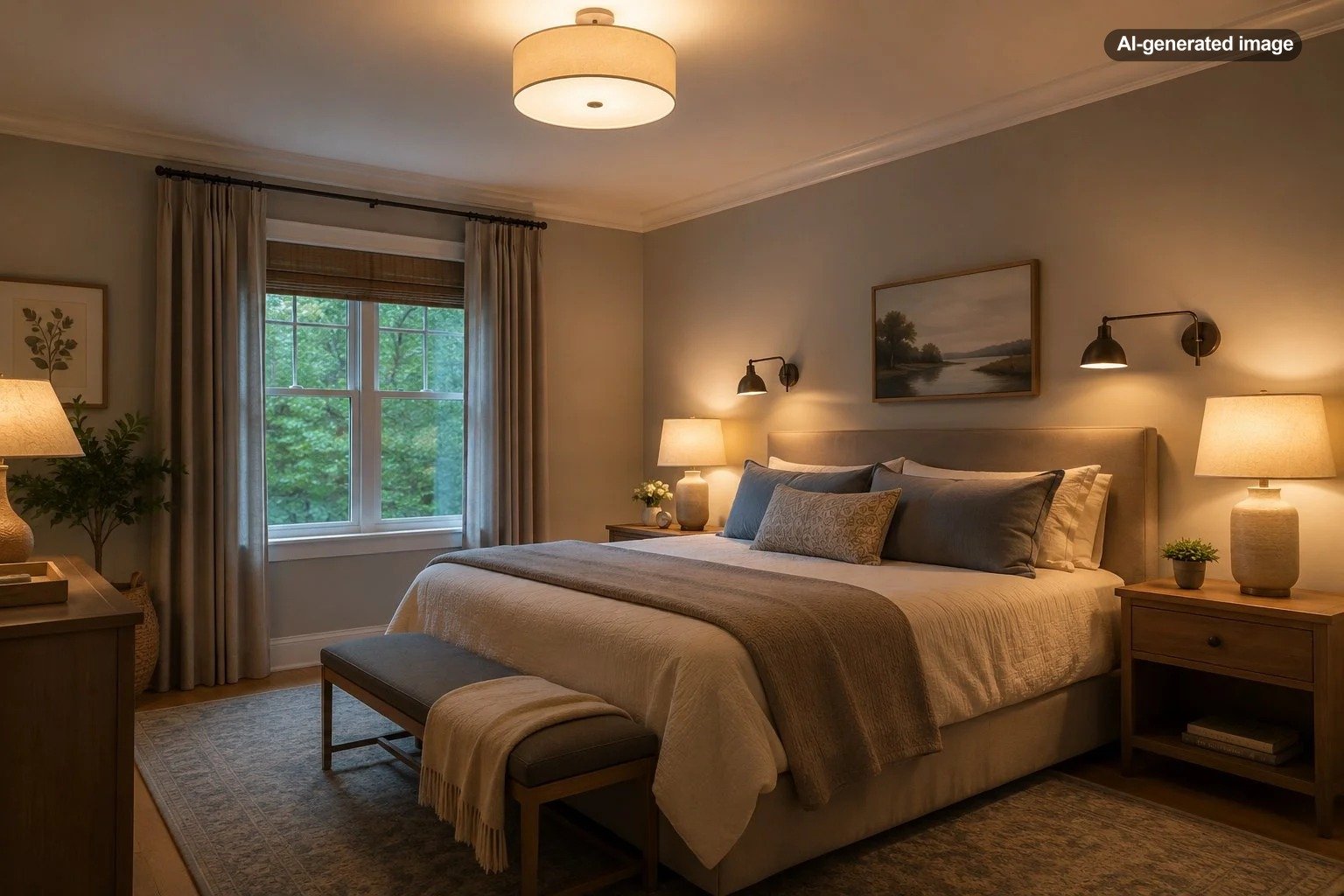
What Type of Lighting Is Best in a Guest Room?
The best lighting for a guest room is not one especially bright fixture. It is a simple, layered arrangement: warm ambient light for entering and moving around the room, focused task lighting beside the bed, and a softer low-level option for nighttime use. Each layer should be easy to operate without instructions or a hunt for an elusive wall switch.
For most guest rooms, begin with a dimmable ceiling fixture or a lamp that spreads light broadly. Add a bedside lamp on each side of a shared bed when space permits, then consider a night-light or another gentle source near the route to the door. The result should feel comfortable at bedtime while still providing enough useful light for reading, unpacking, dressing, and finding a charging cable that has slipped behind the nightstand.
Start with layered light, not a single fixture
Lighting professionals distinguish among ambient, task, and accent lighting. The U.S. Department of Energy describes ambient lighting as general illumination and task lighting as the additional light used for a particular activity. That distinction is especially useful in a guest room because the space needs to support several activities without feeling as bright as a kitchen or office.
Ambient lighting supplies the room’s general glow. This may come from a ceiling fixture, recessed lights, a pendant, a ceiling fan light, or a floor lamp that sends light upward. It should make the bed, luggage rack, closet, and walking path clearly visible.
Task lighting belongs where a guest might read, work, apply makeup, or sort belongings. Bedside lamps, wall-mounted reading lights, and desk lamps are better at these jobs than a central ceiling fixture because they place light closer to the activity.
Low-level lighting makes nighttime movement less jarring. A plug-in night-light, a small lamp on its lowest setting, or a carefully positioned motion-activated light can help guests orient themselves without flooding the room with light.
| Lighting type | Best use | Main advantage | Potential drawback |
|---|---|---|---|
| Ceiling fixture | General room lighting | Illuminates the room at once | Can feel harsh without a dimmer or diffuser |
| Bedside lamp | Reading and winding down | Easy to control from bed | Uses nightstand space |
| Wall-mounted light | Bedside task lighting | Keeps surfaces clear | Placement must suit the bed and mattress height |
| Floor lamp | Ambient or task lighting | Adds light without installation | Needs stable floor space and a sensible cord route |
| Night-light | After-dark navigation | Provides gentle orientation | Poor placement can shine toward the bed |
Choose warm light and judge brightness by lumens
Warm white light is usually the most comfortable choice for a guest bedroom. Bulbs around 2700K create a familiar, relaxed appearance, while 3000K can look slightly cleaner and may suit a crisp contemporary room. Cooler light can be useful at a dedicated desk, but using very cool bulbs throughout the bedroom may make the space feel more clinical than restful.
Keep the color temperature reasonably consistent across fixtures that will be on together. A warm bedside lamp beside a noticeably blue ceiling light can make even a thoughtfully decorated room look disjointed. Matching bulbs is one of the least expensive ways to make separate fixtures feel like a coordinated lighting plan.
Brightness should be compared in lumens, not watts. ENERGY STAR explains that lumens measure light output, while watts describe the energy a bulb consumes. Rather than applying one lumen target to every guest room, consider the size of the room, shade opacity, wall colors, daylight, and number of fixtures. A dark shade and deep wall color absorb more light than an open fixture in a pale room.
Make bedside lighting the priority
If the budget allows only one improvement beyond the main room light, spend it on bedside lighting. Guests should be able to read and switch off the light without getting out of bed. In a room with a queen or king bed, two independently controlled lamps are more considerate than one central lamp because one person can read while the other rests.
Scale matters. A tiny lamp can disappear beside a tall headboard, while an oversized shade may crowd a narrow table. Aim to place the useful portion of the light near the seated reader’s shoulder level, then check that the bulb itself is shielded from direct view. An opaque or softly diffusing shade controls glare better than a bare bulb.
In a small room, plug-in wall sconces or compact swing-arm lights can preserve nightstand space without requiring hardwired installation. Renters should check lease terms before mounting anything, and cords should be routed so they do not cross a walking path or become pinched behind furniture.
Use a floor lamp when the room lacks overhead light
A floor lamp can provide the ambient layer in a guest room with no ceiling fixture, or it can brighten a dark corner that the central light misses. An uplight washes the ceiling with broad, indirect illumination, while a model with a separate adjustable task light can support reading or desk work. This is particularly useful when the guest room doubles as an office.
Affiliate disclosure: CraneManor.com may earn a commission when you purchase through links on this page. This does not affect the price you pay. Learn more.
One space-conscious example is a torchiere floor lamp with a task light, which combines broad upward illumination with a more focused secondary source. Before choosing any floor lamp, confirm its dimensions, bulb requirements, dimmer compatibility, ceiling clearance, switch location, and cord placement. The base should sit securely where luggage, doors, and nighttime foot traffic are unlikely to knock it.
Plan for guests who do not know the room
A guest room should be understandable at a glance. Decorative controls lose their charm when a tired visitor cannot tell which button turns off the lamp. Conventional switches, clearly visible lamp controls, and independent operation are often more welcoming than a system that depends entirely on an app, voice assistant, or unfamiliar remote.
Place the primary switch near the entrance and bedside controls within comfortable reach. If a smart bulb is used, make sure the lamp can still be operated manually. Guests should not need an account, Wi-Fi access, or a spoken command to turn out the light.
Avoid glare, shadows, and awkward cord placement
A bright fixture is not automatically a useful one. Bare bulbs, clear shades at eye level, and downlights directly over the pillow can produce uncomfortable glare. A heavily shaded lamp can create the opposite problem, leaving the room attractive but impractical for reading or unpacking. Diffusion, placement, and more than one light source usually matter more than maximum output.
Check the room at night from a guest’s perspective. Turn on the lights from the doorway, sit on both sides of the bed, open the closet, and walk toward the hall. Look for dark transitions, reflections in mirrors, exposed bulbs, and switches hidden behind furniture.
Before you decide
- Provide ambient and bedside lighting with separate controls.
- Choose a consistent warm white color temperature.
- Compare bulb brightness by lumens and follow the fixture’s labeling.
- Keep controls visible and reachable without an app.
- Shield bulbs from direct view when a guest is sitting or lying down.
- Keep cords away from doorways and walking paths.
- Use a qualified professional for hardwired changes when appropriate.
Do not let convenience override electrical safety
Inspect lamp cords, plugs, sockets, and switches periodically, especially in a room that sits unused for long stretches. Stop using a fixture if its cord is frayed, its plug is damaged, its socket is loose, or it behaves unusually. Follow the fixture and bulb manufacturers’ instructions, including bulb type and maximum permitted wattage.
Avoid treating an extension cord as permanent room wiring. The U.S. Consumer Product Safety Commission advises using extension cords only when appropriate for the intended load and replacing damaged cords rather than repairing them. Do not run cords beneath rugs or place them where furniture can crush them. If the room lacks conveniently placed receptacles, consult a qualified electrician about a suitable permanent solution and any local requirements.
Frequently asked questions
Should a guest room have a ceiling light?
A ceiling light is convenient but not essential. A floor lamp or pair of lamps can provide general illumination when they distribute light broadly. The more important requirement is that guests can light the room from the entrance and move around safely.
Are bedside lamps necessary on both sides?
Two are preferable for a bed shared by two people, but a small room may not have enough surface space. Plug-in wall lights, narrow lamps, or one central fixture with independent reading lights can be practical alternatives.
Is 2700K or 3000K better for a guest bedroom?
Both can work. Choose 2700K for a warmer, more traditional feeling and 3000K for a slightly clearer, more contemporary appearance. Consistency between fixtures is more important than the small difference between them.
Should guest room lights be smart?
Smart controls are useful only when they preserve straightforward manual operation. A guest should always have an obvious way to turn lights on and off without downloading an app, joining a network, or learning a home automation routine.