
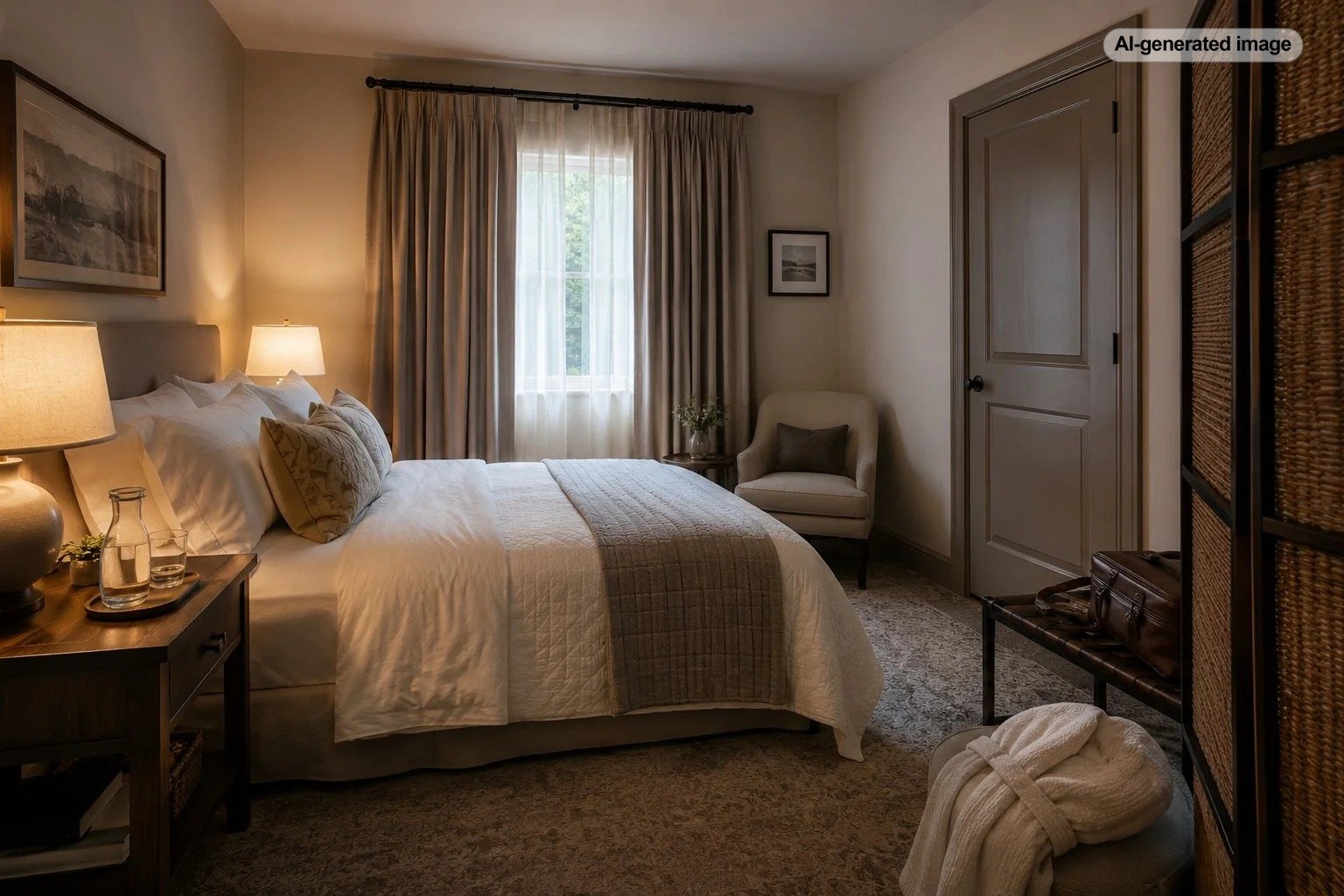
How Do You Make a Guest Room Feel Private?
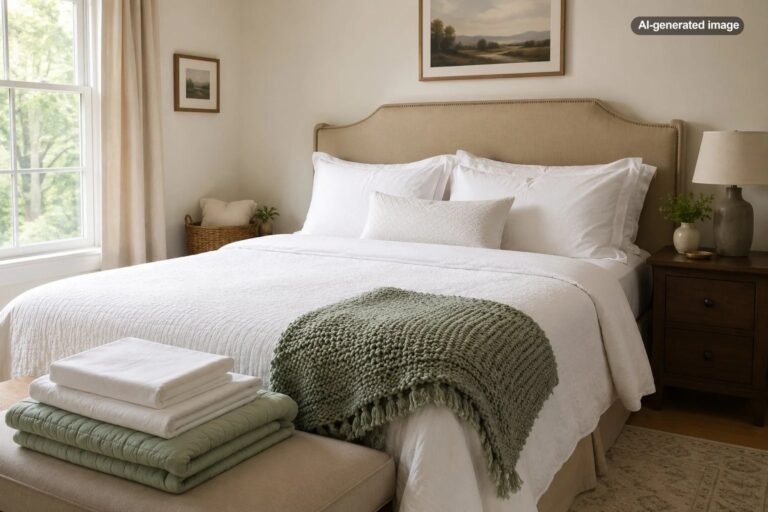
A guest room feels private when visitors can close themselves off from household activity, control what can be seen through the windows, keep their belongings contained, and spend time in the room without feeling as though they are occupying somebody else’s everyday space. You do not need a separate guesthouse or a large suite. The most effective changes are usually simple: reliable window coverings, a door that closes properly, a clear place for clothes and luggage, enough lighting to function independently, and a little distance from the household’s visual and auditory clutter.
Privacy is partly physical, but it is also psychological. A beautiful bedroom can still feel exposed if the curtains are sheer at night, people regularly walk past the doorway, or every dresser drawer is filled with the host’s belongings. Conversely, even a modest spare room can feel comfortably self-contained when guests understand which space is theirs and can control it without asking permission.
Start with the door
The doorway establishes the strongest boundary between a guest room and the rest of the home. A door that closes fully already does much of the work. Check that it does not drift open, scrape badly, or require an awkward shove that makes guests reluctant to use it.
If the bedroom has a functioning privacy lock appropriate for the home, make sure guests know how it works. If it does not, avoid improvising with complicated temporary hardware that could create an inconvenience or safety problem. The larger goal is simply to make closing the door feel normal rather than antisocial.
Household habits matter too. Once someone is staying in the room, treat a closed door as a boundary. Knock before entering, including when retrieving something that normally lives in the spare room. If the room doubles as an office, hobby room, or storage area, relocate frequently needed items before the visit.
Give the windows real privacy after dark
Window treatments deserve special attention because a covering that looks private during daylight may behave very differently at night. Sheer curtains can soften a window beautifully while still revealing silhouettes or interior details when the room is illuminated.
For a guest bedroom, use a layer that can provide meaningful visual coverage when closed. Depending on the room, that might be lined curtains, shades, blinds, shutters, or a layered combination such as a shade behind decorative drapery. The guest should be able to operate the covering easily without having to decipher an unusual mechanism.
If the room faces a sidewalk, neighboring window, shared courtyard, or another close sightline, evaluate privacy from outside after sunset with the bedroom lights turned on. That simple check can reveal gaps at the sides of blinds or curtains that are barely noticeable from inside.
Privacy does not necessarily require making the room dark all day. Layered treatments can preserve daylight while giving guests a more opaque option for changing clothes and sleeping.
Create a place for personal belongings
Guests tend to feel more settled when they can unpack at least partially instead of keeping everything piled on the floor or permanently zipped inside a suitcase. Clear a few hangers in the closet, an empty drawer if available, and a portion of a dresser or shelf.
Affiliate disclosure: CraneManor.com may earn a commission when you purchase through links on this page. This does not affect the price you pay. Learn more.
A dedicated suitcase surface is especially useful because it defines where travel belongings can live without spreading across the bed or into common areas. A folding luggage rack can work well when floor space allows and can be stored between visits.
Do not make guests guess which areas are available. Empty space communicates permission more clearly than a beautifully organized drawer filled with your own things.
For short stays, a few hooks can also provide useful temporary storage for a robe, jacket, handbag, or tomorrow’s outfit. In a small room, wall-mounted or over-door solutions may be easier to accommodate than another piece of furniture.
Let guests function without repeatedly entering shared spaces
A private-feeling guest room should support the small routines that happen before bed and first thing in the morning. Provide a bedside lamp, accessible outlets or charging space, water, tissues, a wastebasket, and a mirror if the room does not have one nearby.
These details are not about recreating a hotel. They reduce the number of times a guest has to walk through the house in pajamas looking for a charger, glass of water, or place to set something down.
If guests are sharing a bathroom with the household, show them where towels and basic supplies are before bedtime. A predictable bathroom routine can make a shared arrangement feel considerably less awkward.
Reduce visual reminders that the room belongs to someone else
A guest bedroom does not have to be impersonal, but excessive personal storage can make visitors feel as though they are sleeping in borrowed territory. Family photographs are not inherently a problem. Overflowing filing boxes, exercise equipment, laundry baskets, open household storage, and shelves packed with private paperwork are more disruptive.
Use closed storage for items that cannot be removed. Clearing the nightstand is particularly worthwhile because guests naturally expect that surface to be available for a phone, glasses, medication, or a glass of water.
The bed itself should look intentionally prepared rather than temporarily uncovered. Fresh bedding, usable pillows, and a clear place for decorative cushions at night make the room easier to inhabit. Privacy is reinforced when a guest does not have to rearrange the host’s possessions before using the room.
Use furniture to create boundaries in multipurpose rooms
Not every guest sleeps behind a dedicated bedroom door. A daybed in an office, sleeper sofa in a den, finished basement, or loft may require visual zoning instead.
Start by orienting the sleeping area away from the busiest circulation path when possible. A bookcase, folding screen, curtain, console, or furniture arrangement can create a visual boundary without permanently dividing the room. Even changing the direction from which the bed is approached can make the sleeping zone feel less exposed.
Be careful not to create a cramped obstacle course in the name of privacy. Guests should still have a clear, comfortable route through the space, particularly at night.
Manage noise without trying to soundproof the house
Privacy also involves being able to hear – and be heard – less. Most homes do not need acoustic construction for occasional guests. Start with ordinary household behavior: lower television volume near the room, avoid early-morning vacuuming outside the door, and discourage prolonged conversations in an adjacent hallway.
Soft furnishings can make a room feel less acoustically bare. Rugs, upholstered furniture, curtains, and bedding absorb some reflected room sound, although they should not be treated as substitutes for actual soundproofing.
A small fan or white-noise machine may appeal to some guests, but preference varies. If you provide one, make it optional rather than assuming everyone wants continuous background noise.
Guest-room privacy comes from giving someone control over a small part of your home for the length of their stay.
Think about privacy from the guest’s point of view
Walk through the room as though you had arrived with a suitcase and knew nothing about the house. Can you close the curtains without exposing yourself to the street? Is there somewhere obvious to put clothes? Can you reach an outlet from the bed? Does the bedroom door stay closed? Would you need to move somebody else’s belongings before unpacking?
Before guests arrive
- Confirm that the bedroom door closes properly.
- Check window privacy from outside after dark.
- Clear at least one usable storage area.
- Provide an obvious place for a suitcase.
- Make bedside lighting and outlets accessible.
- Remove household items you expect to need during the stay.
- Explain bathroom, thermostat, and nighttime routines that could otherwise require questions.
Do you need a lock on a guest room door?
Not necessarily. For many households, a door that closes properly combined with a consistent knock-before-entering rule provides an adequate sense of privacy. If a lock is present, it should operate normally and be appropriate for the room and household.
Are blackout curtains necessary in a guest bedroom?
No, but the window covering should provide genuine privacy. Blackout or room-darkening treatments can also help guests who sleep late or are sensitive to exterior lighting, while layered window treatments offer more flexibility during the day.
How much closet space should you clear for guests?
You do not need to empty an entire closet for a short visit. A small section with several usable hangers, an empty drawer or shelf, and a place for luggage is usually more practical than leaving every storage area technically present but completely full.
How can you make an office and guest room feel private?
Put work materials behind closed storage, remove anything you expect to retrieve during the visit, provide dedicated guest surfaces, and visually separate the sleeping area from the desk when the layout allows. Most importantly, suspend normal office use while the guest is occupying the room.
The goal is control, not isolation
A private guest room does not need to feel cut off from the rest of the household. It simply needs to give visitors control over the basics: closing the door, covering the windows, changing clothes, storing possessions, resting, and completing nighttime routines without feeling observed or constantly dependent on the host.
When those boundaries are clear, even a compact spare bedroom can feel remarkably comfortable. Spend less time adding decorative extras and more time asking whether a guest can genuinely use the room as their own for a few nights. That distinction is what turns an available bed into a thoughtfully prepared guest room.