
How Large Should an Area Rug Be Under a Sectional?
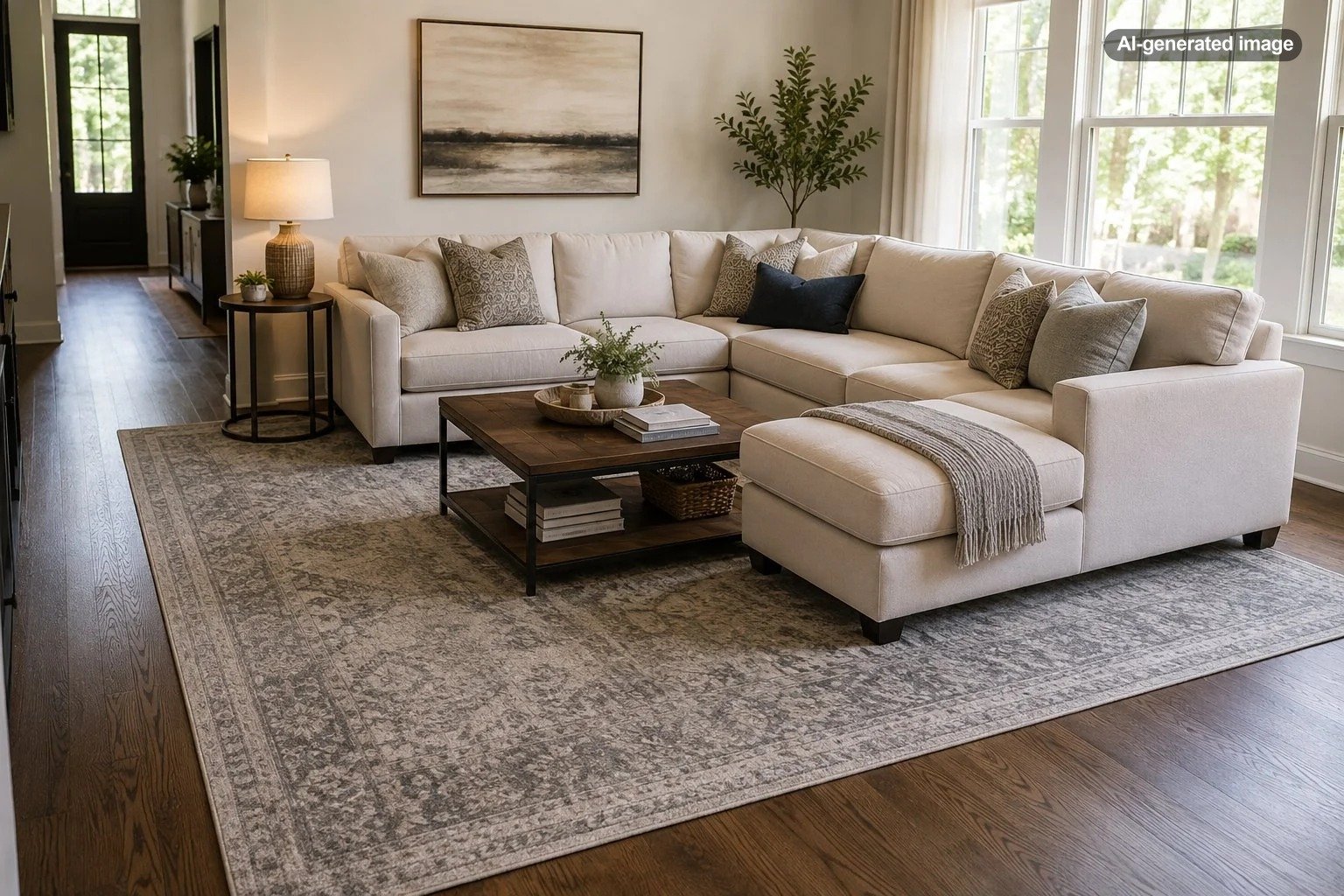
An area rug under a sectional should usually be large enough to connect the sectional with the rest of the seating area rather than looking like a small island beneath the coffee table. In many living rooms, that means choosing a rug that allows at least the front legs of the sectional to rest on it, with enough rug extending beyond the sofa to make the arrangement feel deliberate.
There is no single correct rug dimension for every sectional. The right size depends on the sectional’s footprint, the room dimensions, nearby chairs or tables, and whether you want the rug to sit beneath all of the furniture or simply anchor the conversation area.
Start with the sectional, not a standard rug size
Standard rug dimensions are useful only after you know what the rug needs to cover. Measure the sectional from its widest point to its widest point, including the chaise or return. Then measure how far the seating projects into the room.
A long sectional with a shallow chaise creates a different footprint from a square corner sectional, even when both sofas have a similar overall width. A U-shaped sectional needs another approach because the rug often becomes the visual center of an enclosed seating zone.
What to do
- Measure the sectional’s total width and maximum depth.
- Measure the available floor area around it, including walking paths.
- Decide whether you want all legs, front legs, or none of the sectional on the rug.
- Mark the proposed rug dimensions on the floor with removable painter’s tape.
- Stand at the room entrance and from adjoining spaces to check the overall proportion before ordering.
The tape step is particularly useful because rugs can look surprisingly different in an open room than they do as dimensions on a product page. It also helps reveal whether the proposed rug interferes with door swings, floor vents, media cabinetry, or circulation paths.
Choose a placement style before choosing the rug
Front legs on the rug
For many living rooms, placing the front legs of the sectional on the rug is the most flexible arrangement. The rug visually connects the seating without requiring enough square footage to support every leg. It also leaves more flooring visible, which can be useful in smaller rooms.
The key is making the placement look intentional. Avoid positioning the rug so close to the sectional’s edge that the front feet barely catch it. A little visible rug behind the front legs gives the arrangement more visual weight.
All sectional legs on the rug
A larger rug can accommodate the entire sectional and sometimes adjacent chairs or tables as well. This approach is especially effective in an open floor plan, where the rug acts as a boundary around the living zone.
It requires substantially more rug, however, and may crowd a modest room. The rug should still relate comfortably to the room itself rather than running awkwardly into walls or adjoining circulation areas simply to keep every furniture leg aboard.
Sectional completely off the rug
A smaller rug can float in the center of the seating area with the sectional entirely off it. This is usually most successful when the rug is clearly proportioned to the open space inside the sectional rather than appearing undersized by accident.
This configuration can suit compact rooms, apartments, or layouts where a larger rug would obstruct circulation. The tradeoff is that it creates less visual connection between the sectional and the floor covering.
A good rug does not need to cover the room; it needs to make the furniture look as though it belongs together.
How common rug sizes work with sectionals
| Rug size | Often works best for | What to check |
|---|---|---|
| 6 x 9 feet | Small seating zones or rugs floating inside a compact sectional | Make sure it does not look stranded beneath only the coffee table |
| 8 x 10 feet | Compact to medium sectionals | Check whether the front legs can sit comfortably on the rug |
| 9 x 12 feet | Many medium to large living-room arrangements | Confirm adequate clearance around the entire rug |
| 10 x 14 feet | Large sectionals and generous open seating areas | Make sure the rug does not overwhelm the room or block circulation |
These sizes are planning references rather than formulas. A 9-by-12-foot rug may feel generous beneath one sectional and surprisingly tight beneath another. Furniture dimensions matter more than the label attached to the rug.
Think about the entire seating group
The sectional may be the largest object in the room, but it is not the only one the rug needs to acknowledge. If you have one or two accent chairs opposite the sectional, a generously sized rug can help pull those pieces into the same conversation area. A rug that reaches the sectional but stops well before the chairs can make the room feel visually divided.
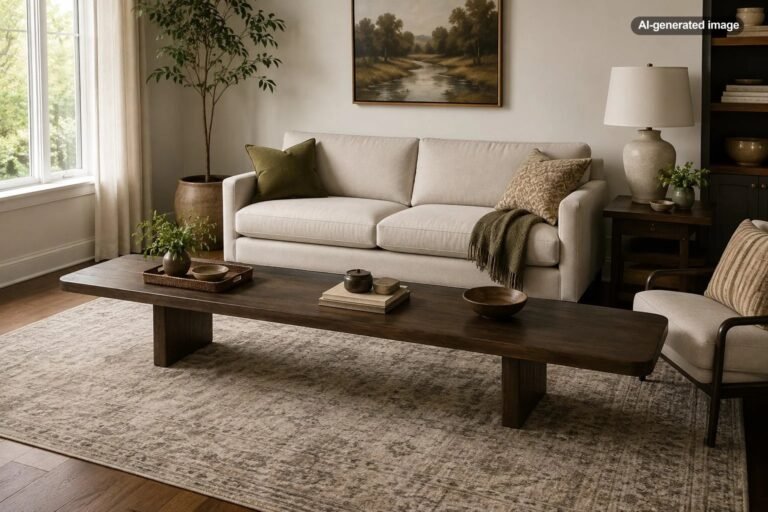
Likewise, consider the coffee table. The table should feel comfortably contained by the rug rather than almost matching its dimensions. If only a narrow border of rug appears around the table, the rug may read as a mat for the table instead of an anchor for the seating area.
Do not forget walking space and exposed flooring
A rug can be appropriately scaled to a sectional and still be too large for the room. Look at how much floor remains between the rug and nearby walls, cabinetry, fireplace surrounds, or passages. The exposed floor acts as visual breathing room and makes the rug look intentionally placed.
This is also where room shape matters. In a long narrow room, increasing rug width may be more useful than adding length. In a nearly square seating room, a larger rectangular rug can sometimes create unwanted emphasis in one direction. The goal is balance among the room, rug, and furniture rather than obedience to a single measurement rule.
Common mistakes when sizing a rug for a sectional
The most common mistake is choosing the rug according to the coffee table rather than the sectional. A small rug may technically fit the open floor in front of the sofa but still make the much larger sectional appear disconnected from the rest of the arrangement.
Another problem is assuming bigger is always better. An oversized rug can push into walkways, sit awkwardly beneath unrelated furniture, or leave an inconsistent sliver of flooring around the room. Scale should look generous, not accidental.
Finally, avoid ordering solely from memory. Sectionals are often larger than they appear once their chaise, corner piece, and deep seats are measured together. A few minutes with a tape measure can prevent a bulky return and make it much easier to compare rug dimensions realistically.
Affiliate disclosure: CraneManor.com may earn a commission when you purchase through links on this page. This does not affect the price you pay. Learn more.
Once you know your required dimensions, material, color, and care needs, you can compare those measurements with options such as a Threshold woven area rug. Confirm the available dimensions and other current product details before deciding whether a particular rug fits your sectional and room.
How to make the final decision
Before you decide
- Measure the sectional at its widest and deepest points.
- Choose whether all legs, front legs, or no sectional legs will sit on the rug.
- Include nearby chairs in the visual seating zone when appropriate.
- Check that the coffee table has a comfortable border of rug around it.
- Preserve practical walking paths and door clearance.
- Tape the rug outline on the floor before buying.
If you are choosing between two sizes and both physically fit the room, the larger option often creates a stronger connection among the sectional and neighboring seating. That does not mean automatically buying the largest rug available. It means giving the furniture enough shared surface that the room reads as one composition.
For most sectionals, begin with the front-legs-on approach and compare the resulting footprint with common 8-by-10, 9-by-12, and 10-by-14-foot sizes. Then adjust for the actual room. The best rug is the one that comfortably anchors the seating group, respects circulation, and looks proportionate from every important view into the space.