
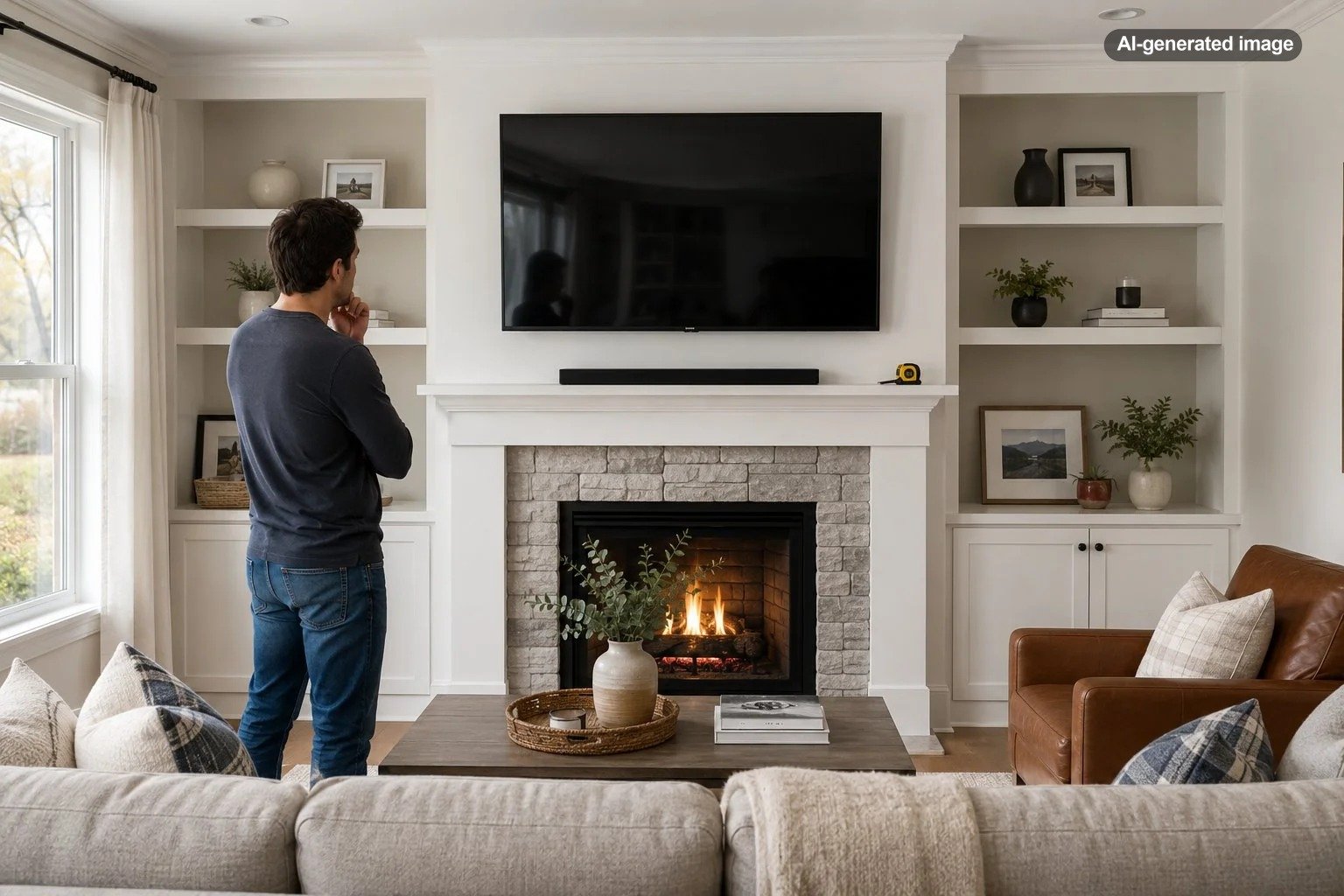
What Is the Right Height for a TV Above a Fireplace?
The right height for a TV above a fireplace is usually the lowest position that satisfies the fireplace manufacturer’s clearance requirements, keeps the television within its permitted temperature range, and remains comfortable from the main seats. In many rooms, that means placing the bottom of the TV roughly 4 to 12 inches above the mantel, but that range is only a planning reference, not a universal installation rule. The fireplace manual, mantel dimensions, television specifications, viewing distance, and seated eye level all matter.
A fireplace often pushes the screen higher than ideal. Before drilling, test both the heat and the viewing angle. A technically mountable position can still be unpleasant for an evening of television if everyone must lean back and look sharply upward.
Start With Seated Eye Level, Not the Mantel
For a television on an ordinary media wall, the most comfortable arrangement generally places the center of the screen near the viewers’ seated eye level. A fireplace complicates that principle because the firebox, required clearances, mantel, and decorative surround already occupy the most desirable part of the wall.
Measure seated eye level from the floor while sitting naturally in the primary viewing position. Then mark the proposed center of the screen on the wall. The difference between those two measurements reveals how far upward viewers will need to look.
A small difference may be manageable, especially from a generous viewing distance. A large difference is more likely to cause discomfort, encourage slouched seating, and make the screen feel disconnected from the furniture arrangement.
The best fireplace-wall installation is not the highest screen that fits; it is the lowest safe screen that remains comfortable to watch.
Use the Television’s Centerline to Calculate Height
Televisions are sold by diagonal screen size, but mounting height is determined by the screen’s actual vertical dimension. Measure the TV itself or consult its dimensional drawing. Do not estimate from the advertised diagonal size alone.
To calculate the approximate bottom edge, divide the TV’s total height by two and subtract that number from the desired centerline height. For example, if a television is 30 inches tall and its planned centerline is 65 inches above the floor, its lower edge would sit about 50 inches above the floor.
Next, compare that lower-edge measurement with the top of the mantel. If the TV overlaps the mantel or leaves insufficient space for ventilation, equipment, or the required clearances, the proposed centerline must move upward or the room needs a different layout.
What to measure
- Measure seated eye level from the finished floor.
- Measure the TV’s full height, including any frame or housing.
- Mark the proposed screen centerline with removable tape.
- Mark the screen’s top and bottom edges.
- Measure the gap between the TV and the mantel.
- Compare the entire arrangement with the fireplace and TV manuals.
Do Not Treat 4 to 12 Inches Above the Mantel as a Safety Rule
A gap of approximately 4 to 12 inches between a mantel and a television is commonly discussed as a visual starting point. It can keep the two elements connected rather than leaving an awkward stretch of empty wall. However, the correct gap cannot be chosen by appearance alone.
Fireplaces vary dramatically. A sealed gas unit, a traditional wood-burning fireplace, and an electric fireplace can have very different heat behavior and installation requirements. Mantel depth also affects how heat moves around the wall. A deep mantel may help redirect rising heat, but it must itself comply with the fireplace manufacturer’s requirements.
Never reduce a required clearance to improve the composition. The installation manual for the exact fireplace model should control decisions about combustible materials, mantels, recesses, wall finishes, and nearby electronics. Local requirements may also apply.
Test the Temperature Before Installing the TV
Heat is the most important practical test. Samsung, for example, advises against mounting a television over a fireplace and states that its TVs should not exceed 104 degrees Fahrenheit. Other manufacturers and models may specify different operating limits, so check the documentation for the exact television rather than applying one brand’s number universally.
Run the fireplace in the way it is normally used, allowing the wall and mantel area to warm fully. Measure the temperature at several points across the proposed television footprint, particularly near the lower edge and ventilation openings. Follow the measuring method recommended by the fireplace or TV manufacturer when one is provided.
Remember that a brief test may not represent a long winter evening. Fireplace output, fan settings, room airflow, open doors, and the duration of operation can all change conditions. If the result approaches the TV’s maximum permitted temperature, choose another location or have the arrangement evaluated by a qualified fireplace professional.
Check the View With a Full-Size Template
A tape mark at the screen center is useful, but a full-size template gives a much more honest impression. Cut kraft paper or join sheets of paper to match the TV’s exterior dimensions. Tape the template to the proposed location and live with it for a day before installing hardware.
Sit in every seat that will be used regularly. Watch the imaginary center of the screen for several minutes rather than glancing at it. Pay attention to whether you lift your chin, slide forward, recline unnaturally, or feel that the screen towers over the room.
Viewing distance matters. A modest upward angle can feel acceptable from a sofa across a large room but severe from seating positioned close to the hearth. Reclining furniture may make a higher screen easier to view, while upright chairs generally favor a lower screen.
Choose a Mount That Addresses the Actual Problem
A fixed mount creates the cleanest profile but offers no correction for a high screen. A tilting mount can direct the screen downward and may reduce reflections, though it does not lower the screen or eliminate the need to look upward.
A pull-down fireplace mount can move the TV forward and lower it for viewing, then return it above the mantel when not in use. This can improve ergonomics, but the hardware requires adequate structure, suitable clearances, and enough room to move without contacting the mantel or fireplace surround.
Any mount must be compatible with the TV’s mounting pattern and weight. It must also be attached to appropriate framing or masonry using a method suited to the wall construction. Decorative stone, brick veneer, tile, and unknown framing conditions can make installation more complicated than an ordinary drywall wall.
Advantages
- Combines two focal points on one wall.
- Preserves other walls for windows, furniture, or artwork.
- Can work well in compact or open-plan rooms with limited layout options.
Tradeoffs
- Often places the screen above the most comfortable viewing height.
- May expose the TV to heat, smoke, ash, or restricted airflow.
- Can complicate wiring, soundbar placement, mounting, and future replacement.
Balance the TV With the Fireplace
Once safety and comfort are resolved, consider proportion. The TV should generally feel connected to the fireplace composition rather than floating near the ceiling. Keep the gap above the mantel deliberate and avoid squeezing decorative objects into a narrow space below the screen.
A television that is substantially narrower than a broad fireplace can look undersized, while an extremely wide screen may overpower a delicate mantel. Built-ins, wall paneling, darker paint, or a surround that visually connects the elements can make mismatched proportions feel more intentional.
Leave enough breathing room around the screen to avoid a cramped appearance and to satisfy its ventilation instructions. Avoid positioning the top edge so close to the ceiling or crown molding that the wall feels vertically compressed.
Know When Another Wall Is Better
The fireplace is not automatically the best TV wall merely because it is the room’s architectural focal point. An adjacent cabinet, a low media console, a corner arrangement, or a separate media wall may place the screen at a better height and protect it from heat.
Separating the fireplace and television can also create a more flexible room. Swivel chairs can face either focal point, and the fireplace can remain visually quiet when the television is off. This approach is especially worth considering when the existing mantel is high, seating is close, or the fireplace produces substantial heat.
Before you decide
- Confirm the fireplace model and read its installation manual.
- Check the TV’s operating-temperature and ventilation requirements.
- Measure seated eye level and the TV’s actual dimensions.
- Test wall temperatures during normal fireplace operation.
- Preview the location with a full-size paper template.
- Verify the wall can support the mount and television.
- Plan code-compliant power, cable, and device locations.
- Compare the fireplace wall with at least one alternate layout.
Frequently Asked Questions
How high should the bottom of a TV be above a mantel?
A gap of about 4 to 12 inches is a common visual planning range, but the correct distance depends on the fireplace manual, mantel design, heat measurements, TV ventilation, and viewing comfort. Required safety clearances always take priority over appearance.
Is a TV above a fireplace always too high?
No, but many fireplace installations do place the screen higher than ideal. A low firebox and mantel, distant seating, reclining furniture, or a pull-down mount can make the arrangement more comfortable.
Can a mantel protect a TV from fireplace heat?
A properly designed mantel may redirect some rising heat, but it does not guarantee that the television will remain within its permitted temperature range. The fireplace manufacturer’s instructions and real temperature measurements are still necessary.
Should the TV be wider than the fireplace opening?
There is no universal requirement. The TV should relate to the width of the mantel, surround, and overall wall composition. A screen slightly wider than the firebox opening can look balanced when it remains narrower than the mantel or broader architectural surround.
Who should install a TV on a fireplace wall?
A qualified installer is sensible when the wall contains masonry, stone veneer, tile, uncertain framing, hidden utilities, or a heavy articulating mount. A licensed electrician may be needed when adding or relocating electrical service. Fireplace-related clearances or heat concerns should be reviewed by a professional familiar with the specific appliance.