
Will a Smart Thermostat Work With a Condo HVAC System?
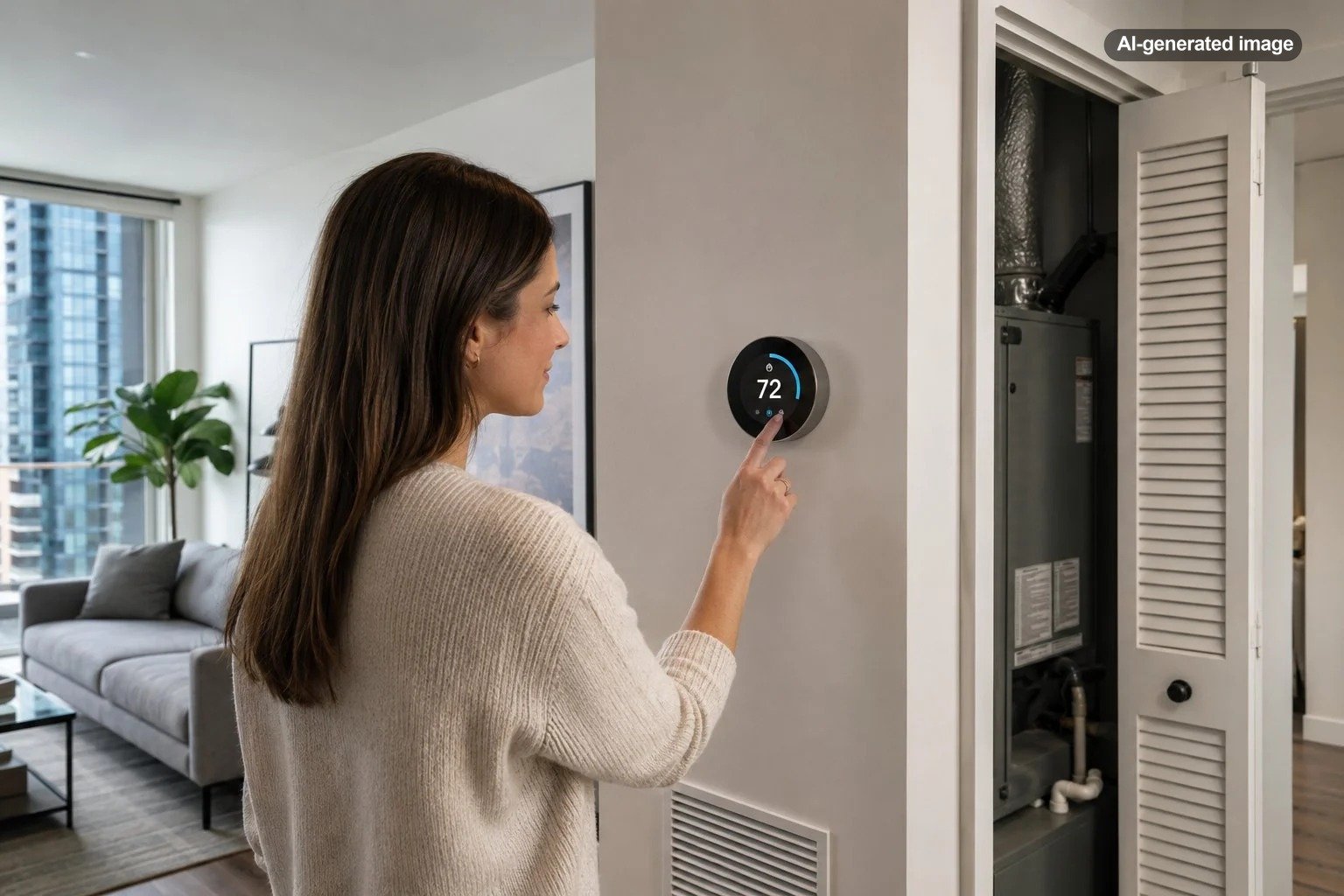
Yes, a smart thermostat can work with many condo HVAC systems, but the fact that you live in a condo does not determine compatibility. The real questions are what type of heating and cooling equipment serves your unit, how the existing thermostat communicates with that equipment, what voltage and wiring are present, and whether the thermostat also controls functions such as multiple fan speeds or building-level zoning.
A conventional 24-volt system with familiar thermostat terminals is often a promising candidate. A proprietary communicating controller, high-voltage thermostat, specialized fan-coil arrangement, or system tied closely to shared building equipment may require a compatible controller or professional evaluation instead. ENERGY STAR likewise recommends confirming HVAC compatibility before purchasing a smart thermostat, especially with variable-speed, multi-stage, and zoned equipment.
Why condo HVAC systems need a closer compatibility check
Detached houses often have one furnace or air handler paired with an outdoor air-conditioning unit or heat pump. Condos can use those arrangements too, but multifamily buildings also commonly introduce shared infrastructure, individual fan-coil units, zone controls, central plant equipment, or manufacturer-specific control systems. That variety is why two neighboring condo buildings can have completely different thermostat requirements.
Think of the thermostat as a controller rather than simply a temperature display. A replacement has to send the signals your equipment expects. A thermostat that works perfectly with a standard heat pump cannot automatically be assumed to control a fan coil, a proprietary communicating air handler, or a building system that relies on specialized control wiring.
| What you find | What it may mean | Smart thermostat outlook |
|---|---|---|
| Thin low-voltage wires with terminals such as R, C, Y, W, G, or O/B | Conventional thermostat control | Often promising, subject to model compatibility |
| Several separate fan-speed wires | Multi-speed fan control | Model choice matters; professional review may be useful |
| Two or a few terminals labeled for data or communication | Possible proprietary communicating system | May require the equipment manufacturer’s controller |
| Thicker wires or line-voltage markings | Higher-voltage thermostat circuit | Many mainstream smart thermostats are unsuitable |
| Thermostat connected to building-managed equipment | Shared or centrally controlled HVAC | Confirm building and equipment requirements first |
Start by identifying what the thermostat actually controls
Before removing anything, determine whether your condo has equipment dedicated to your unit. Look for an air handler, furnace, heat pump, fan-coil cabinet, packaged unit, or other indoor HVAC equipment that belongs specifically to the condo. The existing thermostat model and the equipment documentation can also provide useful clues.
One important distinction is between conventional low-voltage controls and proprietary communicating systems. Some high-efficiency equipment exchanges digital information with a dedicated thermostat rather than relying only on traditional calls for heating, cooling, and fan operation. ENERGY STAR notes that very high-efficiency and variable-speed systems may be better served by a controller from the equipment manufacturer.
That does not mean sophisticated equipment can never use a third-party thermostat. It means you should not assume that replacing a communicating controller with a conventional smart thermostat will preserve every capability. Equipment staging, fan modulation, humidity functions, diagnostics, or other features can depend on the original control strategy.
Check the voltage and thermostat terminals
Many popular smart thermostats are designed around standard 24-volt HVAC controls. Google, for example, states that current Nest models work with many 24-volt gas, electric, forced-air, heat-pump, and radiant systems, with exact support varying by thermostat model and wiring configuration.
If you are comfortable removing only the thermostat faceplate without disturbing the wires, photograph the terminal labels before doing anything else. Labels such as R or Rc, C, Y or Y1, W or W1, G, and O/B are common on conventional systems. The letters matter more than wire color because installation practices vary.
A C wire deserves special attention. It supplies continuous power to many electronic thermostats. Some smart thermostats can operate without one in certain configurations, while other systems require a C wire or an approved power accessory. Google specifically notes that heating-only, cooling-only, zone-controlled, and heat-pump systems are among the arrangements that may need a common wire or compatible power accessory.
Fan-coil systems can be the tricky condo case
One of the most important condo-specific questions is whether the wall control operates a fan-coil unit. Fan coils can be configured in several ways, including arrangements in which the thermostat controls multiple blower speeds in addition to heating or cooling valves. That can make a thermostat swap less straightforward than it would be with a conventional single-speed forced-air system.
Google’s current guidance illustrates why the details matter: Nest thermostats generally support standard 24-volt fan controls, but support for multiple fan speeds differs by model. Google says Nest Learning Thermostats can work with system fans having one, two, or three speeds, while the Nest Thermostat and Nest Thermostat E support single-speed system fans; systems with certain additional fan terminals warrant professional installation.
If your existing thermostat has buttons or settings for low, medium, and high fan speeds, do not buy a replacement solely because its packaging says it works with heating and cooling. Confirm that the exact smart thermostat can duplicate the required fan-control functions.
Zoning does not automatically rule out a smart thermostat
A condo may have more than one thermostat, or the building may use zoning components between the thermostat and the HVAC equipment. Standard zoning can still be compatible with smart controls. Google states that Nest thermostats are usually compatible with zoned systems using multiple thermostats, although some arrangements involving damper control are exceptions and some zone panels require a C wire or power connector.
The practical lesson is that the word zoned is not enough to determine compatibility. You need to know whether each thermostat sends ordinary heating and cooling calls to a zone panel, directly operates specialized dampers, or communicates through another control architecture.
Do not overlook condo association and building requirements
Even when a thermostat is technically compatible, a condo can introduce another layer: responsibility for the HVAC equipment. Your association documents, management office, or maintenance team may distinguish between equipment that belongs to the unit owner and equipment maintained by the association.
This is particularly relevant when heating or cooling comes from shared central equipment, when maintenance staff need access to controls, or when a building uses standardized thermostats as part of its mechanical system. Do not assume that another owner’s installation establishes permission for your unit; equipment and governing requirements can differ.
What about the Google Nest Thermostat?
The Google Nest Thermostat is a relevant example because it is designed for many conventional residential HVAC arrangements, but it should not be treated as universally compatible with condo systems. Google provides a compatibility-checking process, and its documentation emphasizes that power requirements and supported HVAC functions vary by system.
Affiliate disclosure: CraneManor.com may earn a commission when you purchase through links on this page. This does not affect the price you pay. Learn more.
If your wiring and HVAC type have been confirmed as compatible, a compatible smart thermostat can add convenient scheduling and remote adjustment. The important part is confirming compatibility before purchase rather than assuming that Wi-Fi capability alone makes a thermostat suitable for your equipment.
A sensible compatibility check before you buy
Before you decide
- Identify whether the HVAC equipment is dedicated to your condo or shared by the building.
- Find the make and model of the existing thermostat and, when accessible, the indoor HVAC equipment.
- Photograph the existing thermostat terminal labels without disconnecting wires.
- Determine whether the thermostat uses standard low-voltage wiring or a proprietary communication connection.
- Check whether it controls one fan speed, several fan speeds, a heat pump, auxiliary heat, or multiple equipment stages.
- Confirm whether a functioning C wire or manufacturer-approved power accessory is required.
- Run the exact wire configuration through the thermostat manufacturer’s compatibility checker.
- Check condo association or building-management requirements before altering controls tied to shared equipment.
For a straightforward 24-volt system, those checks may provide a clear answer. For a fan coil, communicating system, unusual zone control, dual-fuel arrangement, or shared building system, a qualified HVAC technician can identify the control type and determine whether a third-party thermostat can be installed without sacrificing required functions.
When professional installation makes sense
Professional help is particularly useful when the existing thermostat does more than simply call for heating and cooling. Multi-speed fans, multi-stage equipment, auxiliary heat, proprietary communication, and building-level controls create more opportunities for a replacement thermostat to be electrically compatible yet functionally incomplete.
ENERGY STAR advises that variable-speed, multi-stage, and zoned systems may benefit from professional thermostat selection or installation.
Google similarly recommends professional help for certain complex configurations and warns that incorrect fan-control installation can damage the HVAC system or thermostat.
In a condo, the smartest thermostat purchase begins with identifying the control system already on the wall.
FAQ
Can I replace my condo thermostat myself?
Possibly, if the HVAC system is confirmed as compatible and the installation falls within the thermostat manufacturer’s instructions. If the wiring is high voltage, unfamiliar, proprietary, multi-speed, or connected to shared building equipment, professional evaluation is the more sensible route.
Does a condo association have to approve a smart thermostat?
That depends on the building’s governing documents, maintenance responsibilities, and HVAC design. A thermostat serving equipment wholly within your unit may be treated differently from a controller connected to common mechanical equipment. Check the rules that apply to your building rather than assuming a universal policy.
Will a smart thermostat work without a C wire?
Some thermostat-and-HVAC combinations can operate without a C wire, but others require one or need an approved power accessory. The correct answer depends on the thermostat model and the wiring and equipment configuration.
Can a smart thermostat control a condo fan coil?
Sometimes. Compatibility depends on voltage, valve control, fan speeds, wiring, and the functions the existing thermostat performs. A fan coil with several independently controlled fan speeds deserves especially careful model matching.
Is a smart thermostat worthwhile in a condo?
It can be useful for scheduling, remote temperature adjustment, and managing comfort when the thermostat is fully compatible with the HVAC system. Those conveniences do not overcome an electrical or control mismatch, so compatibility should come before feature comparisons.
Sources & further reading
- ENERGY STAR: Smart Thermostats – compatibility considerations, system types, wiring, and installation guidance.
- Google Nest Help: Learn about the common or C wire – thermostat power requirements and situations in which a C wire or power accessory may be needed.
- Google Nest Help: Fan compatibility with Nest thermostats – guidance for standard, multi-speed, and variable-speed fan controls.
- Google Nest Help: Zoned system compatibility – information about zone panels, dampers, and thermostat power.