How Do You Stop Patio Furniture Covers From Blowing Off?
To stop patio furniture covers from blowing off, start with a cover that fits closely, pull every built-in hem or drawcord snug, and fasten the cover to the furniture with its straps or buckles. The goal is not merely to make the cover heavier. It is to reduce the loose fabric and open edges that let moving air get underneath and turn the cover into a small, surprisingly determined sail.
If a cover repeatedly lifts during ordinary windy weather, the problem is usually one of three things: it is too large, it is not secured at enough points, or air is getting underneath faster than it can escape. Correcting those issues is generally more effective than piling random objects on top.
Start with the fit before adding anything else
A cover should have enough room to slip over the furniture without straining at the seams, but excess fabric creates its own problem. A significantly oversized cover leaves folds, gaps, and broad loose panels that catch gusts. Even a strong tie-down system has a harder job when several inches of material are flapping around every side.
Measure the furniture itself rather than relying only on labels such as lounge chair, loveseat, or dining table. Width, depth, and height matter, and unusually shaped arms, backs, cushions, and bases can change how a cover sits. A close-fitting cover normally gives wind fewer places to enter and less fabric to lift.
Do not go so small that the cover must be stretched tightly over corners. Excessive tension can stress seams and may keep the bottom from reaching its intended attachment points. The useful middle ground is a cover that follows the general shape of the furniture while still installing and removing without a wrestling match.
Use every strap, buckle, hem, and drawcord provided
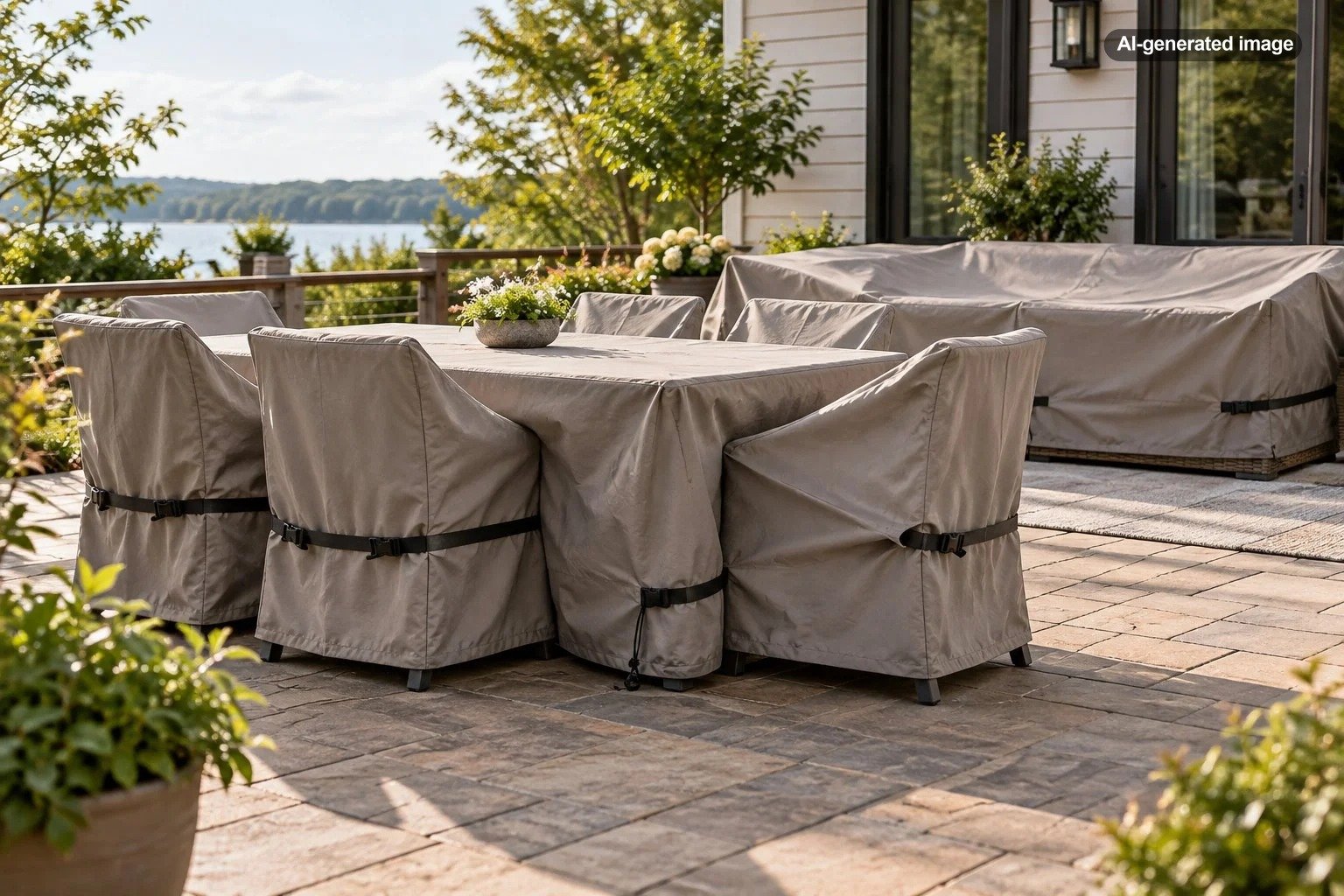
Many purpose-made outdoor furniture covers use more than one retention method. Common designs combine an elastic or adjustable hem with buckle straps that pass around furniture legs or other fixed parts of the frame. Manufacturers also use ventilation openings to reduce condensation and wind loft.
Tighten the lower edge after the cover is fully seated. Then connect the straps around solid parts of the furniture, following the cover manufacturer’s directions. A strap hanging loose beside a chair leg is decoration; a properly fastened strap is doing actual work.
Check each attachment periodically, particularly after moving the furniture, removing the cover for a gathering, or going through several windy days. Adjustable cords can loosen, buckles can be left undone, and furniture can shift enough to change the way a formerly snug cover fits.
What to do
- Center the cover so roughly equal material reaches each side.
- Pull the cover fully down rather than leaving it perched above the lower frame.
- Tighten its elastic hem or drawcord if equipped.
- Fasten every intended buckle or leg strap around a secure part of the furniture.
- Walk around the piece and look for large openings where wind can enter.
- After the next windy period, check whether anything slipped or loosened and adjust the fit accordingly.
Pay attention to wind loft, not just wind speed
The most troublesome force is often air getting underneath the cover. Once the fabric begins to inflate, a gust can pull upward across a much larger area than it could if the cover stayed close to the furniture.
This is why ventilation can matter. Some outdoor covers incorporate vents specifically to promote airflow and reduce the tendency for the cover to balloon. Coverstore, for example, describes chair covers with mesh vents, adjustable hems, and buckle straps, while Classic Accessories describes ventilation as a feature that helps reduce wind loft on its outdoor furniture covers.
That does not mean cutting your own holes into a cover. Doing so can compromise water protection, seams, and durability. If your current cover behaves like a parachute despite being properly fitted and secured, a purpose-built vented design may be a more sensible replacement.
Reposition furniture when the patio creates a wind tunnel
Sometimes the cover is not the whole problem. Walls, privacy screens, narrow side yards, balcony railings, and building corners can channel moving air through a small area. Furniture placed directly in that path may experience far more lifting force than a piece only several feet away.
When practical, move covered furniture to a more sheltered part of the patio before an extended windy period. Turning a chair or sectional can also reduce the size of the opening presented directly to the wind. On balconies and exposed rooftops, however, do not assume ordinary cover straps are appropriate protection for severe conditions. Follow property rules and remove or secure loose outdoor objects as required when hazardous weather is expected.
The best wind strategy is to keep air from getting under the cover in the first place.
Should you put weights on patio furniture covers?
Weights can sometimes reduce movement, but they should be a secondary measure rather than the main retention system. Random bricks, stones, tools, planters, or other hard objects can damage the fabric, stain it, scratch the furniture underneath, or become displaced. Placing substantial loose objects on outdoor furniture is particularly unwise when severe weather is approaching.
If the cover manufacturer offers a compatible weighting or securing method, follow those instructions. Otherwise, improving fit and using built-in attachment points is usually the cleaner approach. Separate aftermarket clips or cords should never be tightened in a way that cuts into fabric, bends furniture, creates a trip hazard, or puts excessive tension on seams.
When replacing the cover makes more sense
A cover that is dramatically oversized, missing its straps, stretched out around the hem, or torn near its attachment points may simply be difficult to secure reliably. Repeated improvisation can become more troublesome than choosing a cover designed for the dimensions and shape of the furniture.
Look for practical retention features rather than assuming thicker material alone solves the problem. A useful design may combine a close fit with an adjustable lower edge, straps or buckles, and ventilation. Those features address several different parts of the wind problem at once.
Affiliate disclosure: CraneManor.com may earn a commission when you purchase through links on this page. This does not affect the price you pay. Learn more.
For a compatible lounge chair, a water-resistant patio chair cover is one example of the fitted-cover approach. Measure the chair carefully before choosing any cover, secure it as intended, and remember that water-resistant fabric should not be treated as a guarantee against every storm or against moisture becoming trapped underneath.
Common mistakes that make covers easier to blow away
- Buying much too large: Extra material provides more fabric for the wind to catch.
- Ignoring the straps: Built-in buckles cannot help when they are left hanging loose.
- Leaving one side open: A gap on the windward side can let the entire cover inflate.
- Covering furniture carelessly: A twisted or off-center cover may prevent its hem and straps from reaching the right places.
- Assuming heavy fabric is enough: Weight can help, but fit, attachment, and control of wind loft are also important.
- Forgetting seasonal checks: Exposure and repeated removal can change how securely a cover fits over time.
FAQ
Can I use bungee cords to hold a patio cover down?
Only if the arrangement is compatible with the furniture and cover and can be installed without damaging either one or creating a hazard. Built-in straps and manufacturer-approved retention features are preferable because they are designed around the cover’s construction. Avoid over-tensioning any improvised cord.
Why does my furniture cover balloon in the wind?
Air is probably entering beneath the cover faster than it can escape. An oversized fit, loose lower edge, open corner, or lack of ventilation can contribute. Tightening the intended attachment points and using an appropriately fitted vented cover can reduce the effect.
Should patio covers touch the ground?
Follow the cover manufacturer’s fit guidance. Many furniture covers are designed to protect the main furniture body without necessarily enclosing every inch of the legs or wheels. More fabric hanging on the ground is not automatically more secure and can collect dirt or moisture.
What should I do before a severe storm?
Do not rely on ordinary patio covers as storm restraints. Follow official local weather and emergency guidance, the furniture manufacturer’s instructions, and any property or building requirements. Loose outdoor objects may need to be moved into a protected location when dangerous winds are expected.