How Do You Secure Outdoor Furniture on a High-Rise Balcony?
Securing outdoor furniture on a high-rise balcony starts with a simple principle: anything light enough to shift, tip, roll, fold, or lift in strong wind should either be restrained with a building-approved method or brought indoors before hazardous weather arrives. That includes more than chairs and tables. Cushions, planters, umbrellas, covers, decorative objects, storage bins, and small side tables can all become problems when gusts increase.
The safest setup combines appropriately heavy furniture, thoughtful placement, removable restraints where permitted, and a reliable storm routine. Just as important, residents should check their lease, condominium rules, homeowners association requirements, and building management policies before drilling, bolting, tying anything to a railing, or making permanent modifications. Balcony construction and building rules vary, so a fastening method that is appropriate in one property may be prohibited in another.
Start by identifying what can move
A heavy outdoor dining table may appear immovable during normal weather, while a stackable chair beside it can slide surprisingly easily. The goal is not simply to make the balcony look orderly. It is to identify every object that could move independently if wind reaches it from an unexpected direction.
Walk through the space one item at a time. Pay particular attention to folding chairs, lightweight aluminum furniture, stools, small tables, empty planters, watering cans, lanterns, outdoor rugs, cushions, covers, and anything hanging from a hook. An umbrella deserves special attention because its canopy can catch wind. The U.S. Consumer Product Safety Commission has highlighted the danger of wind-lofted umbrellas, reinforcing why umbrellas should not be treated like ordinary stationary furniture.
Before you decide
- Can the item tip when pushed from the side?
- Does it have wheels, folding legs, or a lightweight frame?
- Can a cushion, cover, tray, or accessory separate from it?
- Would the item still be secure if wind came from a different direction?
- Can it be carried indoors quickly before severe weather?
- Does your building permit the restraint method you are considering?
Use weight and low profiles to your advantage
Furniture selection is one of the easiest ways to reduce the amount of securing you need to do. In exposed locations, heavier pieces with broad footprints and relatively low profiles generally make more practical choices than very light, tall, or top-heavy designs. Weight alone, however, should never be treated as a guarantee that an object cannot move.
Placement matters as well. Avoid positioning lightweight furniture right beside the balcony perimeter simply because that creates the best view. A more protected location near a solid wall may reduce direct exposure, although wind can behave unpredictably around tall buildings. Furniture should also remain clear of doors, required paths of travel, drains, and any other building features that need unobstructed access.
On a high-rise balcony, the best furniture arrangement is not merely the one that looks balanced; it is the one that remains manageable when the weather stops cooperating.
Choose restraints carefully and get permission first
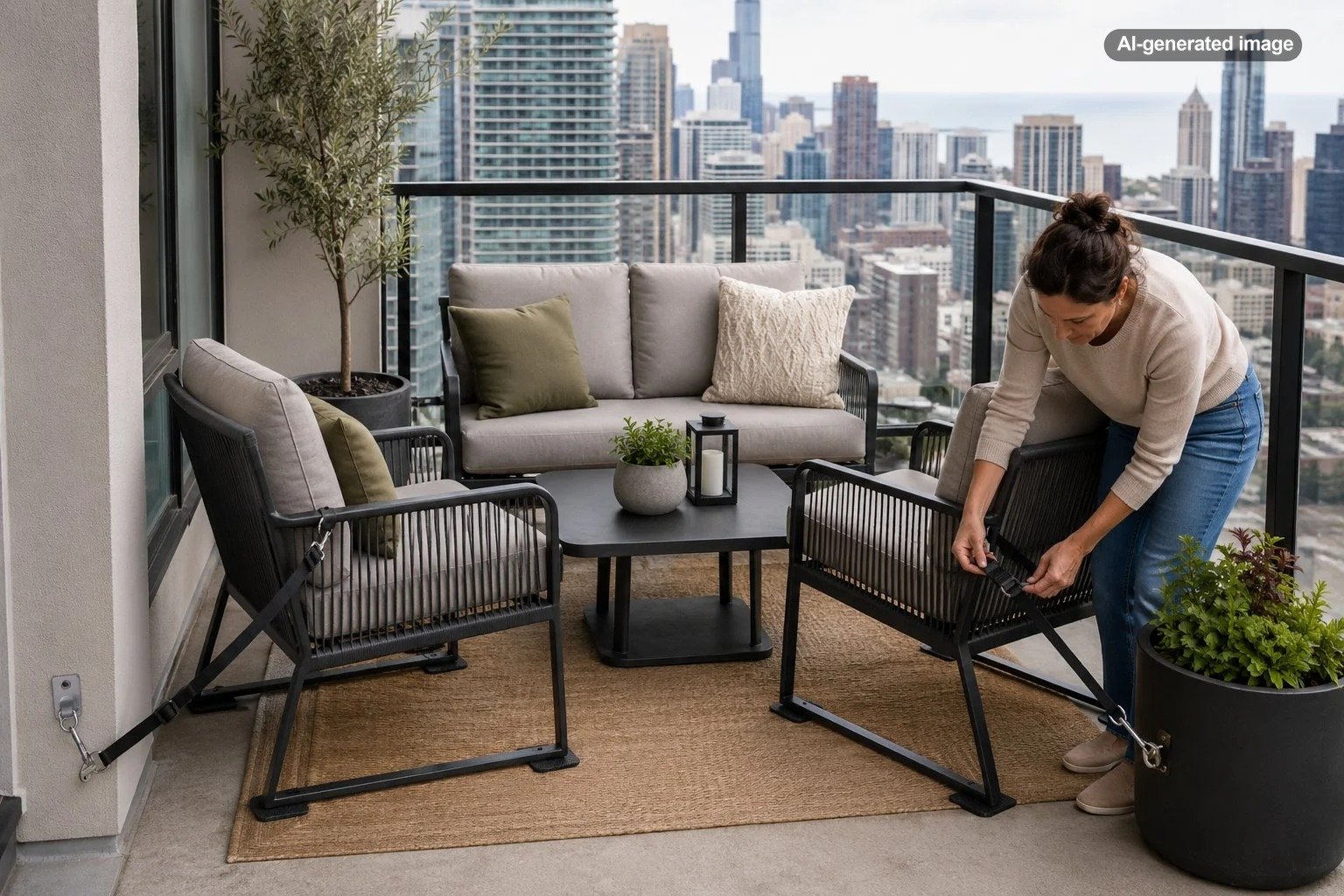
When restraints are allowed, straps, cables, or other purpose-appropriate fastening systems can help keep compatible furniture from shifting. The critical detail is what those restraints are attached to. Do not assume a guardrail, decorative screen, pipe, conduit, or other balcony component is suitable for anchoring furniture.
If permanent anchoring would require drilling into concrete, masonry, metal, waterproofing, or the building envelope, contact building management before doing anything. Penetrating the wrong surface can create maintenance problems and may violate building or condominium rules. For renters, removable solutions may be preferable, but even a removable strap should connect only to a point that the property owner or building management has approved for that purpose.
Do not rely on furniture covers as anchors
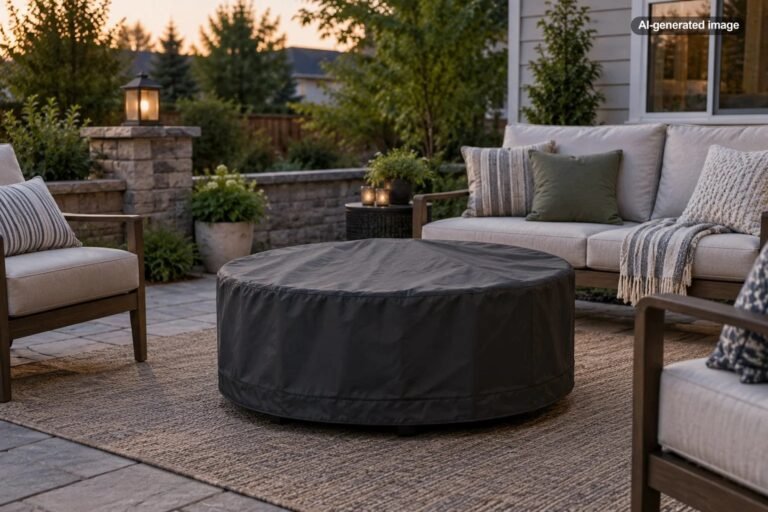
A cover is useful for protecting compatible furniture from routine dirt, sun, and weather exposure, but it is not a substitute for securing the furniture itself. A poorly fitted or loosely fastened cover can catch wind, so it should be installed and secured according to its instructions and removed when conditions exceed what the manufacturer recommends.
Likewise, tying several lightweight chairs together may make the group more convenient to handle, but it does not automatically make the group safe in high wind. The combined assembly can still slide or overturn. Think of restraints as one layer in a larger plan rather than a reason to leave everything outside regardless of the forecast.
Treat umbrellas as a separate wind-safety problem
Balcony umbrellas deserve a more conservative approach than ordinary furniture. Their large surface area can catch wind, and a closed umbrella can still be affected by gusts. If your building permits an umbrella, use only a compatible base and follow the manufacturer’s instructions for installation, use, and wind limitations.
Closing an umbrella should not be your entire storm plan. When strong winds or severe weather are expected, removing the umbrella and storing it indoors is the more cautious choice when that can be done safely. CPSC materials specifically address the hazard of umbrellas becoming airborne in wind.
Make cushions and small accessories easy to bring inside
The least glamorous part of balcony safety is often the most useful: have an indoor storage location ready. If every storm requires finding space for six cushions, two planters, a lantern, and a folding table, it is easy to postpone the job until conditions are already deteriorating.
Storage benches can be convenient for ordinary balcony organization when permitted by the building, but a storage container itself must not become another unsecured object. If an item cannot be safely secured outdoors, plan for indoor storage instead.
Have a wind-warning routine instead of a wind-speed guess
There is no single wind-speed number that makes every chair, table, umbrella, balcony layout, and building exposure safe below it and unsafe above it. Furniture shape, weight, orientation, attachments, and local airflow all matter. Rather than trying to invent a universal threshold, follow manufacturer instructions, building requirements, and official weather alerts.
The National Weather Service advises people to secure loose outdoor items when high winds are possible, and official New York City severe-weather guidance similarly tells residents to secure loose outdoor items such as patio furniture before winds increase.
That makes early preparation far more sensible than waiting until furniture begins moving.
What to do
- Check the forecast and any official watches, warnings, or local emergency guidance.
- Bring cushions, decor, umbrellas, lightweight furniture, and other easily moved objects indoors before conditions deteriorate.
- Confirm that furniture intended to remain outside is positioned securely and that any permitted restraints are properly installed.
- Close balcony doors and avoid going outside to retrieve objects once strong winds or dangerous weather are underway.
- After the event, inspect furniture and restraints for movement or damage before returning the balcony to normal use.
What should you avoid?
Avoid adding improvised weights that can separate from the furniture, tying objects to questionable attachment points, or making unauthorized holes in building surfaces. Avoid leaving an umbrella open while unattended, and do not assume that a heavy planter or table is impossible to move simply because you cannot lift it comfortably.
Most importantly, do not go onto an exposed balcony during dangerous wind to rescue furniture. The National Weather Service notes that high winds can blow objects around and pose a significant safety threat, while its warning guidance emphasizes taking shelter during high-wind conditions.
A chair is replaceable; retrieving one after conditions have become hazardous is not worth the risk.
FAQ
Can I tie balcony furniture to the railing?
Only if your building or property manager specifically permits the attachment and the railing or designated connection point is appropriate for that use. Do not assume a safety guard or railing is designed to serve as a furniture anchor.
Is heavy furniture safe to leave outside during a storm?
Not automatically. Weight can improve stability, but shape, wind exposure, orientation, construction, and attachment all affect whether an item may move or overturn. Follow official weather guidance and any manufacturer or building instructions.
Should I bring balcony cushions inside when it gets windy?
Yes, bringing lightweight cushions and accessories indoors before strong winds arrive is a simple way to prevent them from becoming airborne. Official severe-weather guidance routinely advises securing loose outdoor objects.
Can I drill anchors into my balcony floor or wall?
Do not do so without explicit authorization. Balcony slabs, exterior walls, coatings, waterproofing systems, and other building components should not be modified based on a generic DIY recommendation. Ask the property owner, condominium association, or building management what is permitted.
What is the safest approach before a major wind event?
Remove loose and portable objects early, store umbrellas and lightweight furniture indoors when practical, verify approved restraints on anything that remains outside, and stay off the balcony once hazardous conditions begin. Monitor official weather information rather than waiting to see whether objects start moving.