
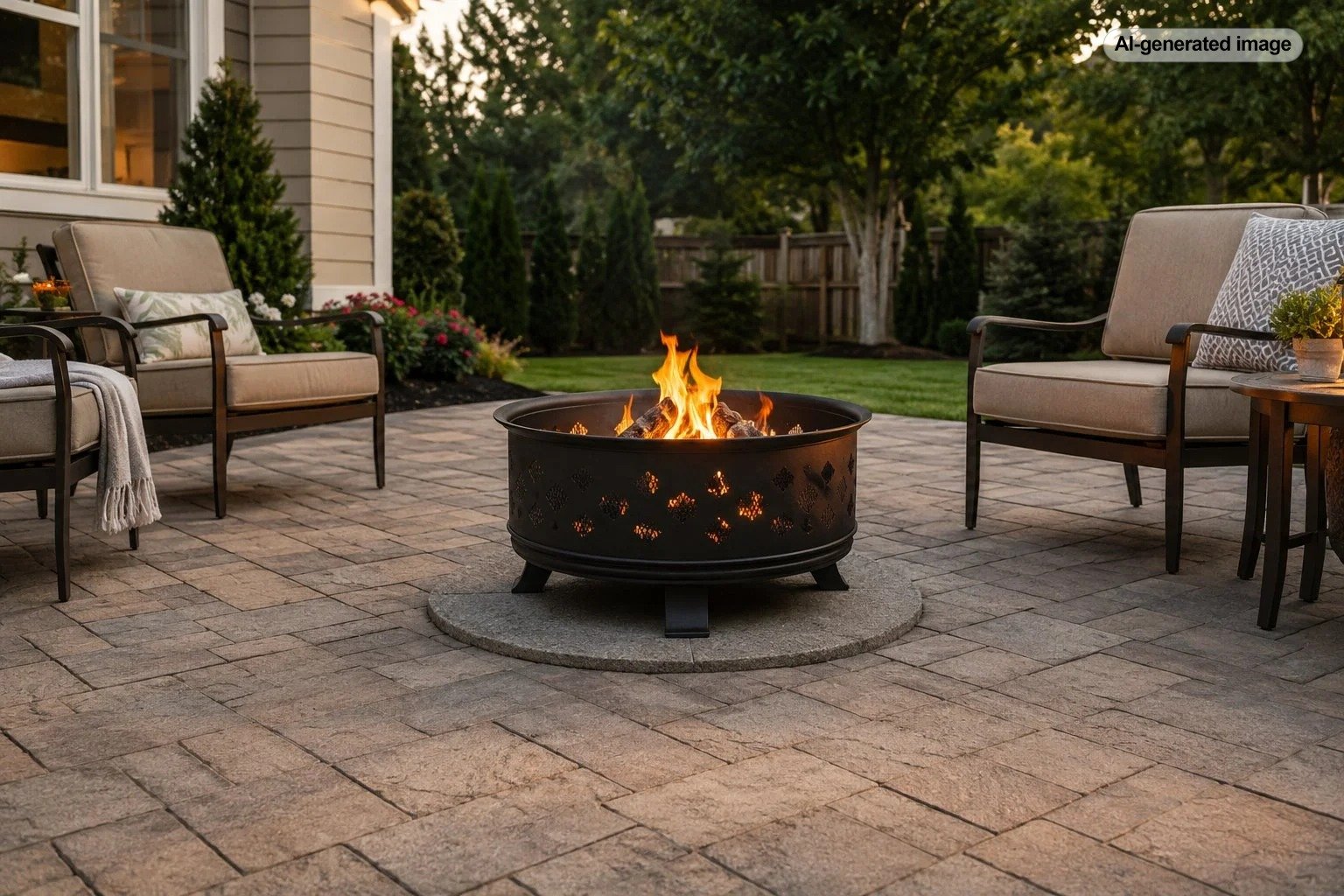
Can You Put a Fire Pit on a Paver Patio?
Yes, you can put a fire pit on a paver patio, but the important question is not simply whether the pavers will hold it. You also need to consider heat exposure, the type of fire pit, the condition of the patio, clearances from combustible materials, and the manufacturer’s installation requirements.
Concrete pavers are noncombustible, but that does not make every paver installation immune to heat damage. Concentrated heat from a wood fire can discolor, crack, or otherwise damage concrete products, particularly when the fire is close to the patio surface. A properly designed fire feature manages that heat instead of asking ordinary paving stones to absorb it indefinitely.
Why pavers can work under a fire pit
A well-built paver patio provides several qualities that make it a practical location for an outdoor fire feature: a level walking surface, a firm base, and a noncombustible finish. Some hardscape manufacturers specifically describe fire pit systems that may be installed on an existing patio when the patio is stable and suitable for the installation.
The limitation is heat. Belgard notes that direct heat from wood-burning fire pits can crack or discolor pavers and recommends appropriate insulation or protection. Unilock likewise advises protecting concrete components from extreme heat with materials such as a metal insert or fire-rated brick.
That distinction matters because a paver patio and a firebox perform different jobs. Patio pavers are primarily paving materials. The fire pit itself should contain and manage combustion while preventing damaging heat exposure to surrounding materials.
The type of fire pit makes a major difference
Wood-burning fire pits
Wood-burning pits deserve the most attention because the fire can produce substantial radiant and conducted heat near the base. Hot embers and ash can also escape when the fire is stirred or wood is added.
A purpose-built fire pit with an appropriate metal liner, refractory material, or fire-rated brick offers much better protection than simply stacking ordinary landscape blocks around an open fire. Unilock states that its wall products are not themselves fire-rated and should be protected from intense heat when used in a fire pit.
If you are building a permanent wood-burning feature, it can also be preferable to integrate the fire pit with the patio base rather than simply placing a heavy structure on finished pavers. Belgard notes that cutting out the pavers and placing a fire pit on the underlying base can reduce pressure on the pavers and help address settling and ash-related issues.
Gas fire pits and fire tables
Gas-burning fire features may be easier on the patio surface when the burner and combustion area are elevated and the appliance is specifically designed to stand on a patio. That does not eliminate safety requirements. Gas appliances have their own ventilation, clearance, fuel-system, and installation instructions that should be followed exactly.
Do not improvise around vents or enclosures. For permanent gas installations, local requirements may also apply to gas piping, shutoffs, placement, and installation work.
Portable tabletop and liquid-fuel fire products
Small size should not be confused with low risk. The U.S. Consumer Product Safety Commission has warned about serious flame-jetting and burn hazards associated with some alcohol and other liquid-fuel fire products. Never pour gasoline or another inappropriate liquid fuel onto a fire, and never refuel a liquid-fuel device while a flame or ignition source may still be present.
How to protect patio pavers from fire pit heat
The best protection depends on the specific fire pit. There is no universal pad, ring, or homemade barrier that can be assumed safe for every model.
Before you decide
- Confirm that the fire pit manufacturer permits use on a masonry or paver surface.
- Check the required clearance beneath and around the unit.
- Determine whether the fire pit requires a metal insert, refractory liner, fire brick, or another heat-management system.
- Make sure the patio is level, stable, and free of loose or badly settled pavers.
- Keep the feature away from furniture, cushions, umbrellas, plants, fences, siding, overhangs, and other combustible materials as required.
- Check local fire restrictions, burn rules, HOA requirements, and any applicable installation requirements.
For a permanent masonry fire pit, the protective system should be part of the design rather than an afterthought. Concrete products can deteriorate when repeatedly exposed to extreme temperatures, so the fire-containing materials should be selected for that job.
For a portable fire pit, use only a heat shield, stand, mat, or other protective accessory that is appropriate for the appliance and surface. Avoid assuming that a thin decorative mat automatically protects against prolonged high heat.
Check the patio itself before adding the fire pit
A fire feature should sit on a patio that is stable enough to support it without rocking, leaning, or concentrating weight on badly settled areas. This becomes especially important with large masonry fire pits, which can be substantially heavier than portable units.
Look for rocking pavers, significant settlement, open joints, drainage problems, or a visibly uneven surface. A portable fire pit that wobbles is an obvious concern, while a permanent structure built over an unstable section can become uneven as the patio moves.
Clearance matters beyond the pavers
The surface beneath the fire is only one part of the safety equation. A perfectly protected paver patio does not make a fire pit suitable beneath a low roof, next to upholstered furniture, beside a wood fence, or under overhanging vegetation.
Follow the clearance requirements provided by the fire pit manufacturer and any applicable local rules. Belgard’s installation guidance, for example, emphasizes following local and state fire codes and maintaining appropriate setbacks from buildings, property boundaries, and combustible materials.
Also consider how people move through the space. A fire pit placed directly in a primary walkway can create a trip and burn hazard even if the paving material itself is appropriate. Allow enough circulation room that guests do not have to squeeze between the fire and furniture.
The safest fire pit layout manages heat, flame, people, and nearby materials – not just the surface directly underneath the fire.
What about seating around a paver-patio fire pit?
Plan the seating arrangement after you establish the fire pit’s required clearances, not before. Outdoor chairs can usually be repositioned, while a permanent fire pit cannot.
Remember that combustible cushions, throws, umbrellas, and furniture components may need greater separation than the stone or concrete beneath them. Wind can also carry sparks from wood-burning fires beyond the immediate perimeter of the pit.
If furniture remains outdoors between gatherings, ordinary weather protection can help preserve compatible pieces, but covers should be removed and stored well away from the fire before lighting it. Never leave a loose furniture cover close enough to a fire feature that wind could blow it toward the flame.
Common mistakes to avoid
- Treating noncombustible as heatproof. Concrete pavers do not burn like wood, but extreme heat can still damage them.
- Building the fire directly against ordinary concrete landscape block. Use the protective liner or refractory materials required for the design.
- Ignoring the manufacturer’s instructions. Portable, gas, wood-burning, and liquid-fuel products can have very different requirements.
- Placing the pit wherever the seating happens to fit. Required clearances and safe circulation should determine the layout first.
- Using gasoline or inappropriate liquid fuels. This can create severe flash-fire and flame-jetting hazards.
- Assuming local rules are universal. Burn restrictions, setbacks, permitting, HOA rules, and fire regulations vary by location.
- Leaving the fire unattended. Outdoor fires should be actively supervised until they are safely extinguished according to the appliance or fire pit instructions.
When a professional installation is the better choice
A simple portable fire pit may only require careful placement and adherence to its instructions. A permanent masonry or gas fire feature can be a different project entirely.
Consider qualified professional help when the project involves gas piping, a permanent burner system, substantial masonry construction, uncertain patio support, covered outdoor areas, tight clearances, or questions about local fire and building requirements. Professional evaluation is also sensible if the existing patio has significant settlement or structural movement.
Frequently asked questions
Will a fire pit crack patio pavers?
It can. Hardscape manufacturers caution that direct or extreme heat can crack, discolor, or otherwise damage concrete products. Appropriate liners, inserts, refractory materials, elevation, or other approved heat protection can reduce direct exposure.
Can I put a wood-burning fire pit directly on concrete pavers?
Do not assume that direct placement is appropriate. Check the fire pit manufacturer’s instructions. Wood-burning fires can expose the surface beneath them to considerable heat, so a designed heat barrier or properly constructed fire pit system may be necessary.
Is a gas fire table safer for pavers?
An elevated gas fire table may expose the patio to less direct heat than an open wood-burning pit, but suitability depends on the specific appliance. Follow the manufacturer’s required base, ventilation, and clearance instructions.
Should a permanent fire pit be built on top of the finished pavers?
Not always. Some systems can be installed on an existing stable patio, while other installations may be better integrated with the patio base. Follow the hardscape and fire-feature manufacturer’s instructions for the specific system.
Can I put a fire pit under a covered patio?
Only when the specific appliance is approved for that installation and all required clearances, ventilation provisions, and local requirements are satisfied. Do not assume an outdoor-rated fire pit is automatically suitable beneath a roof or enclosure.