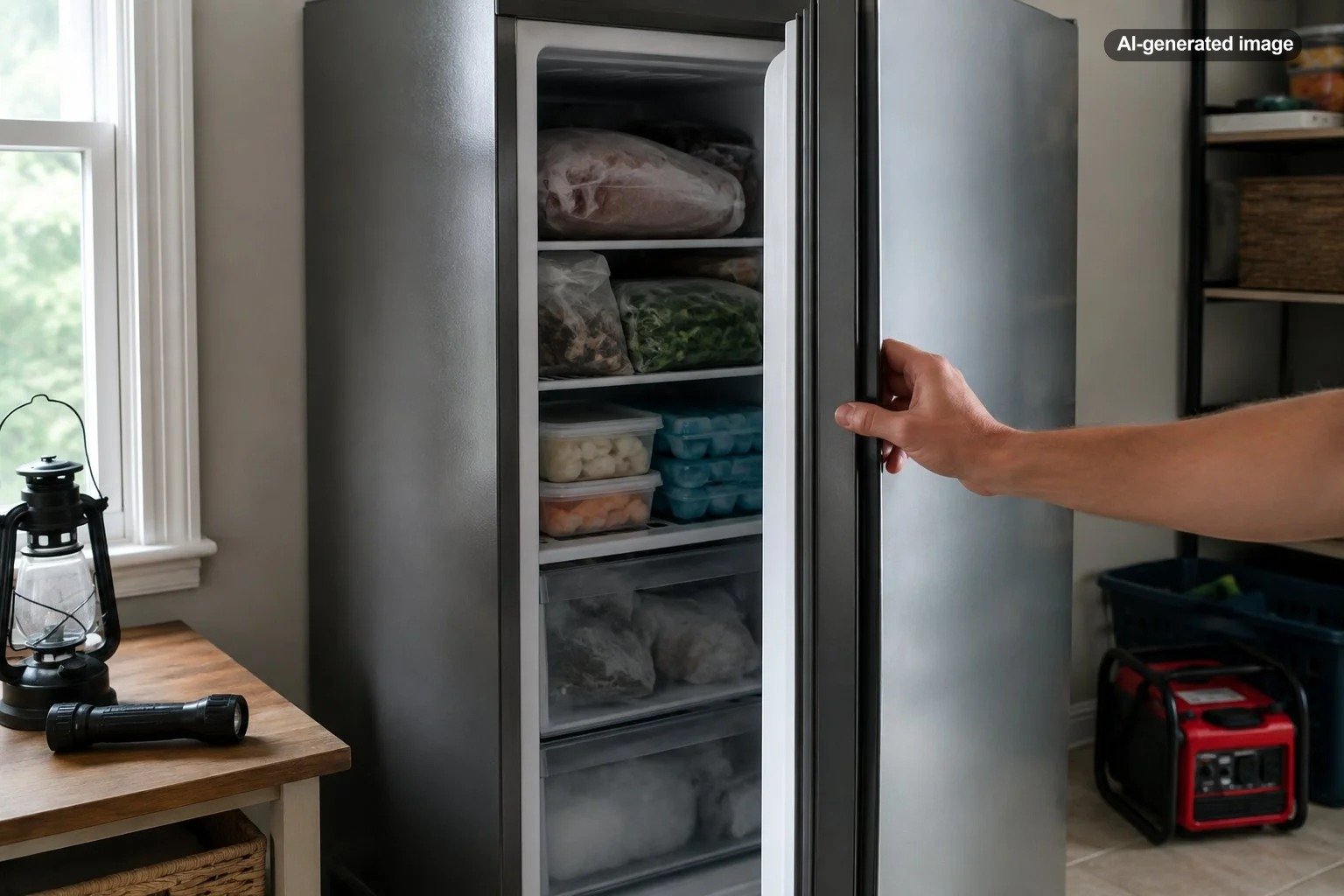
How Long Will a Freezer Stay Cold Without Power?
If the power goes out, a full freezer can generally hold a safe cold temperature for about 48 hours, while a half-full freezer can hold it for about 24 hours, provided you keep the door closed. Those are planning estimates, not automatic expiration times. The actual safety of your food after an outage depends on its temperature, whether it still contains ice crystals, and how often the freezer was opened.
The simplest rule during an outage is also the most effective: leave the freezer closed. Every unnecessary check lets cold air escape and shortens the time you have.
Why a full freezer stays cold longer
A packed freezer contains a large amount of already-frozen material. That frozen food acts as thermal mass, helping neighboring packages remain cold even after the compressor stops running. In a half-empty freezer, there is more air space and less frozen mass available to absorb heat.
This is why grouping packages together can help when an outage begins. USDA guidance recommends keeping freezer items close together so they retain cold more effectively. You do not need to reorganize the freezer extensively during the outage, however. Opening the door for a prolonged sorting session can defeat the purpose.
Keep the freezer door closed
During a power failure, resist the temptation to keep checking whether food is still frozen. A closed freezer is essentially an insulated cold box. Opening it exchanges cold interior air for warmer room air, accelerating the warming process.
If you need one particular item, decide what you are retrieving before you open the door. Open it once, work quickly, and close it firmly. Avoid repeatedly opening the freezer to feel packages or inspect ice.
If your freezer has an external temperature display that continues operating on backup power, it can be useful, but an appliance thermometer inside the freezer gives you a more direct reference once you can safely check it.
What temperature matters after the power returns?
The key food-safety threshold is 40 F. The FDA says that if an appliance thermometer shows the freezer is at 40 F or below when power returns, the food is safe to refreeze. If you do not have a freezer thermometer, examine individual packages instead.
Food that still contains ice crystals, or that measures 40 F or below with a food thermometer, can generally be refrozen or cooked. Refreezing may affect texture or quality, but that is different from a food-safety problem.
Do not rely on smell or appearance to decide whether perishable food is safe. Harmful microorganisms do not necessarily produce an obvious odor, discoloration, or other visible warning.
During an outage, time is useful for planning, but temperature is more useful for deciding what to keep.
What if the freezer has been without power longer than 48 hours?
Passing the 48-hour mark does not mean that every package in a previously full freezer instantly becomes unsafe. Likewise, being under 48 hours does not guarantee that every item stayed adequately cold if the door was opened repeatedly, the freezer was only partly full, or the surrounding space was unusually warm.
Once the expected cold-holding window has passed, temperature becomes especially important. Check an appliance thermometer if one was present. Otherwise, check individual foods for ice crystals and, when appropriate, measure their temperature with a food thermometer.
How to make a freezer last longer during an outage
The best preparation happens before the electricity fails. A few inexpensive habits can give you better information and more flexibility during a storm or utility interruption.
What to do
- Keep an appliance thermometer in the freezer. It can help you determine the actual temperature after an outage instead of relying only on elapsed time.
- Keep the freezer at 0 F or below during normal operation. That gives frozen food the proper starting temperature before an outage occurs.
- Freeze containers of water when severe weather is expected. Extra frozen mass can help keep the compartment cold longer.
- Group frozen foods together. Closely packed frozen items help each other retain cold.
- Keep coolers and frozen gel packs available. They can be useful when an outage is expected to last beyond the freezer’s normal cold-holding window.
- Know where block ice or dry ice is available locally. For extended outages, additional cooling can help preserve food when handled correctly.
Can you add dry ice to a freezer?
Dry ice can extend cold storage during a prolonged outage, but it requires more caution than ordinary ice because it is extremely cold and releases carbon dioxide gas as it sublimates. Follow supplier handling instructions, protect your hands from direct contact, and use it only with adequate ventilation. Never treat an airtight container as appropriate storage for dry ice.
The FDA notes that dry or block ice can help keep food cold during extended outages. If you expect a major storm, locating a supplier before the power fails is more useful than trying to find one after roads, stores, and utilities are disrupted.
Does opening the freezer once ruin the 48-hour estimate?
No. A brief opening does not suddenly eliminate all the freezer’s stored cold. But every opening moves the temperature in the wrong direction, and repeated or prolonged openings can significantly reduce the amount of time food stays adequately chilled.
Think of 48 hours for a full freezer and 24 hours for a half-full freezer as estimates based on keeping the door closed. If family members repeatedly browse the freezer during an outage, those estimates become less dependable.
What foods deserve the most attention?
When evaluating the freezer after an extended outage, focus first on perishable foods such as meat, poultry, seafood, prepared meals, and other foods that normally require temperature control. Items that still have ice crystals or remain at 40 F or below have a much clearer safety case than packages that are fully thawed and have been warm for an unknown period.
Food quality is a separate question. Ice cream, frozen desserts, sauces, and other foods may suffer noticeable texture changes after partial thawing and refreezing even when temperature conditions have remained within food-safety guidance. A package can therefore be safe yet no longer particularly appealing.
Freezer versus refrigerator during a power outage
Do not apply freezer timelines to the refrigerator compartment. An unopened refrigerator keeps food cold for only about four hours, according to FDA and USDA guidance. Refrigerated perishables therefore require attention much sooner during a lengthy outage.
If the outage will extend beyond that period, moving refrigerated perishables to a properly iced cooler can help, provided the cooler keeps food at 40 F or below. The freezer, because of its lower starting temperature and frozen contents, normally provides a much longer buffer.
How to prepare before the next outage
If you live where thunderstorms, hurricanes, ice storms, wildfire-related shutoffs, or utility interruptions are plausible, freezer preparedness can be surprisingly simple. Keep an appliance thermometer inside, leave a little room for frozen water containers when severe weather approaches, and avoid letting a rarely used freezer sit nearly empty.
You also do not need to pack every cubic inch. The practical goal is to have enough frozen mass to retain cold effectively while still allowing the appliance to function normally during everyday use.
Before a predicted storm, freeze refrigerated foods you will not need immediately, such as meat or leftovers that can be frozen safely. This can protect those foods while also adding more frozen mass to the freezer.
Frequently asked questions
Will food stay frozen for two days without electricity?
It can. A full freezer that remains closed can generally hold its temperature for about 48 hours. A half-full freezer is closer to 24 hours. Actual conditions vary, so check temperature or ice crystals after the outage.
Can I refreeze meat after a power outage?
If it still contains ice crystals or is 40 F or below, FDA guidance says it can generally be safely refrozen or cooked. Quality may decline after thawing and refreezing.
Should I throw everything away after 24 hours?
Not automatically. A full freezer may remain adequately cold for about twice that long when kept closed. Evaluate actual temperature and the condition of individual packages rather than discarding everything based only on the clock.
Can I tell whether frozen food is safe by smelling it?
No. Appearance and odor are not reliable ways to determine whether potentially hazardous food remained at a safe temperature.
What is the best thing to buy for freezer outage preparation?
An inexpensive appliance thermometer is one of the most useful tools because it replaces guesswork with actual temperature information. Coolers, frozen gel packs, and a plan for obtaining ice can also be valuable during longer outages.