
What Is the Best Air Filter for Everyday Home Use?
For most homes with a central forced-air HVAC system, the best everyday air filter is a pleated filter with a MERV 13 rating, if the system can handle it without restricting airflow. If your equipment is not designed for MERV 13, use the highest MERV rating the manufacturer or a qualified HVAC technician says the system can accommodate. The goal is not to buy the highest number on the shelf; it is to balance useful particle capture with proper airflow and a snug fit.
Why MERV 13 is a strong everyday target
MERV stands for Minimum Efficiency Reporting Value. It is a standardized way to compare how well HVAC filters capture particles in the 0.3-to-10-micron range. A higher MERV number generally means better capture of the particle sizes covered by the rating.
For homeowners who want more than basic equipment protection, MERV 13 is a useful benchmark because it captures a greater share of smaller particles than lower-rated filters. EPA guidance specifically says that, when upgrading filter efficiency, consumers should choose at least MERV 13 or the highest rating their system can accommodate.
That last phrase matters. A filter is part of an air-moving system, not a stand-alone accessory. If a filter creates more resistance than the system was designed to handle, airflow can suffer. That is why an older system, a narrow filter slot, or a system already struggling with airflow deserves a compatibility check rather than an automatic jump to the highest available rating.
The best filter is also the one that fits correctly
Efficiency ratings get most of the attention, but fit is just as practical. Residential HVAC filters come in many lengths, widths, and thicknesses. A filter should sit snugly in its intended slot without being bent, crushed, or forced into place. Gaps can allow air to bypass the filter, which undermines the point of buying better filter media.
Before shopping, read the size printed on the filter already installed, then confirm it against the equipment label or manual when possible. Do not assume that a filter that is close in size is close enough. If the filter rack appears damaged, unusually loose, improvised, or difficult to access, an HVAC technician can help determine whether the filter setup itself needs attention.
Before you decide
- Confirm the exact filter dimensions required by your system.
- Check whether the equipment documentation specifies an acceptable filter type or efficiency range.
- Choose MERV 13 when the system can accommodate it; otherwise use the highest compatible rating.
- Make sure the filter fits snugly without bending or leaving obvious gaps.
- Plan for regular inspection and replacement rather than treating the filter as a set-it-and-forget-it item.
Do not choose a filter by MERV alone
A higher MERV rating can improve particle capture, but everyday performance depends on more than the label. Your HVAC system filters air only while it is moving air through the return and supply ducts. EPA notes that central systems often operate only when heating or cooling is needed, so an efficient filter does not continuously clean room air unless the system is running.
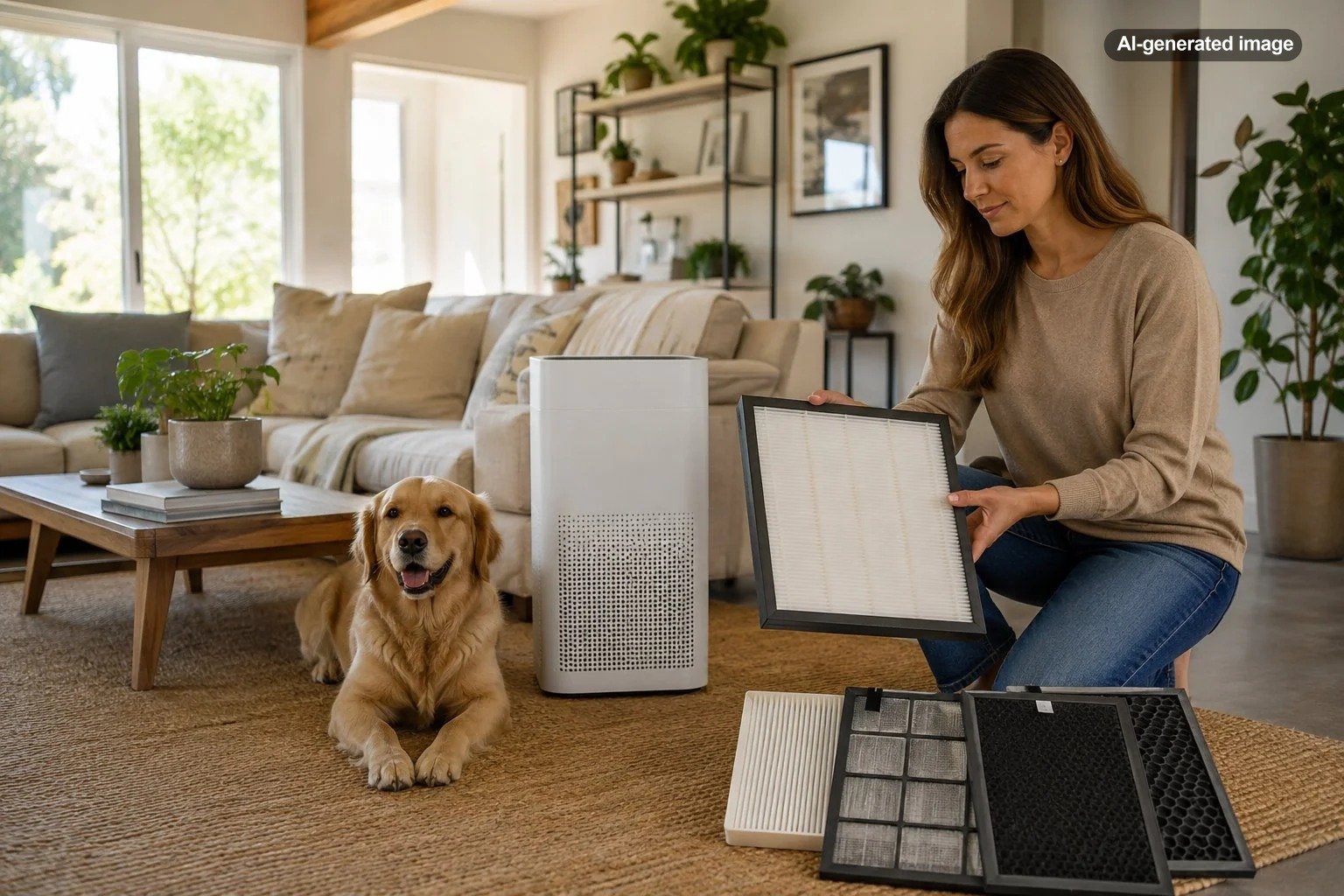
This is one reason a household with a specific room-level concern may benefit from a portable air cleaner in addition to the central filter. For particle removal, EPA recommends sizing a portable unit by its clean air delivery rate, or CADR, for the room or area being served. A portable unit is not a replacement for source control or ventilation, but it can add filtration where people spend the most time.
Also remember what an ordinary HVAC filter is designed to do. Most residential furnace and HVAC filters focus on particles. They are not a universal solution for gases, odors, moisture problems, or every indoor-air-quality concern. If the issue is persistent smoke, a strong chemical odor, recurring mold, or another identifiable source, address the source rather than expecting a furnace filter to solve it.
The best everyday filter is the highest-efficiency filter your system can use comfortably, installed correctly and changed before it becomes overloaded.
How often should you change an HVAC filter?
There is no single replacement interval that fits every home. EPA advises following the filter manufacturer’s recommendations and notes that many manufacturers commonly suggest replacement every 60 to 90 days. ENERGY STAR recommends checking the filter monthly, especially during heavy heating and cooling seasons, and changing it sooner if it looks dirty.
Household conditions can shorten the useful interval. A home with shedding pets, renovation dust, frequent open windows, wildfire smoke, or unusually long HVAC run times may load a filter faster than a lightly occupied home. Instead of relying only on a calendar reminder, inspect the filter regularly and learn what “ready to change” looks like in your own system.
What about allergies, pets, smoke, and odors?
For everyday particle control, a compatible MERV 13 filter is a sensible starting point for homes with pets, seasonal pollen, or general dust concerns. It can capture more fine particles than basic low-MERV filters, but it should not be presented as a cure for allergy or asthma symptoms. EPA says filtration may help indoor air quality and may provide health benefits in some circumstances, but results vary and filtration does not remove every pollutant.
Smoke requires a little more context. Fine particles can be reduced with effective particle filtration, while gases and odors are a different challenge. EPA notes that activated carbon or other sorbent media may be used for gases in portable air cleaners, and that the amount of carbon matters. If wildfire smoke or another outdoor pollution episode is affecting your area, follow current public-health guidance as well as your HVAC manufacturer’s instructions.
For mold, filtration is not the fix for the underlying problem. EPA states that air cleaners and HVAC filters do not correct the moisture source that allows mold to grow. A recurring moisture or mold issue calls for source correction and proper cleanup, not simply a denser filter.
When a basic filter may be the better choice
MERV 13 is not automatically right for every piece of equipment. Some older or constrained systems may need a lower-rated filter to maintain proper airflow. Renters may also have limited control over HVAC changes, particularly in apartments or condos with shared or landlord-maintained systems. In those cases, use the approved filter type for the equipment and consider a correctly sized portable air cleaner when additional room-level particle filtration is desired.
FAQ
Is a MERV 13 filter better than MERV 8 for home use?
For particle capture, MERV 13 is more efficient across the tested particle-size ranges. If your HVAC system can accommodate it, EPA recommends MERV 13 or the highest rating the system can handle. If it cannot, a properly fitted lower-rated filter is the better choice for that equipment.
Is HEPA the best filter for a central HVAC system?
HEPA is a high-efficiency particle-filtration category, but a standard residential HVAC system is not automatically designed for a HEPA filter. Do not assume you can replace a conventional furnace filter with HEPA media. Check the system requirements or consult an HVAC technician.
Does a better furnace filter eliminate the need for an air purifier?
No. Central filters operate when the HVAC system moves air, while a portable air cleaner can provide additional filtration in a specific room or area. Whether you need both depends on the pollutant, the room, and how your HVAC system operates.
Can an air filter remove odors?
Most ordinary HVAC filters are primarily particle filters. Odors and gases may require activated carbon or another gas-focused technology, and the source of the odor should still be identified and addressed.