
The Best Home Safety Devices to Check, Replace, or Add This Year
A safer home does not require turning every room into a control center. The most valuable safety devices are usually quiet, modest, and easy to forget until they are needed: smoke alarms, carbon monoxide alarms, fire extinguishers, leak sensors, radon tests, electrical protection, and secure anchors for heavy furniture.
This year, start by checking what you already own. Test it, find its manufacture or expiration date, confirm that it is installed in the right place, and replace anything that is damaged, obsolete, recalled, or beyond the manufacturer’s stated service life. Then fill the genuine gaps in your home rather than buying gadgets simply because they sound reassuring.
Begin with a room-by-room safety audit
A useful safety review is more specific than walking through the house and asking whether everything looks fine. Carry a flashlight, your phone, and a notepad. Check bedrooms, hallways, the kitchen, bathrooms, laundry area, garage, basement, attic access, utility spaces, and outdoor living areas.
For each device, record its location, power source, test result, manufacture date, visible condition, and replacement instructions. Hardwired equipment still deserves attention because backup batteries, sensors, wiring, and interconnected functions can fail. A green indicator light is helpful, but it is not a substitute for using the test function as directed by the manufacturer.
What to do
- Test every alarm and confirm that household members can hear it from sleeping areas.
- Read the label for the manufacture date, replacement date, model number, and applicable instructions.
- Look for corrosion, paint, dust buildup, loose mounting, damaged cords, missing batteries, or blocked sensors.
- Check the model against current recall notices when its condition or history is uncertain.
- Write down missing coverage and replace critical devices before adding convenience-focused technology.
Check every smoke alarm
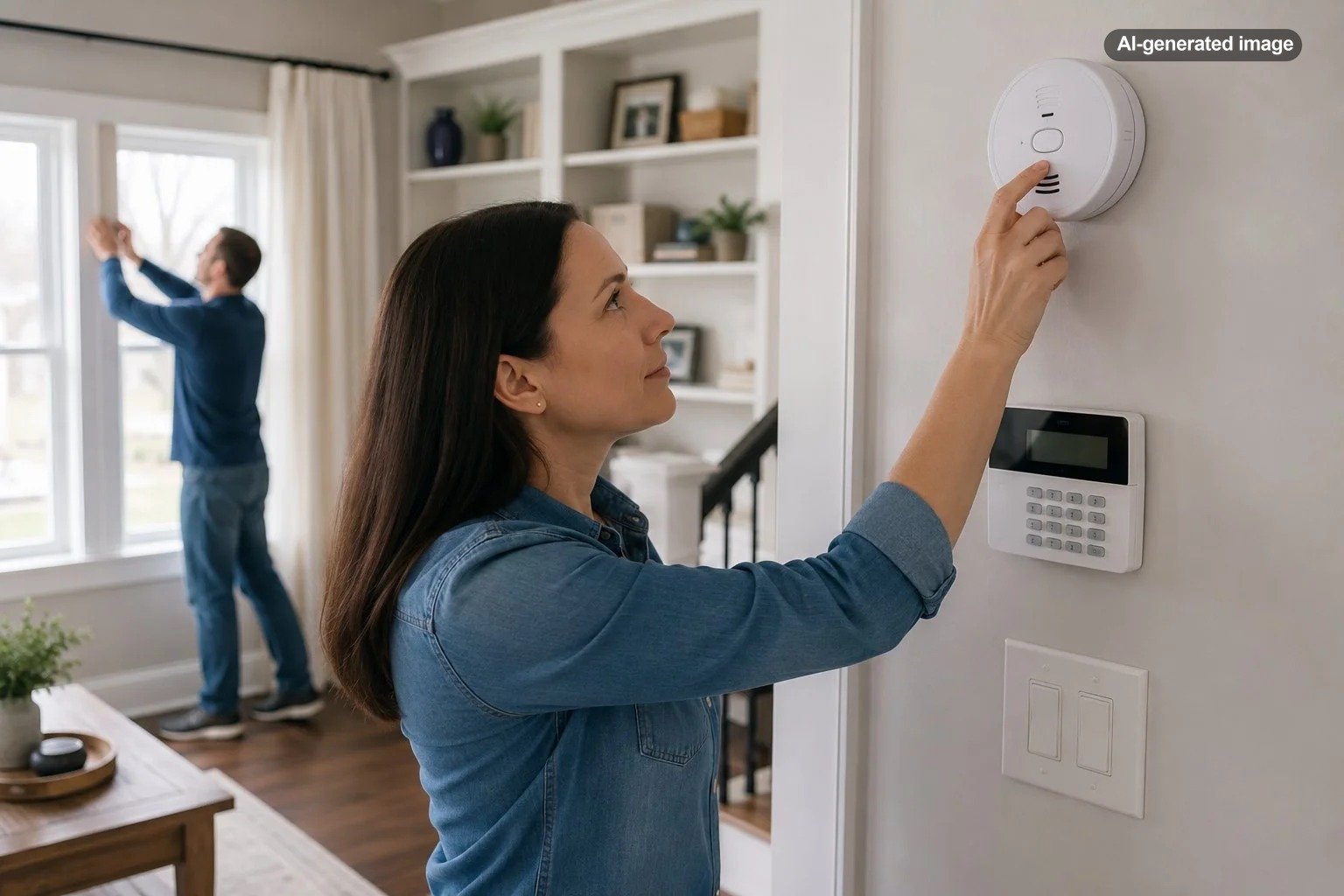
Smoke alarms belong inside every bedroom, outside each separate sleeping area, and on every level of the home, including the basement. The U.S. Fire Administration advises testing smoke alarms monthly and replacing them 10 years after the manufacture date. Follow the manufacturer’s instructions when they are more specific, particularly for sealed-battery and interconnected systems.
Do not assume a smoke alarm is current because the housing still looks white or the test button makes noise. Turn the unit carefully and locate the date printed on its back or side. Replace alarms that are past their stated service life, physically damaged, painted over, unreliable during testing, or affected by a recall.
Interconnected alarms provide an important advantage in larger, multistory, or acoustically separated homes: when one unit detects smoke, all compatible alarms sound. This can be especially useful when bedrooms are far from kitchens, garages, workshops, fireplaces, or laundry equipment.
Confirm carbon monoxide coverage
Carbon monoxide alarms are essential in homes with fuel-burning furnaces, boilers, fireplaces, water heaters, ranges, attached garages, or portable generators. They are also sensible in many all-electric homes with attached garages or nearby combustion sources.
The U.S. Consumer Product Safety Commission recommends carbon monoxide alarms on every level and outside sleeping areas. Units should be installed according to their instructions and positioned where furniture, curtains, vents, or other obstructions will not interfere with them. Plug-in and hardwired alarms should have battery backup when specified.
Use the test button regularly, replace batteries as directed, and pay attention to end-of-life signals. The test button generally confirms that the alarm’s circuitry and audible warning operate; it does not independently verify the accuracy of the sensing element. Replace the entire unit when it reaches the manufacturer’s stated replacement age.
If a carbon monoxide alarm sounds, move everyone outside to fresh air and call emergency services. Do not remain inside to search for the source, and do not reenter until responders say it is safe.
Inspect fire extinguishers without overestimating them
A portable fire extinguisher can help with a small, contained fire when the correct unit is accessible and the user has a clear escape route. It is not a reason to remain in a room that is filling with smoke, confront a spreading fire, or delay calling emergency services.
Check that each extinguisher is easy to reach, properly mounted, free of corrosion or damage, and suitable for the hazards in its location. Review the pressure indicator when the model has one, inspect the hose and nozzle, and look for a stated inspection, recharge, or replacement requirement. Do not place the only kitchen extinguisher directly beside the cooktop, where flames could block access.
Households with garages, workshops, fireplaces, outdoor kitchens, or multiple floors may need more than one extinguisher. Selection and placement should follow the label, manufacturer guidance, and local fire-safety recommendations. Everyone expected to use one should understand its limitations before an emergency occurs.
Add water leak detectors where damage begins quietly
Water leak detectors are not life-safety alarms in the same category as smoke or carbon monoxide alarms, but they can reveal a plumbing or appliance problem before it becomes extensive. Useful locations include beneath sinks, beside water heaters, near washing machines, behind refrigerators with water lines, around sump pumps, beneath air-handling equipment with condensate drainage, and near plumbing in finished basements.
A basic battery-powered sensor can provide a loud local alarm. Connected models can send phone notifications, and some systems can work with an automatic shutoff valve. The more sophisticated option is not automatically better: connected devices depend on power, batteries, networking, compatible software, and correct notification settings.
Test leak sensors with the method stated in the instructions and verify that alerts reach the intended phones. Position the sensing contacts at the lowest likely collection point rather than several inches away on a higher surface. A sensor that cannot touch the first escaping water may not provide the early warning you expect.
Test for radon instead of trying to sense it
Radon is a naturally occurring radioactive gas that cannot be seen or smelled. Testing is the only way to know whether it is elevated in a home. The Environmental Protection Agency recommends testing all homes and taking action to reduce levels at or above 4 picocuries per liter.
Short-term test kits can provide an initial result when used exactly as instructed. Longer-term testing or professional measurement may offer a more representative picture when levels fluctuate or a real-estate decision is involved. Retesting is also worth considering after major renovations, changes to the heating and cooling system, or a shift in which level of the home is regularly occupied.
A continuous radon monitor can be convenient, but it should be treated as a measurement device that requires correct placement and operation, not as a decorative air-quality gadget. Elevated results should be confirmed and addressed using guidance from the EPA, the relevant state or Tribal radon program, or a qualified radon professional.
Review electrical safety protection
Ground-fault circuit interrupters, commonly called GFCIs, are intended to reduce the risk of severe electrical shock in locations where electricity and water may meet. They are commonly found in kitchens, bathrooms, garages, basements, laundry areas, and outdoor receptacles, although requirements vary by location, building age, and applicable code.
Use the test and reset buttons according to the device manufacturer’s instructions. A receptacle that will not trip, will not reset, feels warm, is discolored, sparks, buzzes, or repeatedly loses power needs qualified evaluation. Do not replace electrical protection devices or alter wiring unless you have the appropriate knowledge and the work is permitted for your situation.
Arc-fault circuit interrupters, or AFCIs, provide a different type of protection related to hazardous electrical arcing. Their presence and required locations depend on the electrical system and locally adopted standards. An electrician can identify missing protection, nuisance-tripping causes, damaged wiring, overloaded circuits, or outdated equipment without turning a general checklist into guesswork.
Secure furniture, televisions, ranges, and windows
Safety devices are not limited to alarms. Anti-tip hardware can help prevent tall or heavy furniture, televisions, and certain appliances from falling. The CPSC advises securing top-heavy furniture and televisions and following manufacturer instructions for proper attachment.
Inspect existing restraints rather than assuming they remain dependable forever. Confirm that fasteners are tight, hardware is not cracked or corroded, wall attachment is appropriate for the surface, and furniture has not been moved without being resecured. Check current recall information for the exact restraint model when its origin is uncertain; recent recalls have involved plastic restraints that could degrade or break.
Homes with young children may also benefit from window guards or opening-control devices, cabinet latches, stair gates, outlet covers, and anti-scald measures. Window screens do not prevent falls. Any window safety device must also preserve required emergency escape capability, so follow the product instructions and applicable local requirements.
Match safety devices to the people in the home
A household safety plan should account for hearing, vision, mobility, memory, height, age, pets, and overnight routines. Standard audible alarms may not adequately alert someone who is deaf or hard of hearing. Specialized systems can incorporate strobe lights, low-frequency sounders, bed shakers, or connected notification devices.
Older adults and people with limited mobility may benefit from improved stair lighting, secure handrails, nonslip surfaces, night lights, accessible emergency contacts, and a medical alert device. These additions should support a realistic escape and response plan rather than create the impression that a single wearable solves every risk.
Know what technology cannot do
Connected cameras, smart locks, video doorbells, glass-break sensors, and monitored security systems can improve awareness and access control. Their value depends on reliable power, secure account settings, current software, sensible placement, and a household response plan.
Review who can access each account, enable multifactor authentication when available, remove former residents and obsolete devices, update recovery information, and test alerts. Also confirm that critical functions still work during an internet or power interruption. A smart lock with a dead battery and no accessible backup method can create a different problem from the one it was meant to solve.
The best safety device is one that fits the actual risk, is correctly installed, and still works when nobody has thought about it for months.
Create a manageable replacement schedule
Do not rely on memory. Add recurring reminders for monthly alarm tests, seasonal battery and equipment checks, annual household reviews, and manufacturer-directed replacement dates. Keep manuals, model numbers, purchase dates, and photographs of labels in one digital folder.
Before you decide
- Does the device address a real hazard in this home?
- Can everyone who needs the warning hear, see, or feel it?
- Will it function during a power or internet outage?
- Is the installation location permitted and recommended?
- Can it be tested without special tools or a paid subscription?
- Is there a clear replacement date or end-of-life indicator?
- Does the household know what action to take when it activates?
Frequently asked questions
Should smoke and carbon monoxide alarms be replaced even if they still beep during testing?
Yes, when they have reached the replacement age stated by the manufacturer or official guidance. The test button does not prove that an aging sensor will respond correctly to a real hazard.
Are combination smoke and carbon monoxide alarms a good choice?
They can simplify installation and maintenance when they provide appropriate coverage, meet applicable standards, and are installed according to their instructions. Confirm that the placement works for both sensing functions.
Which safety device should be added first?
Correct missing or expired smoke and carbon monoxide coverage first. Then address immediate household-specific risks such as electrical faults, an unsecured dresser, a vulnerable water heater, an untested radon level, or inaccessible fire extinguishers.
Do renters need to perform these checks?
Renters should test provided alarms as allowed, report missing or defective safety equipment promptly, and document requests in writing. Responsibilities vary by lease and jurisdiction, so avoid modifying hardwired, structural, gas, or electrical systems without authorization.
When should a professional be called?
Seek qualified help for damaged wiring, repeated breaker trips, gas or carbon monoxide concerns, malfunctioning hardwired alarms, fire-extinguisher servicing, automatic water shutoff installation, radon mitigation, structural anchoring uncertainty, or any task outside your knowledge and local permissions.