
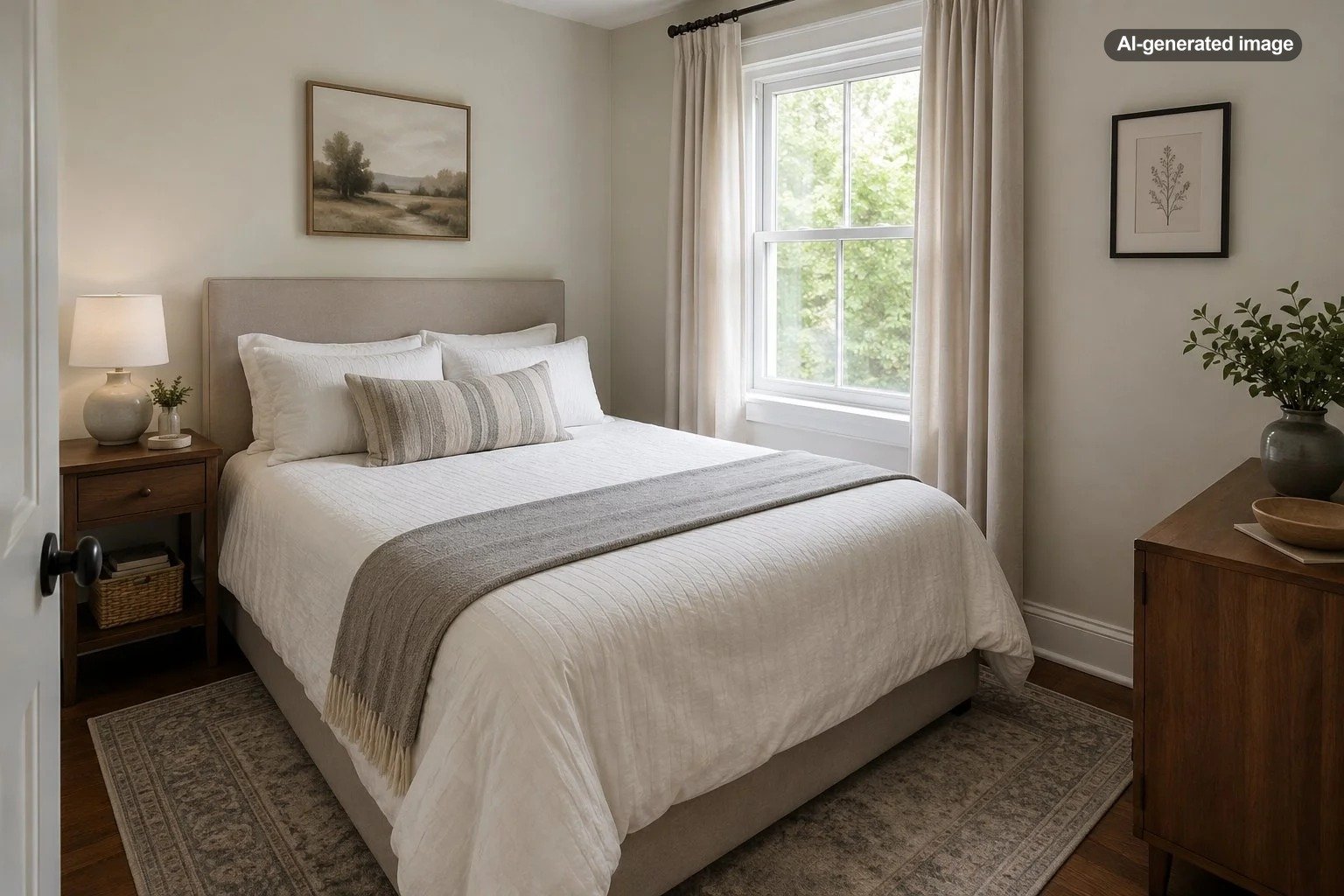
What Size Bed Is Best for a Small Guest Room?
For most small guest rooms, a full-size bed is the best overall choice. It gives one adult noticeably more sleeping space than a twin while requiring less floor area than a queen. A twin is often better in an exceptionally narrow room, while a queen makes sense when couples visit regularly and the room can still support comfortable walking space.
The right answer depends on more than whether the mattress technically fits. You also need space to open the door, reach a closet, place luggage, change the bedding, and move through the room without turning every visit into a sideways shuffle.
Start With the Actual Mattress Dimensions
Standard U.S. mattress sizes provide a useful starting point. A twin mattress is typically about 38 inches wide by 75 inches long. A full is approximately 54 inches wide by 75 inches long, while a queen is about 60 inches wide by 80 inches long.
Those numbers describe the mattress, not the complete bed. Frames, headboards, footboards, upholstered rails, and decorative posts may add several inches to the overall footprint. Always measure the specific frame rather than planning around mattress dimensions alone.
| Bed size | Typical mattress dimensions | Best for | Main tradeoff |
|---|---|---|---|
| Twin | 38 x 75 inches | One guest, narrow rooms, flexible layouts | Limited width for larger adults |
| Twin XL | 38 x 80 inches | Taller solo guests | Bedding can be less convenient to reuse |
| Full | 54 x 75 inches | Most small guest rooms | Cozy rather than spacious for two adults |
| Queen | 60 x 80 inches | Couples and frequent overnight guests | Consumes more walking and storage space |
Why a Full Bed Is Usually the Best Compromise
A full bed occupies only 16 inches more width than a twin, yet it feels substantially more generous for a solo sleeper. That extra width can make the room suitable for adult children, friends, parents, or other guests who may find a twin restrictive.
Compared with a queen, a full saves about 6 inches of width and 5 inches of length. Those differences may sound modest, but they matter in a compact room. Six inches can determine whether a nightstand fits beside the bed, whether a closet door opens fully, or whether someone can walk around the mattress without bumping into furniture.
A full bed can also function for a couple during an occasional short stay. It will not provide the personal space of a queen, so it is less suitable when couples visit often or remain for extended periods. For a guest room used a handful of nights each year, however, that tradeoff may be entirely reasonable.
The best guest-room bed is not the largest one that fits; it is the largest one that still allows the room to function.
When a Twin Bed Is the Smarter Choice
A twin is often dismissed as a child’s bed, but it can be a practical and polished choice for a narrow guest room. It leaves more wall space for a small desk, dresser, luggage rack, reading chair, or storage cabinet. It is also easier to move, rotate, make, and clean around.
Choose a twin when the room serves multiple purposes, such as a home office that occasionally hosts a guest. A daybed, simple platform bed, or bed positioned lengthwise against a wall can preserve useful open floor area.
A twin XL provides the same narrow width with 5 additional inches of length. It can be helpful for taller guests, although sheets and mattress protectors must be purchased in the XL size. Before choosing one, confirm that the longer frame will not interfere with a door swing, closet, radiator, or circulation path.
When a Queen Bed Is Worth the Space
A queen is usually the better choice when the guest list regularly includes couples. It offers more width than a full and additional length for taller sleepers. It also provides access to a broad selection of mattresses, sheets, protectors, and bed frames.
The challenge is maintaining a usable layout. A queen may physically fit inside a small bedroom while leaving too little room for bedside access, luggage, or storage. This is especially noticeable when the bed has a deep upholstered frame, a footboard, or wide nightstands.
A queen works best when the room has a simple rectangular shape, unobstructed wall space, and minimal furniture requirements. Consider using a slim frame, wall-mounted lighting, narrow shelves instead of nightstands, and under-bed storage to reduce the amount of floor space claimed by supporting pieces.
Measure the Room as a Walking Space, Not an Empty Box
Room dimensions alone do not tell you whether a bed will work. Doors, closets, windows, vents, baseboard heaters, outlets, and architectural features all affect placement. The path from the doorway to the bed matters just as much as the open square footage.
What to do
- Measure the room wall to wall, including alcoves and projections.
- Measure the complete exterior dimensions of the bed frame.
- Mark the proposed footprint on the floor with painter’s tape.
- Open the room door, closet doors, and drawers to check for conflicts.
- Place a suitcase or laundry basket where luggage would realistically sit.
- Walk through the layout and confirm that bedding can be changed without moving major furniture.
Try to preserve a comfortable passage along the side guests will use to enter the bed. Access on both sides is preferable for couples, but a small room may require placing one side closer to a wall. That arrangement is generally more acceptable for a twin or a rarely used full bed than for a queen intended for two frequent guests.
Consider Who Actually Uses the Room
A guest room designed for one visiting relative has different requirements from a room used by couples, grandchildren, or friends with mobility concerns. Choose for your likely guests rather than an imaginary universal visitor.
- Mostly one adult: A full provides comfort without overwhelming the room.
- Mostly couples: A queen is preferable when the remaining layout is functional.
- Children or occasional solo visitors: A twin may be entirely sufficient.
- Taller solo guests: Consider a twin XL or queen for the additional length.
- Guests with limited mobility: Prioritize an open route, stable bedside surface, accessible lighting, and an appropriate bed height over maximum mattress width.
Frequency matters too. A room used twice a year does not necessarily need the same bed as one occupied every month. When stays are rare, preserving the room’s everyday usefulness may be more valuable than accommodating every possible guest configuration.
Keep the Bed Frame Visually and Physically Light
The mattress size is only part of the visual equation. A bulky sleigh bed, thick upholstered rails, or oversized headboard can make a modest mattress feel much larger. In a small room, a streamlined platform frame or simple metal frame often provides a cleaner outline and more usable clearance.
Choose bedding that fits neatly rather than pooling heavily on the floor. A tailored coverlet can make the room appear more open, while an overfilled duvet can create a softer, more enveloping look. Neither is inherently better, but the bedding should not obscure walkways or interfere with under-bed drawers.
Affiliate disclosure: CraneManor.com may earn a commission when you purchase through links on this page. This does not affect the price you pay. Learn more.
If the existing duvet insert is still in good condition, a neutral duvet cover with matching shams can give the bed a more finished appearance without adding another bulky layer. The comforter insert is not included, and size and care instructions should be checked before ordering.
Common Bed-Sizing Mistakes
One common mistake is centering the bed automatically. An asymmetrical placement may create a better walkway, allow a door to open properly, or preserve space for luggage. The room does not need to follow showroom symmetry if a different arrangement functions better.
Another mistake is buying a queen because it seems more hospitable, then crowding the room with two nightstands, a dresser, a bench, and decorative seating. Guests generally benefit more from clear movement, a place for a phone, accessible lighting, and somewhere to set a suitcase than from a complete furniture suite.
Do not overlook mattress thickness and frame height. A very tall mattress on a high platform may feel imposing in a compact room and can be awkward for shorter guests. Conversely, an extremely low bed may be uncomfortable for some older adults. Proportion and ease of use should guide the choice.
Before you decide
- Confirm the bed frame’s full exterior measurements.
- Check door, closet, and drawer clearances.
- Leave a realistic place for luggage.
- Consider whether guests are usually solo or paired.
- Account for the sleeper’s height, not only the room’s width.
- Choose a frame that does not add unnecessary bulk.
- Test the layout with painter’s tape before purchasing.
Frequently Asked Questions
Is a full bed comfortable for two guests?
A full can accommodate two adults for an occasional short stay, but it provides less personal width than a queen. Couples who visit frequently will generally be more comfortable on a queen if the room can support it.
Can a queen bed fit in a small guest room?
It may fit, but mattress fit is not the only test. Include the frame, walking paths, door swings, closet access, and luggage space in the layout. A queen that blocks normal use is too large even when its measurements fit within the walls.
Is a twin bed too small for an adult guest?
Not necessarily. A standard twin can work well for one average-height adult, particularly for short visits. Taller adults may prefer a twin XL because it adds length without increasing width.
Should a small guest room have nightstands on both sides?
No. One compact nightstand, wall shelf, or narrow ledge may be enough. For a queen used by couples, provide a reachable surface and light on both sides when possible, even if the two sides are not identical.
What is the final verdict?
For the average small guest room, choose a full-size bed. Move down to a twin when the room is extremely narrow or serves another daily purpose. Move up to a queen when couples visit regularly and the taped-out layout still leaves the room comfortable, accessible, and easy to use.