
How Many Bath Towels Does One Person Really Need?
For most adults, three to four bath towels per person is a remarkably practical number. That gives you one towel in use, at least one clean towel ready to go, and another that can be in the laundry without creating a minor household emergency after a shower.
The right number is not really about how plush you want the linen closet to look. It depends on how often you do laundry, how quickly towels dry in your bathroom, how much storage you have, and whether you like keeping a spare available for guests, spills, hair treatments, or the occasional towel that mysteriously fails to return from the laundry room.
Why three to four towels usually works
A sensible towel supply needs to cover three stages: using, washing, and waiting. If every towel you own is either damp or tumbling around in the washer, you do not really have a useful rotation.
Three towels per person is the lean version. One can hang in the bathroom, one can be freshly laundered, and one can cover the transition between the two. Four adds enough breathing room that a delayed laundry day does not immediately empty the linen closet.
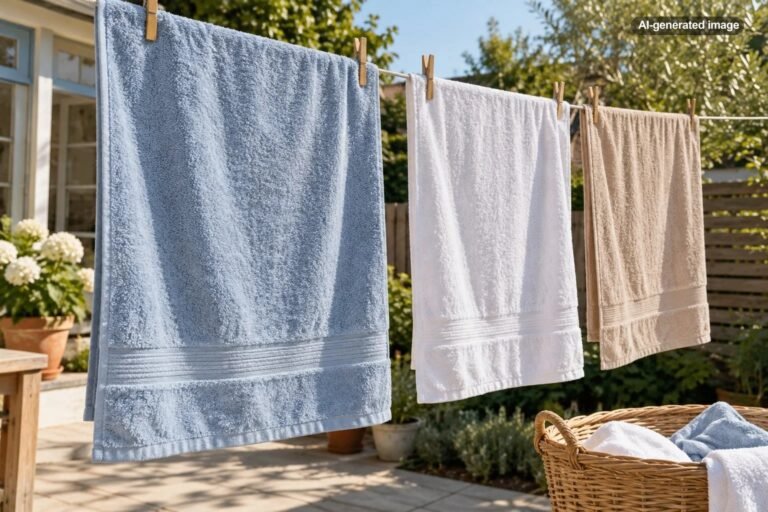
This also makes it easier to let towels dry properly between uses. The American Cleaning Institute advises hanging bath towels to dry between uses and laundering them after several normal uses. A towel that stays bunched on a hook, piled on the floor, or trapped in a humid bathroom may need attention sooner than one that dries completely on a well-spaced bar.
| Towels per person | Best fit | Main tradeoff |
|---|---|---|
| 2 | Minimalists who wash very frequently | Little margin for delayed laundry |
| 3 | Most small households with regular laundry | Requires a reasonably consistent rotation |
| 4 | Most households wanting an easy buffer | Uses slightly more storage |
| 5+ | Infrequent laundry, guests, pools, or towel-heavy routines | Can create unnecessary linen-closet bulk |
Your laundry schedule matters more than the size of your household
Two people who wash linens twice a week can comfortably own fewer towels than one person who waits a week or more between laundry loads. That is why simply multiplying a fixed number by the number of people in the home can produce either shortages or an overstuffed closet.
Think about the longest realistic stretch between towel loads, not your ideal schedule. If you intend to wash towels every few days but regularly postpone the load until the weekend, plan for the weekend routine.
Drying conditions can change the calculation
A towel should have a chance to dry between uses. In a spacious, well-ventilated bathroom with a full-width towel bar, that may happen easily. In a small bathroom where several damp towels share hooks, drying may take longer.
If towels regularly remain noticeably damp when you are ready to shower again, buying more towels can help with rotation, but it does not solve the underlying drying problem. Give towels more room, avoid folding them over themselves while wet, and use the bathroom’s ventilation appropriately. The goal is not to accumulate enough towels to ignore damp ones indefinitely.
Climate also matters. Humid conditions can make air-drying slower, while a heavily air-conditioned or well-ventilated space may behave differently. Rather than following a rigid ownership number, pay attention to how towels actually perform in your bathroom.
Separate everyday towels from guest towels
If overnight guests are common, do not make your everyday rotation do double duty. A small dedicated guest supply makes hosting easier and reduces the temptation to maintain an enormous stack of everyday towels just in case someone visits.
For a home that occasionally hosts one or two people, keeping two to four guest bath towels is generally more useful than adding several towels to every household member’s personal count. Store them together so you know which towels are genuinely available when guests arrive.
Do you need separate hair towels?
Possibly. Someone with long or thick hair may routinely use two towels after a shower: one for the body and another for hair. If that is your normal routine, counting only bath towels can underestimate what you actually need.
You can either increase the total bath-towel count or keep smaller dedicated hair towels. The latter can reduce laundry bulk because a smaller towel may be sufficient for wrapping or blotting hair. The best choice depends on your habits rather than a formal rule.
The same principle applies to households that use towels after workouts, swimming, home spa routines, or bathing pets. Those uses do not necessarily mean everyone needs six everyday bath towels. It can be cleaner organizationally to maintain a separate small group for the specific activity.
More towels are not always more convenient
An oversized towel collection creates its own problems. Towels take up substantial shelf space, especially thick bath sheets. Large stacks can make rotation less obvious, allowing the same towels to sit untouched at the bottom while a few favorites cycle continuously through the bathroom and laundry.
Extra inventory also means there is less pressure to wash and put towels away promptly. That can sound convenient, but eventually the entire collection may arrive in the laundry basket at once. A modest rotation tends to make the system easier to maintain.
If your linen closet is crowded, count the towels you actually use before buying organizers or adding storage. You may discover that several are worn, rarely used, mismatched with your current needs, or being kept solely because they are technically still towels.
Bath sheets require more storage than standard towels
Large bath sheets can be appealing if you prefer generous coverage, but they occupy more room on shelves and in laundry loads. A household replacing standard bath towels with oversized versions may find that the same numerical quantity suddenly feels excessive.
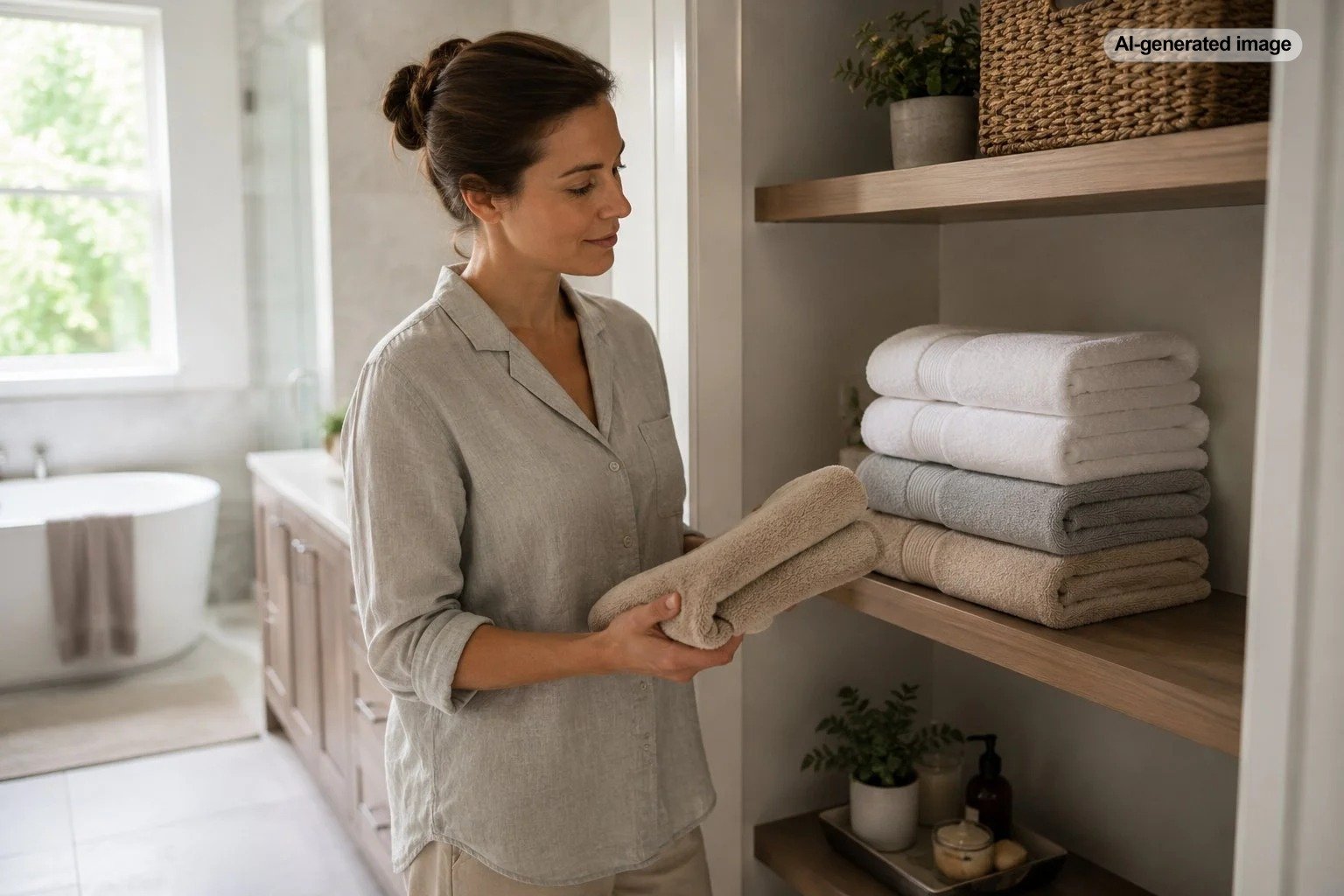
Before deciding how many to keep, fold one the way you normally would and see how much shelf space the full collection would require. The practical capacity of your linen closet is a better guide than an idealized photograph of perfectly stacked towels.
How to build the right towel count for your home
If you are starting from scratch, resist buying a large collection before you understand your routine. Begin with three or four bath towels per person and adjust after a few weeks of normal use.
Before you decide
- Count how many bath towels each person uses at one time.
- Consider how many days normally pass between towel loads.
- Check whether towels dry fully between uses.
- Add dedicated guest towels if you host overnight visitors.
- Account separately for hair, pool, workout, pet, or utility towels.
- Make sure the folded collection comfortably fits your available storage.
If you repeatedly run out of clean towels before laundry day, add one per person and reassess. If half the collection remains untouched for months, you probably have more than you need.
What about hand towels and washcloths?
They deserve their own count because they are used differently. Hand towels may be shared and changed more frequently, while washcloths are often treated as single-use items before laundering. Their ideal quantities therefore have little relationship to the number of bath towels you own.
For organization, keeping bath towels, hand towels, and washcloths in separate stacks or baskets makes it easier to see when one category is running low. A linen closet can appear full while still being strangely short of the one towel size everyone actually needs.
The simplest answer
If you want one number, choose four bath towels per person. It is generous enough for a comfortable wash-and-use rotation without automatically filling the linen closet with unnecessary extras.
People with frequent laundry access may be perfectly happy with three. Those who wash less often, live with slower drying conditions, host regularly, or have towel-heavy routines may prefer five. The useful number is the smallest collection that keeps clean, dry towels available without turning towel storage into a project of its own.