Why Do Towels Get Stiff When Dried Outside?
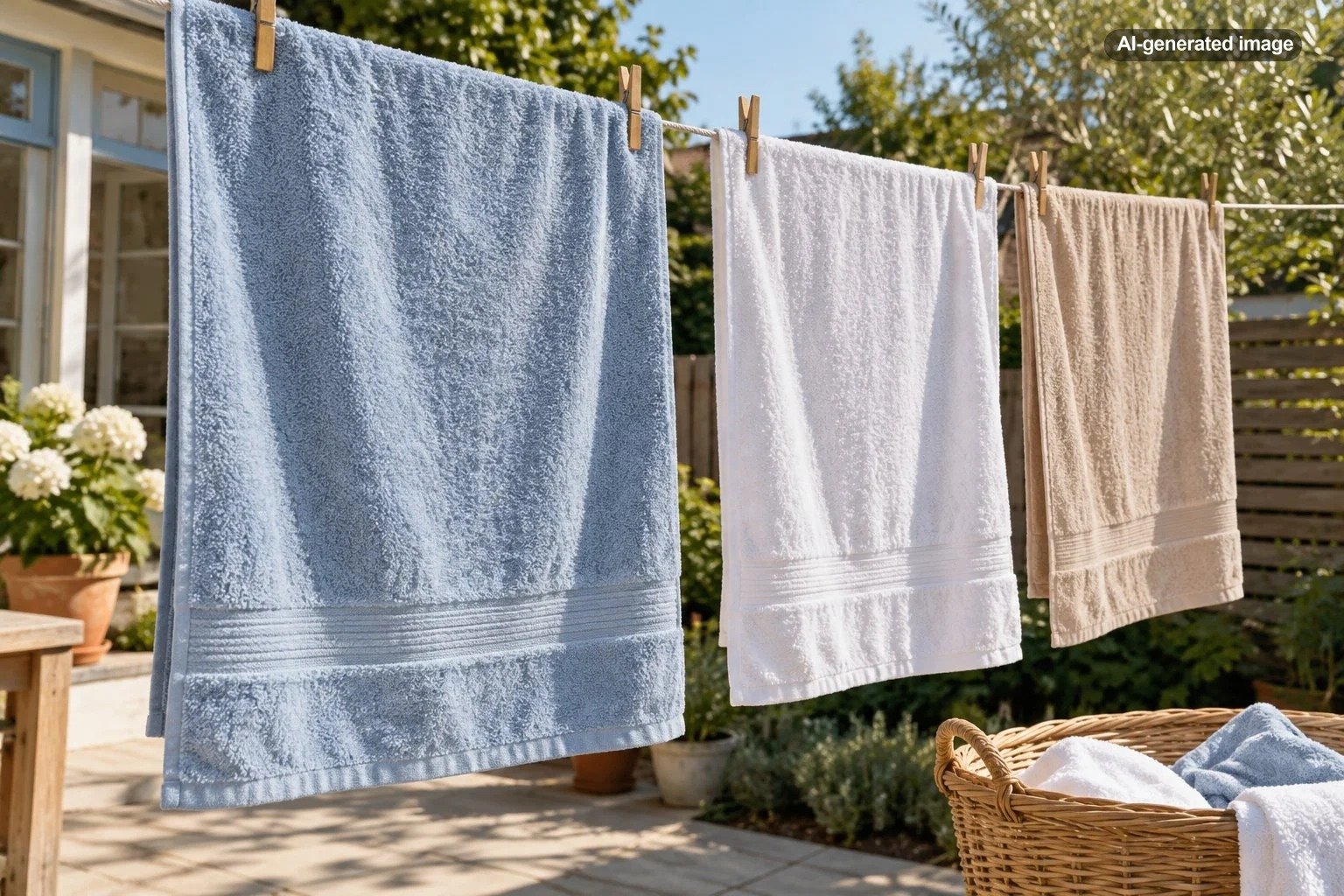
Towels get stiff when dried outside because their cotton fibers settle into a relatively rigid arrangement as the water evaporates. Tiny amounts of moisture remain associated with the fibers, helping neighboring strands cling together through molecular interactions. Without the movement of a tumble dryer to separate and loosen those fibers, a freshly washed towel can end up feeling surprisingly rough.
This happens even when the towel is perfectly clean. Detergent residue, hard-water minerals, and the way a towel hangs can make the stiffness more noticeable, but the drying process itself is often the main explanation.
Fortunately, you can keep the convenience of outdoor drying without accepting towels that feel like cardboard. A few adjustments to washing, hanging, and finishing can make a meaningful difference.
What Actually Makes Cotton Towels Stiff?
Cotton is made primarily of cellulose, a material that readily interacts with water. When a towel gets wet, its fibers absorb moisture and swell. As the towel dries, those fibers lose water, contract, and settle into new positions.
Hydrogen bonding and the behavior of water bound to cotton surfaces contribute to the way neighboring fibers hold together. This creates a firmer structure, particularly when the fabric remains relatively motionless throughout drying.
Research into naturally dried cotton has demonstrated that small amounts of water associated with fiber surfaces can contribute to stiffness through adhesion between fibers. The effect is not simply a matter of a towel being dried too thoroughly in the sun.
Why towels feel different from other cotton fabrics
A cotton T-shirt may also feel firmer after line drying, but its smooth knit structure makes the change less dramatic. Bath towels have thousands of small loops, often called terry loops, that create their thick, absorbent texture.
Those loops need space and movement to remain fluffy. When they dry pressed against neighboring fibers, the surface becomes flatter and less flexible. Because the loops are what your skin touches, even a modest change in their arrangement can make the towel feel noticeably scratchier.
Why tumble-dried towels stay fluffier
A tumble dryer constantly lifts, bends, and separates the fabric as it dries. That mechanical movement keeps the towel’s loops from settling into the same rigid arrangement they might develop on a stationary clothesline.
Heat is not the only reason tumble-dried towels feel soft. The movement itself is important. This is why even a short air-only tumble can help loosen a towel that has already dried outdoors.
Does Sunshine Make Towels Harder?
Sunshine is often blamed for stiff towels because the effect becomes obvious when laundry dries outdoors on a bright day. However, sunlight alone is not the primary cause of normal line-drying stiffness.
The more important factor is that the towel hangs with limited movement while moisture evaporates. A towel dried indoors on a stationary rack can develop a similarly firm texture.
Outdoor conditions still influence the result. Strong sunlight, low humidity, and warm air can speed drying. A gentle breeze may help because it moves the fabric and encourages the loops to separate, although wind alone may not provide enough movement to reproduce the softness of a dryer.
Prolonged exposure to intense sunlight can also contribute to fading and aging in some fabrics. Following the towel’s care label and bringing laundry inside once it is dry are sensible ways to limit unnecessary exposure.
Other Reasons Towels Become Especially Rough
If your towels are stiff whether you dry them inside or outside, the washing routine may be adding to the problem.
Too much laundry detergent
Using extra detergent does not automatically produce cleaner towels. When the washer cannot rinse detergent away completely, residue can remain in the fabric and contribute to a rough or coated feel.
Thick bath towels are particularly vulnerable when a washing machine is overloaded. Water needs to circulate through the layers of cotton to remove detergent and suspended soil.
Use the amount of detergent appropriate for the load, product concentration, soil level, and water conditions. If towels feel coated or unusually stiff, consider an extra rinse rather than automatically adding more cleaning product.
Hard-water mineral buildup
Hard water contains dissolved minerals, including calcium and magnesium. Depending on the washing conditions and detergent, mineral deposits can accumulate in textiles and contribute to stiffness.
If towels feel rough even after tumble drying, or gradually become less pleasant over multiple washes, hard water may be part of the explanation.
A laundry detergent formulated to work effectively in hard water may help. Follow the product directions rather than combining multiple additives without checking their compatibility.
Fabric softener buildup
Liquid fabric softeners and dryer sheets can make towels feel smoother by leaving conditioning substances on their fibers. However, repeated use may also leave coatings that interfere with wetting and absorbency.
That creates an awkward tradeoff: a towel may feel soft against your skin but become less effective at absorbing water.
If absorbency matters more than a particularly silky texture, try washing towels without fabric softener and rely on mechanical fluffing instead.
Age and worn terry loops
Not every stiff towel can be restored to its original condition. Over time, frequent washing, abrasion, and ordinary wear can flatten or damage the loops that give a towel its plush surface.
If a towel remains thin, scratchy, or noticeably less absorbent after a thorough wash and proper drying, worn fibers may be responsible. Changing the drying method can improve its feel, but it cannot rebuild damaged loops.
How to Keep Towels Softer When Drying Them Outside
You do not need a complicated laundry treatment to improve the texture of line-dried towels. The simplest adjustments focus on rinsing thoroughly and keeping the fibers from drying in a tightly compressed position.
A practical line-drying routine
- Wash without overloading. Leave enough space in the drum for towels to move and rinse properly. Follow the washer’s loading guidance.
- Use an appropriate detergent dose. More detergent is not necessarily better, especially for lightly soiled towels.
- Add an extra rinse when needed. This can help if detergent residue appears to be contributing to stiffness.
- Shake each towel firmly. Before hanging, hold the towel securely and give it several strong shakes to open the loops and separate the fabric.
- Hang towels with room for airflow. Spread them out rather than folding them into several thick layers or crowding them against other laundry.
- Move the fabric during drying. When convenient, reposition or shake the towel partway through the drying process.
- Shake again before folding. Once completely dry, a final shake helps loosen fibers that have settled together.
These steps will not necessarily produce the same plushness as a full tumble-dryer cycle, but they can make outdoor-dried towels more comfortable without additional products.
Should You Finish Line-Dried Towels in the Dryer?
If you like outdoor drying but dislike the texture it leaves behind, a short dryer-finishing cycle can offer a practical compromise.
Allow the towels to dry outdoors, then place them in the dryer briefly on an air-only or appropriate low-heat setting. The tumbling motion helps flex and separate the fibers. Dryer balls may provide additional movement, although they are not essential.
Another approach is to bring towels inside while they are still slightly damp and finish drying them in the machine. This provides tumbling during the final drying stage, when the cotton fibers are settling into their dry arrangement.
Neither approach is entirely dryer-free, and results vary with the towel’s material, thickness, and condition. Follow the care label, avoid unnecessary high heat, and make sure the towels are fully dry before storage.
How to Tell Whether the Problem Is Drying or Residue
The most useful distinction is whether stiffness happens only after line drying or appears after every drying method.
| What you notice | Likely explanation | What to try |
|---|---|---|
| Soft from the dryer, stiff from the clothesline | Fibers setting in place without movement | Shake before and after drying or briefly tumble |
| Stiff after both drying methods | Possible detergent or mineral residue | Review detergent dosing and rinsing |
| Soft but less absorbent than expected | Possible fabric conditioner buildup | Try washing without softener |
| Thin, flat, and rough despite washing | Worn or compressed terry loops | Adjust expectations and assess fabric condition |
For a simple comparison, wash two similar towels together. Hang one outside and tumble-dry the other according to their care labels. If the outdoor towel is significantly firmer, the drying process is likely contributing to the difference.
This comparison is less reliable if the towels differ in age, material, or previous use of fabric softeners. Matching towels make the result more useful.
Is It Better to Dry Towels Outside or in a Dryer?
Both methods have advantages. The better choice depends on whether you prioritize energy use, softness, available space, convenience, or fabric care.
Advantages of outdoor drying
Outdoor drying avoids the electricity or gas used by a powered dryer during that load. It can be particularly useful for bulky towels that need plenty of space to dry. Fresh air and moving air can also support evaporation when the weather is suitable.
However, outdoor drying depends on weather and local conditions. Pollen, dust, smoke, unexpected rain, or high humidity can make it less appealing. Some households also have building or community restrictions on visible clotheslines.
Advantages of tumble drying
Tumble drying provides a more consistent soft finish and is convenient when outdoor conditions are poor. It also eliminates the need to carry laundry outside and monitor changing weather.
The tradeoffs include energy consumption, possible shrinkage or wear when inappropriate settings are used, and the need to maintain the appliance and lint system according to its instructions.
A hybrid routine is often practical: line-dry most of the way and use a short tumble cycle for softness when needed.
Common Mistakes That Make Line-Dried Towels Stiffer
Small laundry habits can undermine an otherwise effective drying routine.
- Hanging towels straight from the washer without shaking: Wet loops may remain compressed until the fabric dries.
- Folding thick towels into narrow sections: Multiple layers slow evaporation and can leave portions of the fabric tightly packed.
- Leaving dry towels outside for hours: Additional exposure does little to improve softness and can expose laundry to dust, pollen, or changing weather.
- Adding extra detergent to solve stiffness: Residue may be the problem, so additional detergent can make it worse.
- Using fabric softener at every wash: Conditioning residue can compromise the absorbency that makes a bath towel useful.
- Folding towels while they are still damp: Trapped moisture can produce stale odors and encourages conditions in which mildew may develop.
The goal is to dry towels completely while allowing their loops to remain as open and flexible as practical.
Frequently Asked Questions
Are stiff line-dried towels still clean?
Yes, they can be. Stiffness alone is not evidence of dirt or poor washing. Clean cotton can become rigid during stationary drying. Persistent odors, visible soil, or a coated feel are separate reasons to review your washing routine.
Will a stiff towel soften after you use it?
Often, yes. Handling, bending, and using the towel can loosen the temporary interactions that hold its fibers together. The result may not be quite as fluffy as tumble drying, but an initially crisp towel commonly becomes more flexible with movement.
Does drying towels in the shade prevent stiffness?
Not entirely. Shade can reduce direct sun exposure, but it does not eliminate the fiber interactions responsible for stiffness. Airflow, drying conditions, and how much the towel moves are more relevant to its final texture.
Do microfiber towels become stiff like cotton towels?
Not in exactly the same way. Microfiber towels are typically made from synthetic fibers with different moisture behavior and construction. They may develop texture problems from residue, heat exposure, or wear, but the cotton-specific bound-water mechanism does not apply in the same manner.
Can you make towels soft without fabric softener?
Yes. Proper detergent dosing, thorough rinsing, shaking the towels, and using a brief tumble cycle when available can all help. These methods focus on cleaning and separating the fibers rather than coating them with conditioning products.
The Bottom Line
Outdoor-dried towels become stiff primarily because cotton fibers cling together and settle into a firm structure as moisture evaporates without the movement provided by a dryer. It is a normal property of the material, not automatically a sign that the towels are dirty or ruined.
Start with the easiest changes: avoid excess detergent, rinse well, shake towels before hanging, give them room to dry, and shake them again before folding. If you prefer a noticeably fluffier finish, a short dryer cycle can bridge the gap between fresh-air drying and everyday comfort.
A towel does not have to feel cloud-soft to be clean and useful. But it should still be pleasant to reach for after a shower.