Why Does My Smart Thermostat Read Higher Than a Room Thermometer?
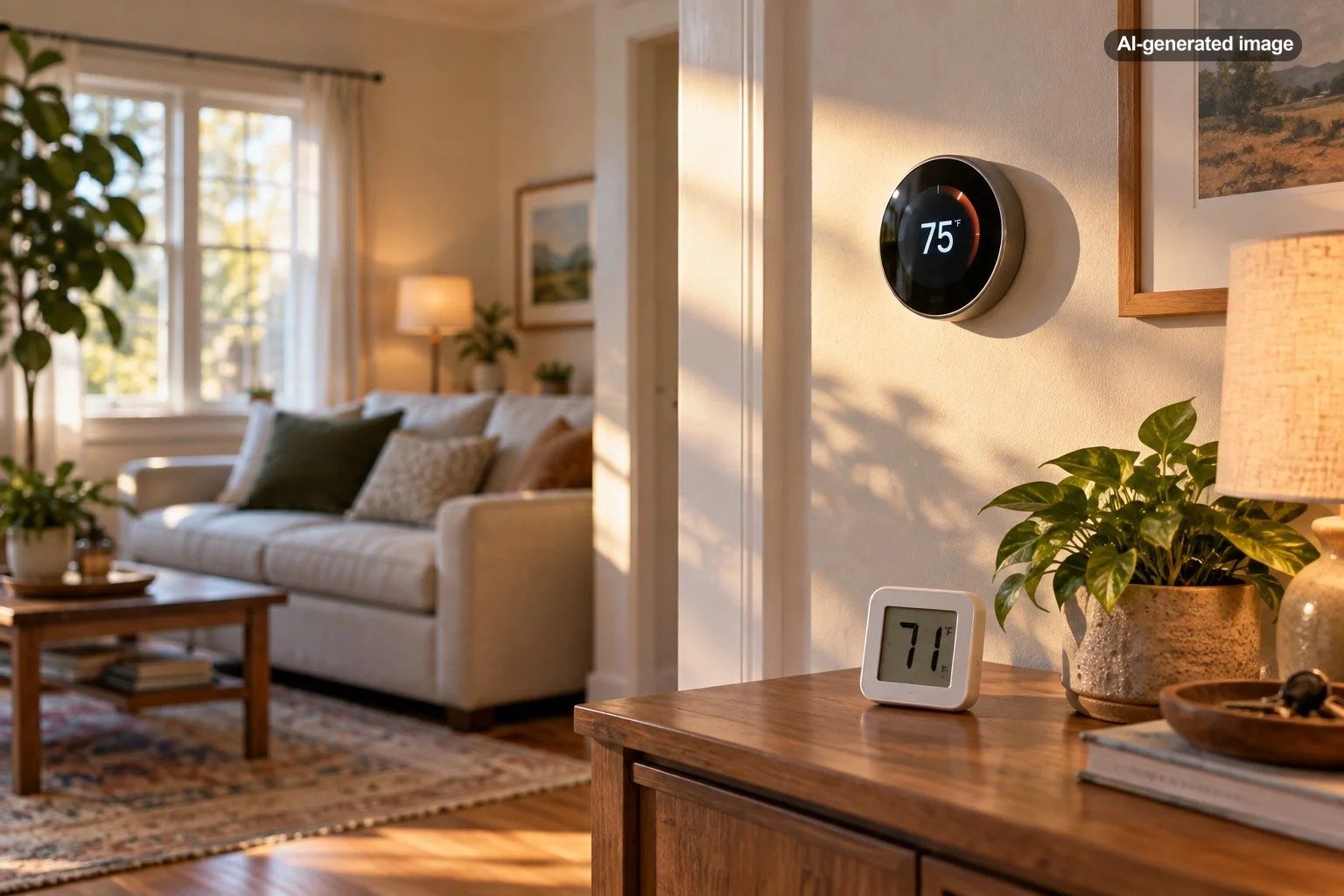
If your smart thermostat says the room is warmer than a separate thermometer does, the thermostat is not necessarily wrong. The two devices may be measuring genuinely different pockets of air, especially when they are mounted at different heights, placed on different walls, or exposed to different amounts of sunlight and airflow. A small, consistent difference can therefore be normal, while a large or changing difference is worth investigating.
The useful question is not simply which number looks right. It is whether both devices are being given a fair chance to measure approximately the same conditions, and whether the thermostat is controlling your heating or cooling in a way that keeps the occupied part of the room comfortable.
Why two temperature readings can be different
Indoor temperature is less uniform than a single number on a display suggests. Air near the ceiling may be warmer than air closer to the floor. A wall warmed by afternoon sun may create different conditions from an interior wall. Supply registers, exterior doors, kitchen appliances, electronics, windows, and poorly insulated surfaces can also affect the air immediately surrounding a sensor.
Google’s guidance for its temperature sensors notes that even different locations within the same room can produce different readings. The company recommends positioning compatible sensors around chest height and points out that window exposure, room orientation, ceiling height, drafts, heating vents, and other environmental factors can influence measured temperature.
That means a thermostat mounted in a hallway and a portable thermometer sitting on a coffee table are not necessarily measuring the same thing, even when they are only one room apart.
Start by comparing both devices in the same place
The most useful first test is to remove location from the equation. Place the room thermometer close to the thermostat, without blocking the thermostat or attaching anything directly to it. Give the thermometer enough time to settle after moving it.
What to do
- Move the portable thermometer near the thermostat at approximately the same height.
- Keep both away from direct sunlight, lamps, open windows, exterior doors, and active supply registers.
- Avoid comparing them immediately after carrying the thermometer from another room.
- Watch the readings during a period when the HVAC system and room conditions are relatively stable.
- Repeat the comparison at another time of day if sunlight or heating and cooling cycles may be influencing the wall.
If the readings become much closer when the devices share the same location, the original discrepancy was probably caused primarily by the room rather than by a failed sensor.
Your thermometer may be measuring a different part of the room
Height matters. Warm air often collects higher in a room, while cooler air can remain lower. A thermometer on a low table may therefore read differently from a wall-mounted thermostat several feet above the floor.
Horizontal position matters too. A thermostat on an interior hallway wall may experience comparatively stable air, while a thermometer beside a window may respond more strongly to outdoor conditions, solar gain, or drafts. Move that same thermometer to a bookshelf, desk, and exterior wall and you may see three somewhat different versions of the room temperature.
Sunlight and nearby heat can make the thermostat read warmer
A thermostat can also be influenced by its immediate surroundings. Direct sun on the thermostat or the wall around it can raise the local temperature. Nearby electronics, lighting, hot pipes, kitchen activity, or warm supply air may have a similar effect.
Google specifically warns against placing compatible temperature sensors near heating vents, stoves, hot water pipes, direct sunlight, poorly insulated walls, drafts, or locations that are unusually high or low in a room. Those examples illustrate why the environment around any temperature sensor deserves attention when readings seem suspicious.
Look at the room at the exact time the discrepancy appears. If the thermostat reads high only during late afternoon, sunlight may be involved. If the difference appears primarily while the heat is running, airflow or a nearby warm surface may deserve closer inspection.
The thermostat may be controlling from another sensor
Some smart thermostat systems can use remote room sensors. Depending on the model and configuration, the temperature shown or used for HVAC control may come from a selected remote sensor rather than from the thermostat’s own location. Other systems can prioritize different sensors according to a schedule.
Google documents this behavior for compatible Nest thermostat and temperature-sensor combinations. When a supported remote sensor is active, that sensor can provide the temperature used for heating or cooling decisions. Homeowners using other brands should check the manufacturer’s app and documentation because sensor behavior varies by system.
Display behavior can make small differences look more important
Consumer temperature devices do not always update or display measurements in exactly the same way. One may respond quickly to a passing draft while another changes more gradually. Displays can also present temperatures at different levels of precision.
This is why a single snapshot is less useful than a pattern. A difference that appears for a few minutes during an HVAC cycle is different from a persistent discrepancy that remains under stable conditions. Focus on repeated behavior rather than expecting two unrelated consumer devices to match at every moment.
Check whether the thermostat location represents the space you actually use
A perfectly functioning thermostat can still produce disappointing comfort if it is positioned in a part of the home that behaves differently from occupied rooms. ENERGY STAR notes that temperature sensors can help manage hot and cold spots caused by factors such as insulation and sun exposure. Google similarly explains that rooms can differ because of windows, insulation, room size, orientation, and the thermostat’s location.
If your thermostat is in a naturally warm hallway, for example, heating may stop while a nearby bedroom still feels cool. During cooling season, a thermostat in a naturally cool location can create the opposite problem. The thermostat may be reporting its own surroundings accurately while failing to represent the room you care about most.
In homes that routinely have large room-to-room differences, the underlying issue may involve airflow, insulation, duct distribution, zoning, solar exposure, or the building itself. A remote sensor may improve control in some compatible systems, but it does not physically correct those underlying differences.
When should you suspect an actual thermostat problem?
A thermostat deserves closer attention when a substantial difference remains after you have compared the devices at the same height and location under stable conditions. Other clues include readings that change erratically without an obvious environmental cause, HVAC operation that no longer corresponds sensibly with room conditions, or a problem that began suddenly after previously normal operation.
Before replacing anything, follow the troubleshooting instructions for your exact thermostat model. Manufacturer documentation may include model-specific diagnostic steps, sensor information, software settings, or installation requirements that do not apply universally.
Do you need a new smart thermostat?
Usually not simply because two thermometers disagree. Placement and room conditions should be investigated first. Replacement makes more sense when the thermostat is actually malfunctioning, is incompatible with the HVAC system, or no longer provides the control features you need.
Affiliate disclosure: CraneManor.com may earn a commission when you purchase through links on this page. This does not affect the price you pay. Learn more.
If replacement is already justified for other reasons, a compatible smart thermostat such as the Google Nest Thermostat is one option to consider. Verify compatibility with your HVAC equipment and wiring before purchasing or installing any thermostat; smart thermostats are not universally compatible with every system.
A practical way to decide what the difference means
Before you decide
- Compare both devices at the same height and location.
- Keep them away from direct sun, drafts, vents, lamps, appliances, and exterior doors during the comparison.
- Check whether a remote sensor is currently controlling the system.
- Look for a consistent pattern instead of judging one momentary reading.
- Consider whether the thermostat’s location represents the room where comfort matters most.
- Use model-specific manufacturer guidance before assuming the thermostat needs calibration, repair, or replacement.
Most thermostat-versus-thermometer disagreements become easier to understand once location is controlled. If the readings agree reasonably well side by side but separate again when the thermometer returns to another part of the room, you have learned something useful about the home’s temperature distribution. If the discrepancy remains persistent under comparable conditions, manufacturer troubleshooting or professional HVAC evaluation is the more sensible next step.
Frequently asked questions
Is a smart thermostat more accurate than a room thermometer?
Not automatically. Accuracy depends on the device, its condition, and where it is measuring. Two perfectly serviceable devices can show different numbers when exposed to different temperatures within the same room.
Should I put my room thermometer directly beside the thermostat?
For a temporary comparison, placing it nearby at approximately the same height can help. Do not cover the thermostat, rest the thermometer on it, or place either device where your test itself changes airflow or heat exposure.
Can direct sunlight make a thermostat read too high?
Yes. Direct sunlight can warm a sensor or the surrounding surface and make that location warmer than the rest of the room. Similar effects can occur near heating vents and other heat sources.
Can different rooms really be several degrees apart?
Yes. Window exposure, insulation, airflow, room size, floor level, orientation, and HVAC distribution can all create meaningful differences between rooms. A thermostat can accurately measure one location without describing every room in the home.