How Much Closet Space Should You Leave for Guests?
Guests usually do not need an entire empty closet. For most homes, leaving roughly one-quarter to one-third of a standard guest-room closet available is enough for a short visit, provided that space includes several empty hangers and an accessible shelf, drawer, or luggage surface. Longer visits call for more room, while a one- or two-night stay can work perfectly well with much less.
The better question is not how many feet of closet rod you can surrender. It is whether a guest has an obvious, convenient place to put clothing, shoes, luggage, and the few personal items they do not want scattered around the room.
Think in terms of a guest’s actual stay
A guest arriving Friday evening and leaving Sunday morning has very different storage needs from a relative staying for ten days. Designing the closet around the kinds of visits you actually host keeps you from sacrificing useful household storage unnecessarily.
| Typical stay | Useful closet allowance | What else helps |
|---|---|---|
| 1-2 nights | Several hangers and a small section of rod | Luggage rack, bench, hooks, or chair |
| 3-5 nights | About one-quarter to one-third of the closet | One drawer or shelf plus shoe space |
| One week or longer | About one-third to one-half when possible | Multiple drawers or shelves and an easy luggage location |
| Frequent long stays | Dedicated guest storage is preferable | Permanent wardrobe, dresser, or built-in section |
These are practical planning ranges rather than rigid design standards. A guest who travels with formal clothing may appreciate more hanging room, while someone arriving with a small carry-on may barely touch the closet.
Hanging space matters more than an empty-looking closet
A beautifully cleared closet is not especially useful if it contains two mismatched hangers and a rod blocked by storage bins. Prioritize a section that guests can reach without rearranging your belongings.
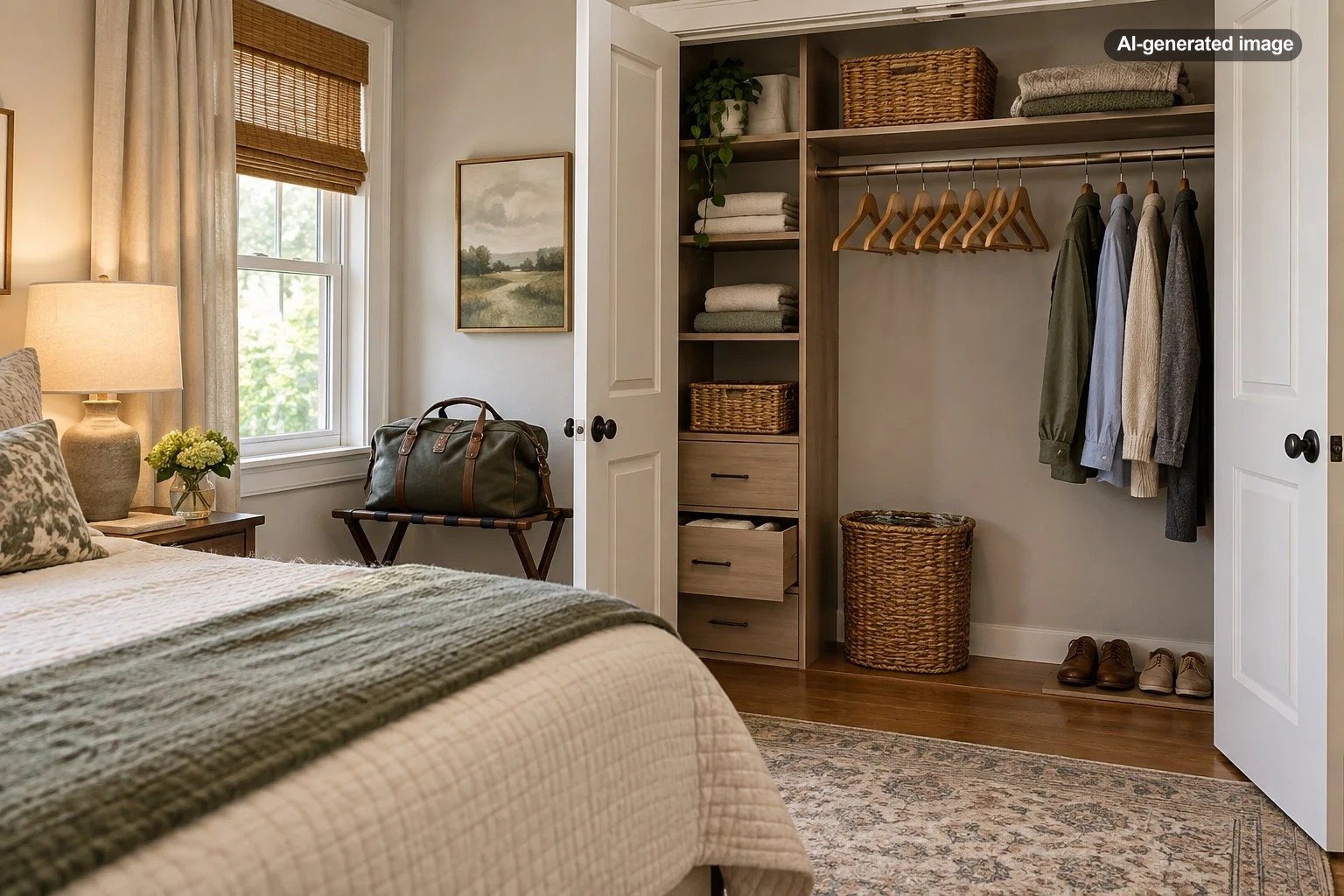
For most short visits, a modest run of open rod with six to ten hangers works well. Include a few hangers sturdy enough for jackets and trousers rather than filling the space entirely with thin specialty hangers. If the closet has double rods, the most convenient section should be the one you leave open.
Avoid making guests move your winter coats, vacuum cleaner, wrapping-paper collection, or boxes just to hang a shirt. Shared storage is perfectly reasonable; storage that requires excavation is less welcoming.
The best guest storage is not necessarily generous; it is obvious, accessible, and intentionally empty.
Give guests somewhere to put folded clothes
Closet rods solve only part of the problem. T-shirts, sleepwear, underwear, exercise clothes, and sweaters are often easier to manage on a shelf or in a drawer. If the room has a dresser, leaving one or two drawers empty can make a smaller closet feel much more functional.
If dresser space is unavailable, clear one reachable closet shelf. Baskets can work for casual storage, although guests should not need to guess which containers are available to them. An obviously empty basket or shelf is better than a beautifully labeled collection of household supplies occupying every surface.
For a room that doubles as an office, hobby room, or family storage area, a narrow freestanding wardrobe or compact garment rack can also provide guest storage without requiring the entire closet to remain empty year-round.
Do not forget the suitcase
A common guest-room mistake is creating ample clothing storage but no sensible place for luggage. The suitcase then ends up on the bed, floor, upholstered chair, or desk for the duration of the visit.
A luggage rack is convenient, but it is not essential. A sturdy bench, low console, cleared section of a dresser, or sufficiently large closet floor can serve the same purpose. What matters is keeping the suitcase off circulation paths and making it easy to open without taking over the bed.
Small guest rooms do not need conventional closets
A compact bedroom can still host comfortably even when the closet is tiny, full, or nonexistent. The key is to assemble several smaller storage options that perform the same jobs.
- Wall hooks: Useful for jackets, robes, handbags, and tomorrow’s outfit.
- Over-door hooks: Helpful where wall space is limited, provided the door can still close easily.
- A garment rack: A practical choice for rooms without built-in hanging storage.
- A small dresser: Particularly useful for guests staying more than a few nights.
- A bench or luggage stand: Gives suitcases a deliberate home.
- An open shelf: Works for folded clothing, shoes, or travel accessories.
This approach can actually be easier for guests because everything is visible. A deep closet packed with household storage may technically offer more cubic feet yet be less convenient than a few intentionally empty places around the room.
Reserve more space for the guests you host most often
Guest rooms work best when designed around real habits rather than an imaginary hotel standard. If parents visit for two weeks every winter, dedicated closet and drawer space is worthwhile. If friends usually stay one night after a dinner party, keeping half the closet perpetually vacant accomplishes very little.
Keep guest storage visually clear
Guests should be able to identify available storage without opening every drawer. Empty space communicates permission. A clear closet section, bare shelf, visibly empty drawer, or luggage rack makes it obvious where belongings can go.
If part of the closet remains dedicated to household storage, group those items together rather than interspersing them throughout the guest area. Storage bins on an upper shelf are unlikely to bother anyone. Personal papers, medications, valuables, or private belongings are better relocated before visitors arrive.
Lighting also matters. A closet that is dark or blocked by furniture may go unused even if plenty of space exists. Make sure the door opens freely and that guests can reach the rod, shelves, and floor without navigating stored objects.
What should stay out of the guest closet?
You do not need to strip the closet bare, but some categories deserve another home during a visit. Avoid leaving fragile items where luggage can knock into them, valuables in obvious locations, or anything you will repeatedly need to retrieve while the guest is staying.
Likewise, do not use the guest’s temporary closet section for things you expect to access every morning. Reaching around someone’s clothes for your coat, vacuum, or work bag makes the space feel borrowed rather than comfortably assigned.
Before guests arrive
- Clear several feet of reachable hanging space when possible.
- Provide enough empty hangers for the likely length of stay.
- Leave one shelf, drawer, or basket clearly available.
- Create a dedicated place for an open suitcase.
- Make sure closet doors and drawers operate freely.
- Remove private, fragile, or frequently needed belongings.
- Check that guests can reach storage without moving boxes or furniture.
Frequently asked questions
Should a guest-room closet be completely empty?
No. In most homes, that is unnecessary. It is perfectly reasonable for a guest closet to share space with linens, seasonal items, or household storage as long as guests have a clearly defined, easily accessible area of their own.
How many hangers should you leave for guests?
About six to ten empty hangers is comfortable for many short stays. Frequent long-term guests or visitors attending events that require several outfits may appreciate more.
What if there is no closet in the guest room?
Combine alternatives such as wall hooks, a garment rack, dresser drawers, shelving, and a luggage stand. Guests primarily need designated places for hanging garments, folded clothes, shoes, and their suitcase; those functions do not have to come from a built-in closet.
Is a dresser more useful than extra closet space?
It depends on the typical guest. For casual visits, one or two empty drawers can be more useful than a large amount of hanging space because much of modern travel clothing is folded. Ideally, offer at least a little of both.
How much space should you leave for long-term guests?
For stays of a week or more, giving guests roughly one-third to one-half of the closet plus meaningful drawer or shelf space is a comfortable target when the room allows it. For recurring extended visits, dedicated storage is worth considering.
Ultimately, hospitality is less about maintaining an empty guest closet than removing friction. A visitor who immediately sees where to hang a jacket, unpack a few clothes, place shoes, and open a suitcase will usually feel well accommodated even when the room still serves several purposes for the household.