Can a Robot Vacuum Handle Thick Area Rugs?
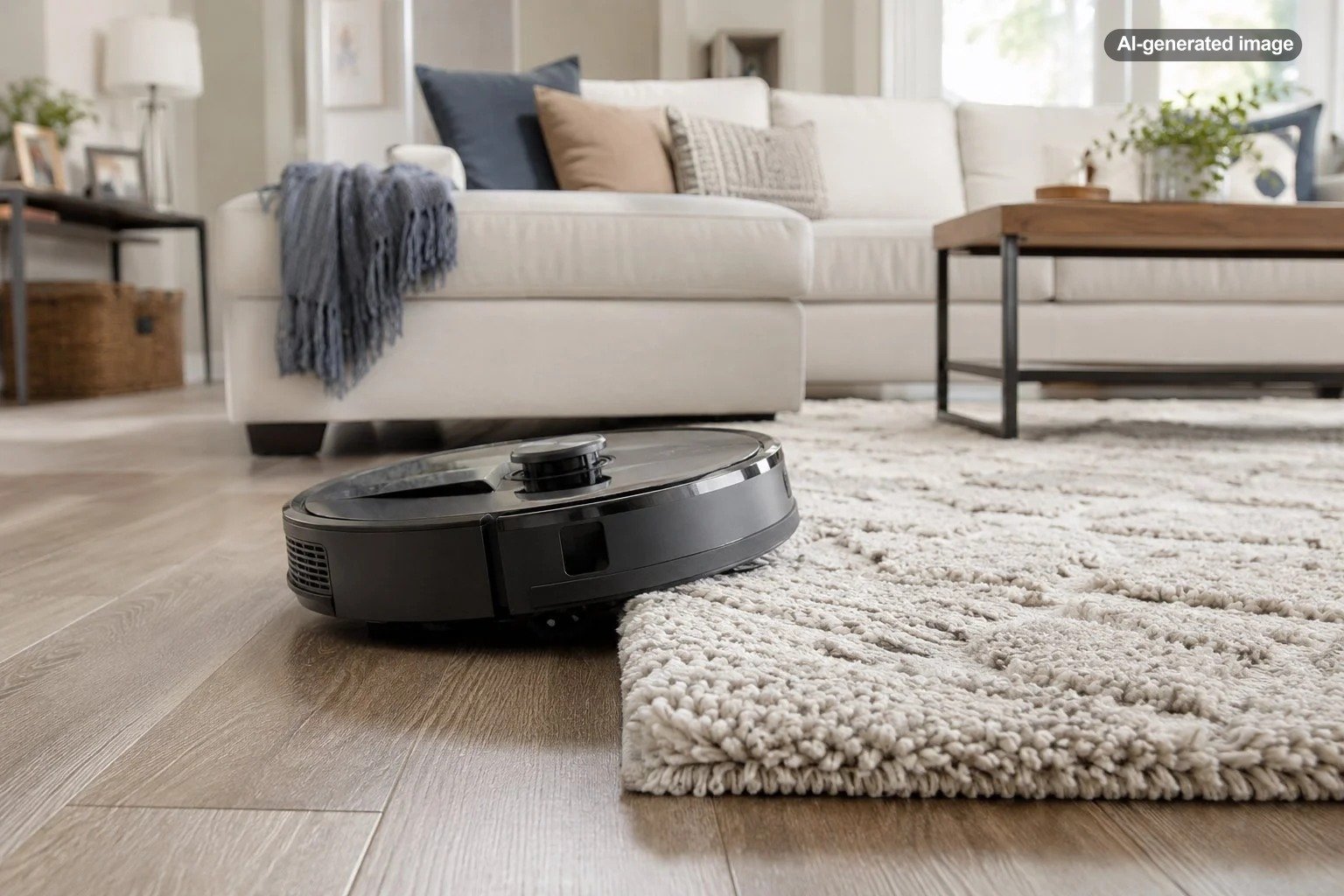
Yes, some robot vacuums can handle thick area rugs, but the answer depends as much on the rug as it does on the machine. A sturdy medium-pile rug with a low, firm edge is usually manageable. A plush shag rug, loosely woven wool rug, or tasseled runner can present several different problems at once.
The main question is not simply whether the vacuum has strong suction. It also needs enough wheel traction, clearance, brush control, and navigation intelligence to climb onto the rug, move through the pile, and leave again without swallowing fringe or becoming stranded.
What makes a thick rug difficult for a robot vacuum?
A human sees one area rug. A robot encounters several separate mechanical challenges: the raised edge, the change in surface resistance, the depth of the fibers, and anything loose enough to wrap around a roller.
The edge may be too steep
The vacuum must first climb from the surrounding floor onto the rug. A gradual bound edge is easier than a thick pad, curled corner, or abrupt border. Even a capable robot may repeatedly bump the edge, turn away, or climb with one wheel before sliding back down.
Deep pile creates drag
Long fibers press against the underside of the vacuum and resist its wheels. This can slow movement, reduce steering accuracy, or make the robot think it is trapped. The pile may also partially block the intake, particularly when the body sits low to the floor.
Loose fibers and fringe can wrap around brushes
Tassels, yarn loops, and long carpet fibers can wind around the main roller, side brush, or wheel axle. Anti-tangle designs may reduce the frequency of jams, but they do not make every fringe style safe for unattended cleaning.
Dark patterns can confuse some sensors
Some robot vacuums use downward-facing sensors to detect stairs and other drop-offs. Depending on the sensor design and rug pattern, very dark areas may occasionally be interpreted as a ledge. The result can be hesitation, incomplete coverage, or refusal to enter part of the rug.
The hardest rug is not always the thickest one; an unstable edge or loose fringe can matter more than pile height alone.
Which thick area rugs are most robot-friendly?
Rug labels do not always tell you whether a robot will clean successfully, so evaluate the physical construction instead. The most compatible rugs tend to share several traits.
| Rug characteristic | Likely robot-vacuum experience |
|---|---|
| Dense, short-to-medium pile | Usually easier to cross and navigate |
| Low, firmly bound edge | Provides a manageable transition from hard flooring |
| Heavy or well-anchored construction | Less likely to bunch, slide, or curl |
| Long shag or loose loops | Greater risk of drag and brush entanglement |
| Long fringe or tassels | Greater risk of wrapping around rollers |
| Thick rug pad beneath the edge | May create a transition the robot cannot climb |
A dense wool rug may be thick yet relatively stable under the wheels. A lighter synthetic rug with a curled edge may cause more trouble even if its pile is shorter. Likewise, a plush rug can be manageable in the center but inaccessible because the pad creates a tall perimeter.
Features that improve performance on rugs
When shopping for a robot vacuum in a rug-heavy home, focus on mechanical compatibility before app extras. Mapping and scheduling are useful, but they cannot compensate for a machine that physically cannot cross the rug.
Before you decide
- Strong drive wheels: Deep tread and responsive wheel suspension can improve traction and climbing.
- Useful ground clearance: The underside should move over the fibers without dragging excessively.
- Carpet detection: Some models recognize carpet and adjust suction or cleaning behavior automatically.
- Controllable brush system: Rubber rollers or accessible brush assemblies can simplify hair and fiber removal.
- No-go zones: App-based barriers let you exclude a troublesome rug without blocking the entire room.
- Obstacle recognition: Better navigation may reduce repeated encounters with curled corners, cords, and small objects near the rug.
Do not rely on suction power alone. Higher suction may improve debris pickup once the robot is on the rug, but traction and clearance determine whether it can move across the surface at all. It is also worth checking the manufacturer guidance for carpet type, threshold capability, brush use, and sensor limitations before purchasing.
How to test your rug safely
The first cleaning should be supervised. A robot that performs well on hard floors may behave differently when its wheels, brushes, and sensors encounter a deep textile surface.
What to do
- Remove cords, lightweight decor, pet toys, and anything else that could be pulled toward the rug.
- Tuck short fringe beneath the rug if it stays flat, or exclude long fringe from the cleaning path.
- Flatten curled corners and confirm that the rug pad does not protrude.
- Place the robot on the surrounding hard floor and let it approach the edge naturally.
- Watch whether it climbs cleanly, turns normally, and maintains steady movement through the pile.
- Inspect the roller, side brush, and wheels after the first pass for wrapped fibers.
- Confirm that the robot can exit the rug and return to its dock without assistance.
A successful climb is only the first test. Let the robot make several turns, travel along the border, and cross the rug in different directions. Problems often appear when one wheel reaches the edge before the other or when the side brush catches fringe during a turn.
Simple ways to improve compatibility
A few adjustments can make a borderline rug easier to clean without replacing either the rug or the vacuum.
- Use a proper nonslip pad. A rug that stays flat is less likely to bunch beneath the wheels. Keep the pad fully concealed so it does not create an extra ledge.
- Secure curling corners. Rug-safe corner grippers can create a flatter approach, provided they are suitable for both the rug backing and the floor finish.
- Manage the fringe. Carefully tuck it under, secure it in a rug-safe manner, or create a no-go boundary along that edge.
- Clean the robot more frequently. Thick rugs, pet hair, and long fibers can fill rollers and filters faster than hard-floor debris.
- Schedule separate zones. Cleaning the rug as its own mapped area can make it easier to observe performance and adjust settings.
Avoid improvised fixes that could damage the rug or floor, such as aggressive tape, exposed adhesive, or bulky objects positioned as barriers. A software boundary or purpose-made rug accessory is usually neater and more predictable.
When a robot vacuum is not the right tool
Some rugs are better maintained with a conventional vacuum, a suitable upholstery tool, or professional cleaning. This is especially true for delicate, antique, hand-knotted, loosely woven, heavily fringed, or unusually deep-pile rugs.
Follow the rug maker’s care instructions before using any powered brush. Rotating rollers may be inappropriate for certain loops, fibers, trims, or handmade details. If the rug begins shedding heavily, develops pulled loops, or shows visible distortion, stop using the robot on that surface.
There is no advantage in forcing full automation where it risks damaging a valuable rug. A practical compromise is to let the robot maintain the surrounding hard floors daily while giving the rug more deliberate attention with the cleaning method recommended for its construction.
Frequently asked questions
Can a robot vacuum clean a shag rug?
Some can move over shorter, dense shag, but long or loose shag presents a high risk of drag and entanglement. Supervise a test and stop immediately if fibers wrap around the brush or wheels.
Will a robot vacuum damage rug fringe?
It can. Fringe may be pulled, tangled, or wrapped around moving parts. Tuck manageable fringe securely beneath the rug or use a no-go zone to keep the robot away from the edge.
Why does my robot vacuum avoid a dark rug?
Its downward-facing sensors may interpret a very dark section as a drop. Check the manufacturer’s troubleshooting guidance rather than covering or disabling safety sensors.
Does more suction make a robot better on thick carpet?
It can improve debris pickup, but it does not guarantee mobility. Wheel traction, ground clearance, brush design, and the height of the rug edge are equally important.
Should I remove the rug pad?
Not necessarily. A well-fitted nonslip pad can help keep the rug flat. The problem arises when the pad is too thick, extends beyond the rug, or creates an abrupt edge the robot cannot climb.
The practical verdict
A robot vacuum can handle many thick area rugs, particularly those with dense pile, stable backing, low edges, and little or no fringe. Performance becomes less predictable as the pile grows longer, the rug becomes softer, or the perimeter becomes taller and less stable.
Judge the pairing as a complete system: robot, rug, pad, edge profile, room layout, and cleaning settings. A supervised test will tell you more than the word thick ever could. When the combination works, automated cleaning can keep surface dust, crumbs, and pet hair under better control. When it does not, mapping the rug as a no-go zone is a sensible solution, not a defeat.