Why Does My Garage Smell Damp After a Storm?
A garage that smells damp after a storm is usually telling you that moisture entered the space, lingered in the air, or soaked into something porous. The cause may be as simple as wet tires and humid outdoor air, but a persistent musty odor can also point to seepage around the garage door, roof or wall leaks, condensation, poor drainage, or damp cardboard and stored fabrics.
The useful question is not simply how to cover the smell. It is where the moisture came from, what became wet, and whether the garage is drying promptly afterward.
Why storms make garage odors suddenly noticeable
Garages often have less climate control and air circulation than the living areas of a house. During and after heavy rain, outdoor humidity rises, vehicles bring water inside, concrete surfaces may stay cool, and small leaks that are invisible in dry weather can become active.
Porous materials make the effect more obvious. Cardboard, unfinished wood, fabric, paper, rugs, drywall, and upholstered items can absorb moisture and release a stale or musty odor as humidity rises. A closed garage can hold that odor long after visible puddles have disappeared.
The U.S. Environmental Protection Agency emphasizes that moisture control is the key to controlling indoor mold. It also notes that water-damaged materials should generally be dried promptly, ideally within 24 to 48 hours, because prolonged dampness supports mold growth.
Start with the simplest explanation: something is still wet
Before assuming you have a hidden building problem, look for ordinary storm-related moisture. Wet floor mats, umbrellas, sports gear, gardening supplies, pet equipment, vehicle carpets, and damp cardboard can make an otherwise dry garage smell surprisingly musty.
What to do
- Move vehicles and portable items so you can see the floor and lower walls.
- Pick up cardboard, rugs, fabric bins, paper bags, and anything else that can retain water.
- Check beneath stored items rather than inspecting only what is visible from above.
- Feel for dampness along the bottom edges of walls and around the garage-door opening.
- Allow safe ventilation when weather conditions permit, or use appropriate dehumidification to help the space dry.
If removing one damp item causes the odor to fade within a day or two, the problem may have been localized. If the smell returns after every substantial rain, keep looking.
Check the garage door and threshold for wind-driven rain
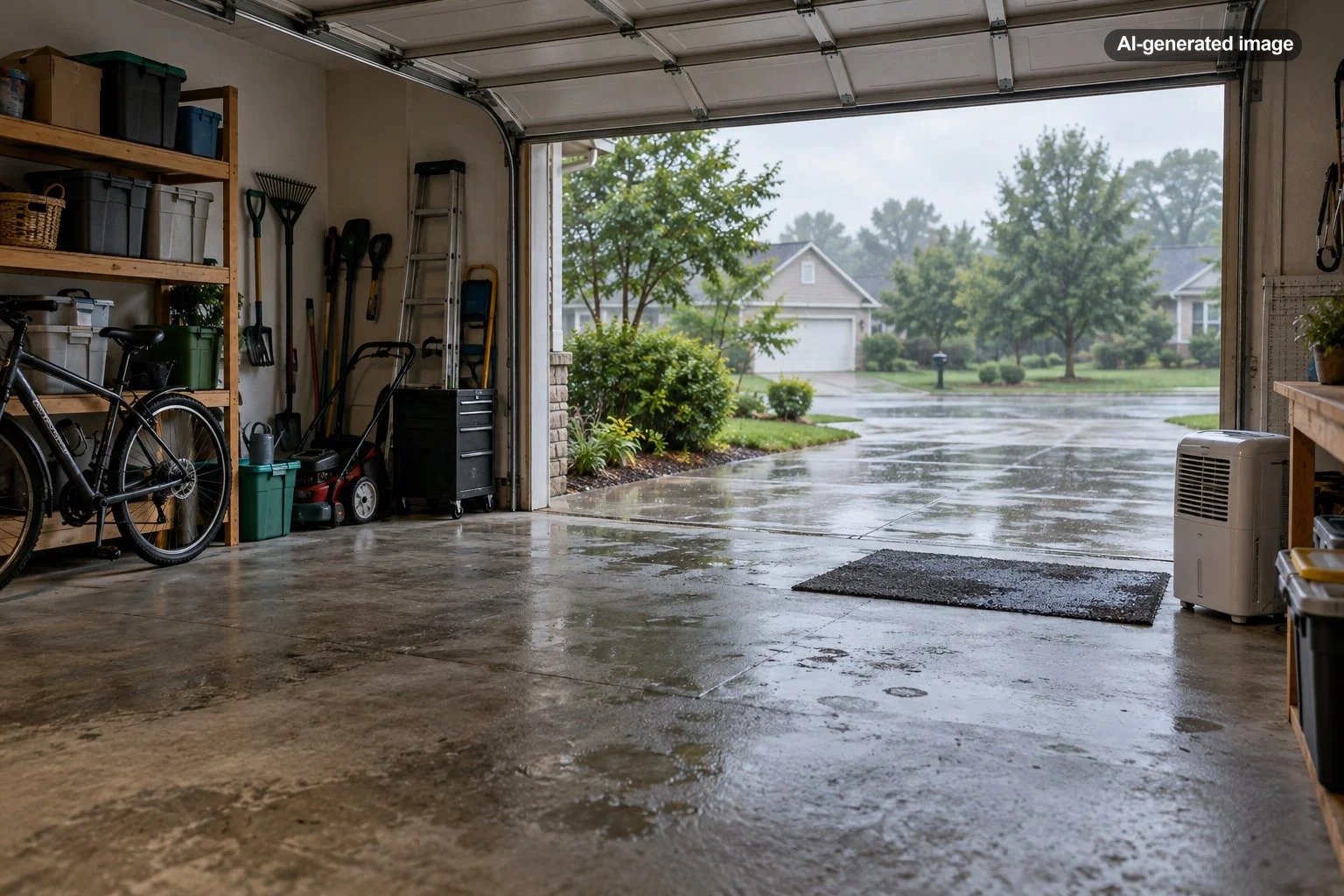
The garage-door opening is one of the most obvious places for storm water to enter. Look for water marks, grit, leaves, or darkened concrete near the bottom seal and corners. These small clues can reveal where water traveled even after the floor has dried.
A worn bottom seal, uneven floor, deteriorated side weatherstripping, or rain driven against the door can allow small amounts of water inside. The amount may be too limited to create a dramatic puddle while still being enough to damp stored boxes or wall materials.
Inspect the roof, ceiling, walls, and penetrations
If the smell is strongest away from the garage door, inspect overhead and around exterior-wall penetrations. Look for ceiling discoloration, softened drywall, peeling paint, staining around windows, damp framing, or moisture near plumbing and utility penetrations.
Do not assume the wet spot is directly below the exterior entry point. Water can travel along framing, sheathing, pipes, fasteners, and other surfaces before becoming visible inside.
Repeated ceiling or wall dampness deserves more attention than a one-time wet floor. Roofing, flashing, exterior wall, and concealed moisture problems can require professional evaluation, especially when the entry path is not obvious.
Look outside for drainage clues
Sometimes the garage is merely the place where an exterior drainage problem becomes visible. After rain, walk around the outside perimeter and see where the water actually goes.
According to EPA moisture-control guidance, maintaining gutters, directing downspouts away from the building, and ensuring the ground carries water away from the foundation are important parts of keeping excess moisture out of buildings.
- Check whether gutters are overflowing or downspouts are discharging beside the garage.
- Look for puddling against the foundation or garage slab.
- Notice whether landscaping or soil directs water toward the structure rather than away from it.
- Inspect exterior cracks and deteriorated sealant where different materials meet.
- Pay attention to low areas beside the garage that remain saturated long after rainfall stops.
Consider humidity and condensation
Not every damp smell means rainwater is physically leaking through the building envelope. A storm can bring very humid air into a garage, and humid air can condense on cooler surfaces.
The EPA recommends keeping indoor relative humidity below 60 percent when possible, with roughly 30 to 50 percent being an ideal range for many indoor environments. A basic humidity meter can help you distinguish a persistently humid garage from one with a localized leak.
If humidity rises sharply during wet weather but you cannot find any water entry, improving air movement or using a properly maintained dehumidifier may help. However, dehumidification should not be used as a substitute for repairing an actual leak or drainage problem.
Do not overlook storage against concrete or exterior walls
Garages tend to accumulate exactly the materials that dislike damp conditions: moving boxes, paper records, seasonal decorations, textiles, unfinished wood, and seldom-used furniture.
Items stored directly on a concrete floor or pressed tightly against exterior walls may stay damp longer because air cannot circulate around them. Raising moisture-sensitive storage off the floor and leaving modest airflow around exterior walls makes future problems easier to notice and reduces the chance that one damp box turns into a whole-garage odor.
Plastic storage bins can protect contents from incidental floor moisture, but they should not be used to conceal an unresolved water-entry problem underneath them.
When a musty odor deserves closer investigation
A musty smell does not by itself prove that there is extensive mold behind the walls. Still, the EPA notes that a moldy odor can indicate mold growth and should be investigated rather than simply covered with fragrance.
Likewise, if you repeatedly clean a surface but the odor returns after every storm, the moisture source probably has not been corrected. Mold cleanup without moisture correction is unlikely to solve the underlying problem.
A practical order for troubleshooting the smell
Working from simple causes toward more complicated ones can keep the investigation manageable.
Before you decide
- Remove or dry obviously wet belongings first.
- Inspect the garage-door threshold immediately after rain.
- Look beneath boxes, shelving, mats, and stored equipment.
- Check ceilings, exterior walls, windows, and utility penetrations for staining or dampness.
- Walk outside and examine gutters, downspouts, grading, and areas where water collects.
- Measure humidity if no direct leak is apparent.
- Escalate to professional evaluation when moisture keeps returning or concealed damage seems likely.
The timing of the odor is one of your best clues. If the garage smells normal during dry weather and damp after every storm, document exactly what changes while it is raining. A few minutes of inspection during wet conditions can reveal more than an hour spent searching several sunny days later.
How to make the garage less prone to damp smells
Once the immediate cause has been identified, prevention becomes much simpler. Keep moisture-sensitive storage off the slab, replace deteriorated weather seals as appropriate, maintain gutters and drainage, allow wet equipment to dry before putting it away, and avoid packing exterior walls so tightly that moisture goes unnoticed.
For garages that naturally experience humid conditions, monitor humidity instead of relying on smell alone. The goal is not to make a garage behave like a climate-controlled living room. It is to prevent water from lingering long enough to damage materials or create recurring biological growth.
A damp smell is most useful when you treat it as a moisture clue, not merely an odor problem.
Frequently asked questions
Can a concrete garage floor cause a damp smell?
Concrete itself can feel cool and contribute to condensation under humid conditions, and moisture can sometimes be present around or beneath stored items on the slab. The important step is determining whether the moisture is coming from humid air, surface water entering from outside, or another building-related source.
Will opening the garage door get rid of the smell?
Ventilation may help when outdoor conditions are drier than the garage, but opening the door during very humid weather can bring in additional moisture. Ventilation also does not correct leaks, drainage problems, or wet porous materials.
Should I run a dehumidifier in my garage?
A dehumidifier can be useful in an enclosed garage with persistently elevated humidity, provided the unit is suitable for the conditions and maintained properly. First rule out active water intrusion, because dehumidification should complement moisture control rather than replace it.
Does a musty odor automatically mean mold?
No. Damp cardboard, wet fabrics, soil, standing water, and humid materials can create stale odors. However, the EPA advises investigating moldy odors because they can indicate hidden mold growth.
What should I check first after the next storm?
Inspect the garage while it is still raining or immediately afterward. Start at the door threshold and floor perimeter, then check stored items, lower walls, ceiling surfaces, windows, and the exterior drainage around the garage.
Sources & further reading
- U.S. Environmental Protection Agency: A Brief Guide to Mold, Moisture and Your Home
- U.S. Environmental Protection Agency: What does mold smell like?
- U.S. Environmental Protection Agency: Indoor Air Quality and Changing Outdoor Environments
- U.S. Environmental Protection Agency: Biological Contaminants and Indoor Air Quality