
What Size Chandelier Works Over a 72-Inch Dining Table?
For a 72-inch dining table, a chandelier about 24 to 30 inches wide is a reliable starting point if you are choosing a round, square, or compact statement fixture. For a linear chandelier, look for a fixture approximately 36 to 48 inches long. These ranges usually create enough presence to anchor a six-foot table without crowding the diners seated beneath it.
The table’s length is only part of the calculation. Its width, the chandelier’s visual weight, the ceiling height, and the room around the table can all shift the ideal size. A delicate open-frame fixture may need to be slightly larger than a dense chandelier with dark metal, multiple tiers, or large opaque shades.
Start With the Table’s Width, Not Just Its Length
A chandelier should relate to the surface directly below it. For round and compact fixtures, a useful design guideline is to choose a diameter measuring roughly one-half to two-thirds of the table’s width.
Many 72-inch rectangular dining tables are approximately 36 to 42 inches wide. Applying that guideline produces a chandelier diameter of about 18 to 28 inches. In practice, the upper half of that range often looks more convincing over a six-foot table, which is why a 24- to 30-inch chandelier is such a practical target.
A chandelier smaller than about 20 inches may look underscaled unless it has a strong silhouette, hangs in a compact room, or is used as one of two matching fixtures. A chandelier wider than 30 inches can work, but its edge should remain comfortably inside the table’s perimeter so that it does not feel intrusive when people stand, sit, or lean across the table.
| Fixture style | Useful starting size | Best suited to |
|---|---|---|
| Round chandelier | 24-30 inches wide | Traditional, transitional, and centered dining rooms |
| Compact geometric fixture | 24-32 inches wide | Open frames and visually light designs |
| Linear chandelier | 36-48 inches long | Rectangular tables and contemporary rooms |
| Two smaller pendants | Approximately 14-20 inches each | Long tables, flexible placement, and balanced repetition |
Choose a Linear Chandelier for a Stronger Relationship to the Table
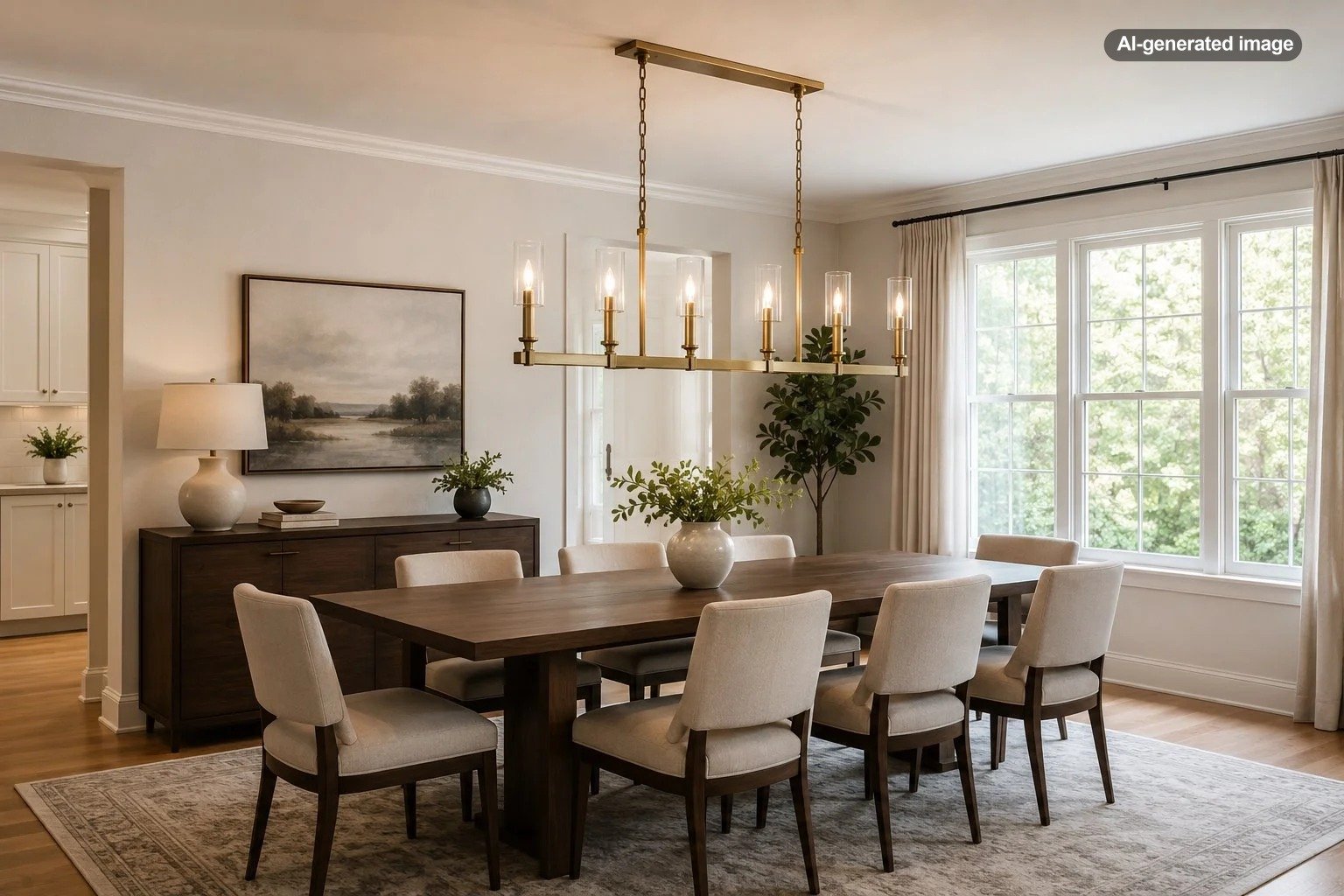
A linear chandelier often looks especially natural over a 72-inch rectangular table because its shape follows the table’s length. A fixture between 36 and 48 inches long generally occupies enough of the table to feel intentional while leaving visual breathing room at both ends.
A 36-inch fixture produces a quieter, more compact effect. It works well in a narrower dining room, over a table with visually prominent end chairs, or when the chandelier has large shades or a heavy frame. A 42- to 48-inch fixture has more architectural presence and can suit an open-plan room where the dining area needs a stronger visual boundary.
Width still matters. Many linear fixtures between 12 and 18 inches wide sit comfortably above a table that is 36 to 42 inches wide. A much wider fixture may appear to hover over the diners rather than over the center of the table.
The best chandelier looks connected to the table without appearing to occupy the diners’ personal space.
Account for Visual Weight
Measurements describe physical size, but visual weight determines how large a chandelier feels. Two fixtures with identical dimensions can have remarkably different effects.
An airy chandelier with thin arms, clear glass, or an open metal frame may tolerate a larger diameter because much of the room remains visible through it. A dense fixture with a dark finish, oversized globes, fabric shades, or several tiers can feel larger than its listed measurements suggest.
Consider sizing toward the lower end of the range when the chandelier has:
- Large opaque shades
- A heavy black, bronze, or solid wood frame
- Multiple tiers or closely grouped bulbs
- Long decorative branches extending toward seated guests
Consider the upper end when the fixture has:
- Clear glass or crystal elements
- A slim, open framework
- Minimal arms and generous negative space
- A pale finish that blends into the room
Hang the Chandelier at the Right Height
For an eight-foot ceiling, begin with the lowest point of the chandelier approximately 30 to 36 inches above the tabletop. This keeps the fixture low enough to connect visually with the table while preserving conversation and sightlines.
With a ceiling higher than eight feet, the chandelier can usually be raised modestly. The exact adjustment depends on the fixture’s height, the room’s proportions, and whether the chandelier is primarily decorative or provides task lighting. A tall, multi-tier fixture may need more clearance than a shallow linear model.
Before final installation, sit in each chair and check whether the chandelier blocks faces, artwork, windows, or a view into the adjoining room. Also confirm that light sources are not directly at eye level. Exposed bulbs can create uncomfortable glare even when the fixture itself is beautifully proportioned.
What to do
- Measure the table’s full length and width.
- Mark the chandelier’s proposed dimensions with painter’s tape or a cardboard template.
- Center the template over the table, not automatically in the room.
- Test a hanging height between 30 and 36 inches above the tabletop.
- Sit in every chair and check sightlines before committing to the final height.
Center the Fixture Over the Table
The chandelier should normally be centered over the dining table rather than centered within the room. This distinction matters when the table is shifted to accommodate a sideboard, doorway, fireplace, or traffic path.
If the existing ceiling box is centered in the room but the table is not, blindly using the box can make the entire arrangement look slightly unsettled. A qualified electrician can advise on appropriate options for relocating the connection or using a fixture installation method suited to the ceiling and chandelier.
Do not assume a decorative hook or improvised anchor can support a heavy fixture. The mounting method must be appropriate for the chandelier’s actual weight and the structure above it.
Adjust for the Dining Room Around the Table
The table remains the primary reference, but the surrounding room provides context. A 24-inch chandelier may feel generous in a compact enclosed dining room and surprisingly small in an open-plan space with tall ceilings.
Size toward 24 inches when the room is narrow, the ceiling is eight feet, or the fixture has a dense silhouette. Move toward 28 to 30 inches when the dining zone is spacious, the chandelier is visually light, or the room contains large-scale furniture and artwork.
In a room with a very high or vaulted ceiling, increasing only the chandelier’s width may not be enough. A taller body, longer suspension, or layered design can help fill the vertical space while keeping the fixture’s horizontal dimensions appropriate for the table.
Common Sizing Mistakes
One frequent mistake is choosing the chandelier according to the room dimensions while ignoring the table. A fixture can suit the room in theory yet extend too close to the table’s sides or look disconnected from the furniture below.
Other common problems include:
- Going too small: A petite fixture can make a six-foot table feel visually unsupported.
- Ignoring the chandelier’s depth: Wide shades and branching arms may intrude even when the listed diameter seems reasonable.
- Hanging it too high: The chandelier may read as general ceiling lighting rather than part of the dining composition.
- Hanging it too low: Diners may lose comfortable sightlines or feel crowded by the fixture.
- Centering it in the room: The light and table can appear misaligned when the furniture layout is intentionally off-center.
Before you decide
- Confirm the table’s width as well as its 72-inch length.
- Choose 24-30 inches for most round chandeliers.
- Choose 36-48 inches for most linear chandeliers.
- Allow extra size for airy, open designs.
- Reduce the size for dense or heavily shaded fixtures.
- Check the fixture’s total height against the ceiling.
- Verify the mounting location and support requirements.
Frequently Asked Questions
Is a 36-inch chandelier too large for a 72-inch table?
A 36-inch round chandelier may be too wide for a typical 36-inch-wide table because its edges would align with the table’s edges. It can work over an unusually wide table or when the fixture is extremely open and delicate, but 24 to 30 inches is generally easier to proportion. A 36-inch linear chandelier, however, is a comfortable size for a 72-inch-long table.
Can I use two chandeliers over a 72-inch table?
Yes. Two smaller pendants or chandeliers can create an attractive rhythm, particularly when the fixtures are narrow. Space them evenly along the table and treat the pair as one composition rather than sizing each fixture as though it were the only light.
Should the chandelier be narrower than the dining table?
Yes. Keeping the chandelier narrower than the tabletop helps preserve visual balance and reduces the chance that the fixture will feel intrusive near diners’ heads and shoulders.
Does the chandelier need to match the table’s shape?
No, but matching shapes can simplify the composition. Linear chandeliers naturally complement rectangular tables, while round chandeliers create a pleasing contrast and can soften a room filled with straight lines.
What is the safest default size?
For a typical 72-inch rectangular table, a round chandelier about 26 to 28 inches wide or a linear chandelier about 42 inches long is a balanced middle-ground choice. Final sizing should still account for the table’s width, ceiling height, and the fixture’s visual density.