
How Far Should Side Tables Be From a Sofa?
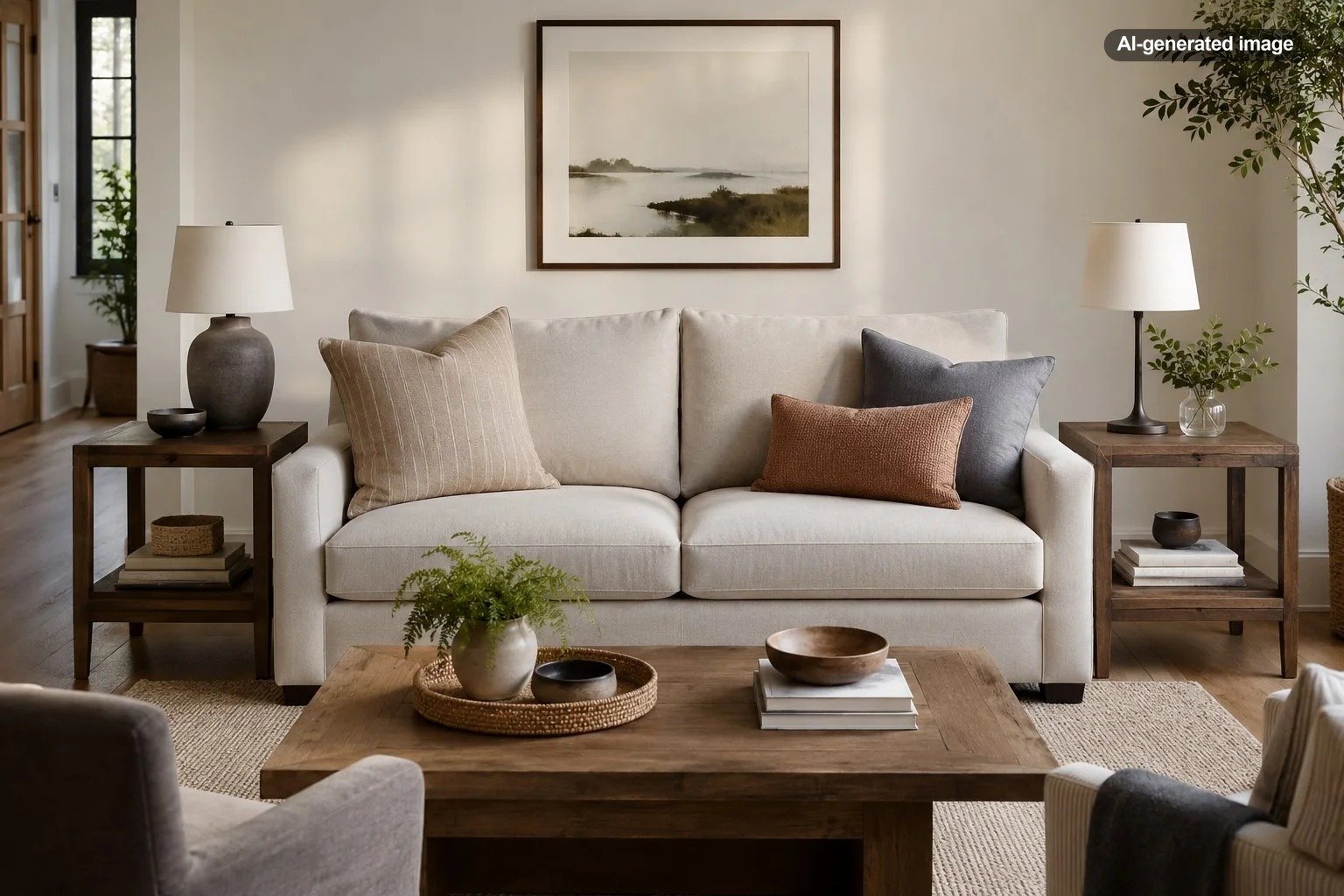
Side tables usually look and function best when they sit about 1 to 3 inches from the sofa arm. That small gap keeps the pieces visually connected while preventing them from looking jammed together. You can place a table slightly farther away when the sofa has wide arms, the table has an unusual base, or extra clearance makes the seating more comfortable.
The exact distance matters less than whether someone seated on the sofa can easily reach a drink, lamp switch, remote, or book without leaning awkwardly. Side-table placement is ultimately a combination of reach, proportion, and traffic flow rather than a single rigid measurement.
Why a small gap usually looks better
A side table is meant to feel like part of the seating arrangement. When it sits several inches away from the sofa for no practical reason, the arrangement can look disconnected and the tabletop becomes less convenient to use. Push it directly against the upholstery, however, and the setup can feel cramped.
A narrow gap creates a subtle visual separation between the two pieces. It also gives you a little room for upholstery, throws, charging cords, or a sofa arm that curves outward instead of dropping straight to the floor.
There is no need to measure the gap obsessively. If the table feels comfortably within reach and the pieces are not rubbing against each other, you are probably in the right range.
The best side-table placement is close enough to use effortlessly but loose enough to let each piece breathe.
Match the table height to the sofa arm
Horizontal distance is only half the equation. A side table that sits at an awkward height can be inconvenient even when it is perfectly positioned beside the sofa.
As a useful rule, aim for a tabletop that is roughly level with the sofa arm or within about 2 inches above or below it. A slightly lower table is often comfortable because your hand naturally moves downward when setting down a glass or phone. A significantly taller table can make the same motion feel less natural.
Do not choose height by sofa seat height alone. Sofa arms vary considerably, particularly among low-profile contemporary sofas, rolled-arm traditional styles, and modular seating. Measure from the floor to the top of the arm where the table will sit, then compare that measurement with the table’s overall height.
What to measure
- Measure from the floor to the top of the sofa arm.
- Measure the available floor space beside the sofa.
- Check how far the table would extend toward the front of the sofa.
- Confirm that someone seated nearby can comfortably reach the center of the tabletop.
- Check the remaining walking clearance around the arrangement.
Pay attention to the table’s depth
A table can be the correct distance from the sofa and still look wrong if it is disproportionately deep. In many rooms, a side table looks most balanced when its front edge finishes around the front portion of the sofa arm rather than projecting far into the walking area.
For a deep sofa, a larger rectangular end table may feel appropriately substantial. Beside a compact apartment sofa, that same piece may look oversized. Round pedestal tables and small drink tables can be especially useful when floor space is tight because their footprint is visually lighter and easier to move around.
If you are choosing between two sizes, think about what the surface must actually hold. A lamp, coaster, and book require more usable area than a table intended mainly for a phone and occasional drink.
Leave enough room for people to walk past
If the side of the sofa borders a passage, traffic flow takes priority over ideal table placement. A side table should not turn an otherwise usable route into an obstacle course.
As a practical planning target, try to preserve roughly 30 inches of passage space where people regularly need to walk between furniture pieces. Some rooms will offer more, while compact rooms may offer less. The important point is to look at the table as part of the entire circulation path rather than judging it only in relation to the sofa.
When clearance is tight, consider a narrower table, a small pedestal table, nesting tables, or even a floor lamp instead of a full-size end table. Removing one table can sometimes make a small living room feel noticeably calmer and easier to navigate.
Should both sides of the sofa have matching tables?
No. Symmetry can look polished, particularly in a formal living room, but matching tables are not required. Different tables can work beautifully when their visual weight and heights feel compatible with the sofa.
For example, one side might hold a larger table with a reading lamp while the opposite side uses a smaller round table. The tables do not need identical dimensions, finishes, or shapes. What matters is that each one makes sense for the person sitting beside it and does not make one side of the sofa feel dramatically heavier than the other.
If you do use matching tables, place each with roughly the same relationship to the sofa arm. Small differences in spacing are rarely noticeable, but obviously different gaps can make an otherwise symmetrical setup appear slightly off.
How lamps and decor affect the spacing
A side table is often asked to do several jobs at once: hold a lamp, provide a landing spot for drinks, display a decorative object, and occasionally accommodate a charger or book. Those objects should influence both table size and placement.
If the table holds a lamp, make sure the lamp does not interfere with someone sitting down or standing up. A very broad lamp shade may require moving the table slightly outward, even if the base itself fits neatly beside the sofa arm. Likewise, a trailing electrical cord may determine which side of the sofa offers the most practical location.
Keep the tabletop relatively restrained. A lamp plus one or two smaller objects often looks more intentional than filling every available inch. Decorative greenery, a small bowl, or a stack of books can add personality without compromising the surface’s practical purpose.
What changes in a small living room?
Small rooms reward flexibility. Instead of trying to fit a traditional end table on both sides of a sofa, decide where a table is actually useful. One properly scaled side table may be enough.
A narrow C-shaped table can provide a convenient surface without occupying much space beside the sofa, while nesting tables can stay compact most of the time and expand when guests need additional surfaces. A small round table can also soften a room dominated by rectangular furniture and reduce the number of corners projecting into circulation space.
Common side-table placement mistakes
The most common mistake is choosing the table first and worrying about measurements afterward. A piece can look perfectly sized in a showroom or online photograph yet overwhelm a narrower sofa or smaller room.
- Leaving too large a gap: The table feels disconnected and may be difficult to reach.
- Pushing the table hard against the sofa: Upholstery can look compressed, and the arrangement may feel crowded.
- Using a table that is much taller than the sofa arm: Everyday objects become less comfortable to reach.
- Letting a deep table jut into a walkway: The room may look balanced from one angle but function poorly in daily use.
- Overdecorating the tabletop: A side table should still have room for the things people actually need while seated.
Before you decide
- Start with roughly 1 to 3 inches between the table and sofa.
- Keep the tabletop close to the sofa arm height.
- Make sure the table can be reached without leaning.
- Check that its depth does not intrude into circulation space.
- Allow enough clear surface for a drink, book, lamp, or other everyday use.
- Choose a smaller or more flexible table when the room is tight.
FAQ
Can a side table touch the sofa?
It can, but a small gap usually looks more intentional and reduces the chance of the table rubbing against upholstery. If space is extremely tight, placing the table close to the sofa is perfectly workable as long as neither piece is being compressed or damaged.
Is 6 inches too far from a sofa?
Six inches is farther than necessary in many layouts, but it is not automatically wrong. A wider gap can make sense if the sofa has a sweeping arm, the table has an unusual base, or the placement improves circulation. Test whether the table still feels comfortably reachable from a normal seated position.
Should a side table be level with the sofa arm?
That is a useful target. A table approximately level with the arm, or within about 2 inches above or below it, generally feels visually balanced and easy to use.
Should the side table line up with the front of the sofa?
It does not need to align perfectly, but avoiding excessive projection usually creates a cleaner arrangement. If the table extends well past the sofa, make sure it is not obstructing the natural walking path.
Do you need a side table on each end of a sofa?
No. Use as many tables as the room and seating habits justify. One table, two different tables, a table paired with a floor lamp, or no side table at all on one end can all work when the arrangement remains practical and visually balanced.