What Size Rug Should Go Under a Dining Table?
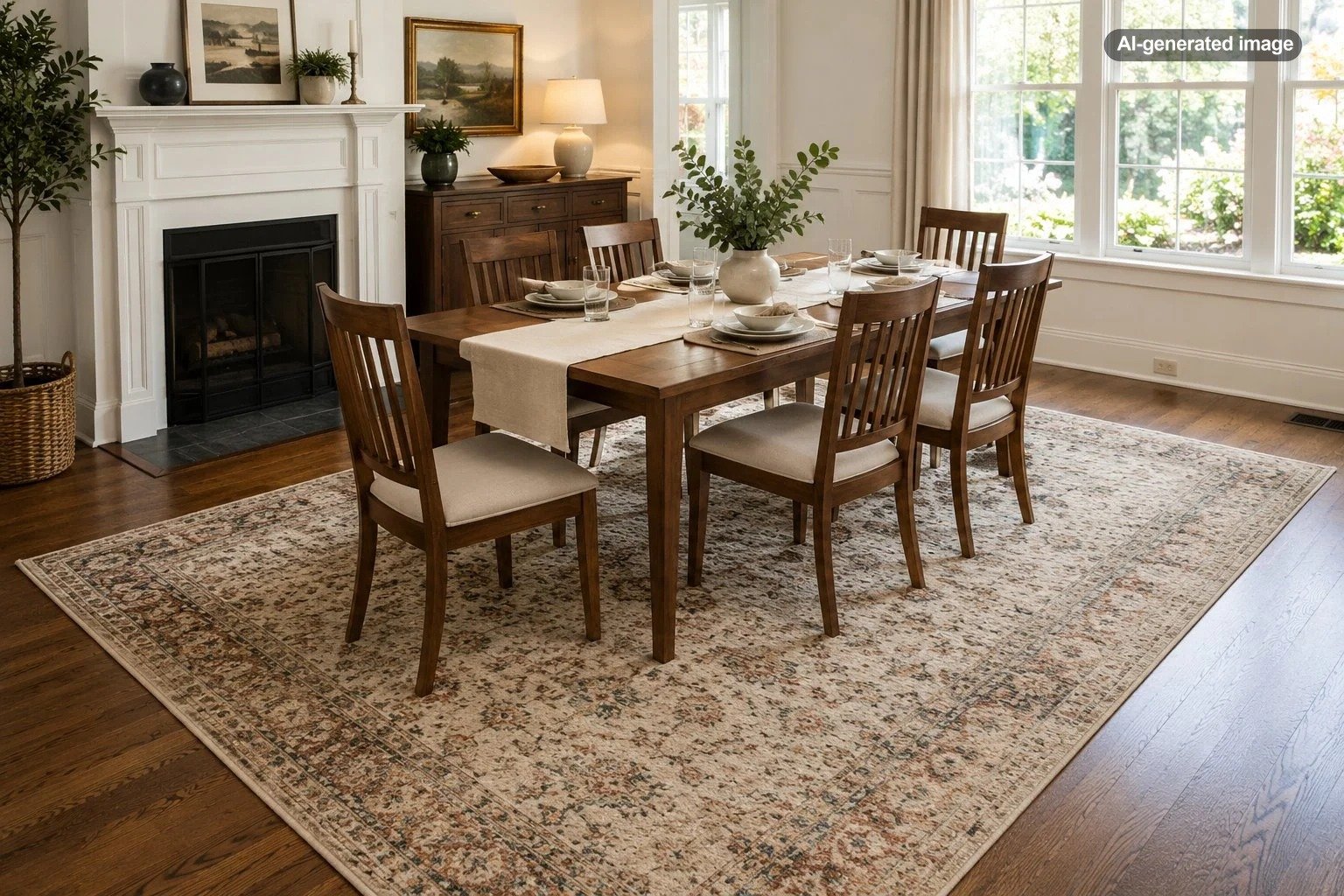
The best rug size for a dining table is one that extends at least 24 inches beyond every edge of the tabletop, with 30 to 36 inches offering even more comfortable chair clearance. This extra space allows diners to pull their chairs out and remain fully supported by the rug instead of catching the back legs on its edge.
That simple rule is more reliable than choosing a rug based on the number of seats alone. Table shape, chair depth, room size, and whether the table expands all influence the final dimensions.
Start With the Chair-Clearance Rule
A dining rug is not merely a decorative frame. It also has to work while people sit down, stand up, and shift their chairs during a meal. When the rug is too small, the chair’s back legs may slide off the edge. Pulling the chair forward again can cause the legs to snag, tilt, or bunch the rug.
For most dining rooms, the practical minimum is 24 inches of rug beyond the table on all sides. A 30-inch border is more forgiving, particularly with deep upholstered chairs, armchairs, or households where chairs are frequently pulled well away from the table. A 36-inch border can look especially balanced in a large room, provided it does not crowd the walls or nearby furniture.
The rug should support the dining chairs in motion, not just make the table look centered when the room is empty.
How to Calculate the Right Rug Dimensions
Begin by measuring the tabletop at its widest and longest points. Do not measure from the chair backs, because chairs move. Add at least 48 inches to each tabletop measurement to create a 24-inch border on every side.
What to do
- Measure the table’s full length and width, including any permanently attached leaves.
- Add 48 inches to the length and 48 inches to the width for minimum chair clearance.
- Add 60 to 72 inches instead when the room and budget allow a more generous border.
- Mark the proposed rug dimensions on the floor with painter’s tape.
- Pull every chair out as it would be used and confirm that all legs remain within the taped area.
For example, a rectangular table measuring 42 by 72 inches needs a rug of at least 90 by 120 inches. That translates closely to a standard 8-by-10-foot rug. A 48-by-84-inch table needs at least 96 by 132 inches, making a 9-by-12-foot rug a more comfortable choice than an 8-by-10.
Common Table Sizes and Useful Rug Starting Points
| Dining table size | Practical rug starting point | Best suited for |
|---|---|---|
| 36- to 42-inch round table | 8-foot round rug | Four-seat breakfast or dining areas |
| 48- to 54-inch round table | 9- or 10-foot round rug | Four to six seats with comfortable clearance |
| 36 by 60-inch rectangular table | 8 by 10 feet | Four to six seats |
| 42 by 72-inch rectangular table | 8 by 10 feet minimum | Six-seat dining rooms |
| 42 by 84-inch rectangular table | 9 by 12 feet | Six to eight seats |
| 48 by 96-inch rectangular table | 10 by 14 feet | Eight-seat or larger dining rooms |
These are starting points rather than rigid rules. Chair depth, the table base, room proportions, and traffic paths may justify going larger. When a table falls between common rug sizes, the larger rug is usually the more functional choice if it fits comfortably within the room.
Match the Rug Shape to the Table
Rectangular tables
A rectangular rug is the most natural choice beneath a rectangular table. It reinforces the table’s proportions and usually fits the architecture of a conventional dining room. For a narrow table in a long room, make sure the rug is still wide enough for the side chairs rather than focusing only on length.
Round tables
A round rug creates a cohesive, tailored look beneath a round table. Add at least 48 inches to the table diameter. A 48-inch table therefore needs a rug around 96 inches, or 8 feet, in diameter. A 54-inch table often works better on a 9- or 10-foot round rug, especially with substantial chairs.
Oval tables
Oval tables can sit on oval or rectangular rugs. An oval rug emphasizes the table’s curves, while a rectangular rug may be easier to find and can make the room feel more architectural. The same chair-clearance rule applies at the ends and along the sides.
Square tables
Square rugs are visually satisfying under square tables, but a large round rug can soften a room filled with straight lines. Whichever shape you choose, preserve equal chair clearance on all four sides.
Account for Extension Leaves
If the dining table expands, size the rug for the table’s extended position whenever the leaves are used regularly. A rug that works beautifully for everyday seating may become too short once the table grows by 18 or 24 inches.
Occasional hosts have two reasonable options. Choose a rug that accommodates the fully extended table, or accept that the end chairs may move closer to the rug edge during rare gatherings. The first option is more polished and practical. The second can make sense in a small room where a larger rug would interfere with doors, cabinets, or traffic.
Check the Rug Against the Room
The dining table is only one part of the calculation. The rug should also leave a visible border of flooring around its perimeter. In many rooms, 12 to 24 inches between the rug and the walls creates a balanced frame. Smaller dining areas may need a narrower margin, while large rooms can tolerate more exposed floor.
Also check clearances around china cabinets, sideboards, radiators, floor vents, and door swings. A rug should not prevent cabinet doors from opening or create an awkward ridge beneath furniture that is meant to sit level. A sideboard can remain completely off the rug; it does not need to share the dining zone unless the room layout naturally supports it.
What If the Room Is Too Small for the Ideal Rug?
In a compact dining room, apartment, or eat-in kitchen, the mathematically ideal rug may crowd the walls. Do not force a rug into a space where it interferes with doors or creates a narrow strip of exposed floor that looks accidental.
One option is to use the largest rug that fits while maintaining reasonable chair clearance. Another is to skip the rug entirely. Bare flooring beneath a dining table can look cleaner and function better than a rug that is visibly undersized. This is especially true in tight breakfast nooks or high-traffic areas where food spills are common.
A custom-size rug or broadloom remnant finished with bound edges can solve unusual room dimensions. This approach can provide the necessary chair clearance without leaving excessive material near the walls.
Common Dining Rug Sizing Mistakes
- Choosing by table size alone: The chairs require more space than the tabletop footprint suggests.
- Buying a rug that ends beneath the chairs: This almost guarantees snagging when diners pull their seats back.
- Ignoring the table leaves: An extendable table can outgrow an otherwise suitable rug.
- Centering the rug in the room instead of under the table: The dining arrangement should usually determine the rug’s position.
- Using a small decorative rug as an island: A rug that barely exceeds the tabletop often makes the furniture appear top-heavy.
- Forgetting nearby doors and cabinets: A larger rug is not helpful if it blocks normal movement.
Before you decide
- Confirm at least 24 inches of rug beyond every table edge.
- Test the dimensions with every chair pulled out.
- Measure the table both closed and fully extended.
- Check door swings, vents, cabinets, and traffic routes.
- Leave a deliberate border of visible flooring around the rug.
- Choose the larger standard size when two options both fit the room.
Frequently Asked Questions
Is an 8-by-10-foot rug large enough for a dining table?
An 8-by-10-foot rug usually works beneath a table measuring up to roughly 42 by 72 inches, depending on chair depth. Mark the dimensions on the floor and test the chairs before buying.
Can a dining room rug be too large?
Yes. A rug can feel oversized when it nearly touches the walls, blocks door swings, or extends awkwardly beneath storage furniture. The rug should define the dining area while leaving a visible, intentional border of flooring.
Should all dining chair legs stay on the rug?
Ideally, all four legs should remain on the rug both when the chair is tucked in and when it is pulled out for sitting. This improves stability and prevents the back legs from catching on the rug edge.
Should a round table always have a round rug?
No. A rectangular or square rug can work beneath a round table when it suits the room better. The key is maintaining even chair clearance and making the shape contrast appear intentional.
Is it acceptable to have no rug under a dining table?
Absolutely. In a small room, a spill-prone household, or a space where the correct rug would obstruct traffic, bare flooring may be more practical and visually successful than an undersized rug.
The final decision comes down to movement and proportion. Size the rug for the chairs when they are in use, not just for the table when it is neatly set. When the rug supports that everyday function and still fits comfortably within the room, the dining area will look more balanced and feel easier to use.