
Can You Use Two Ceiling Fans in One Large Room?
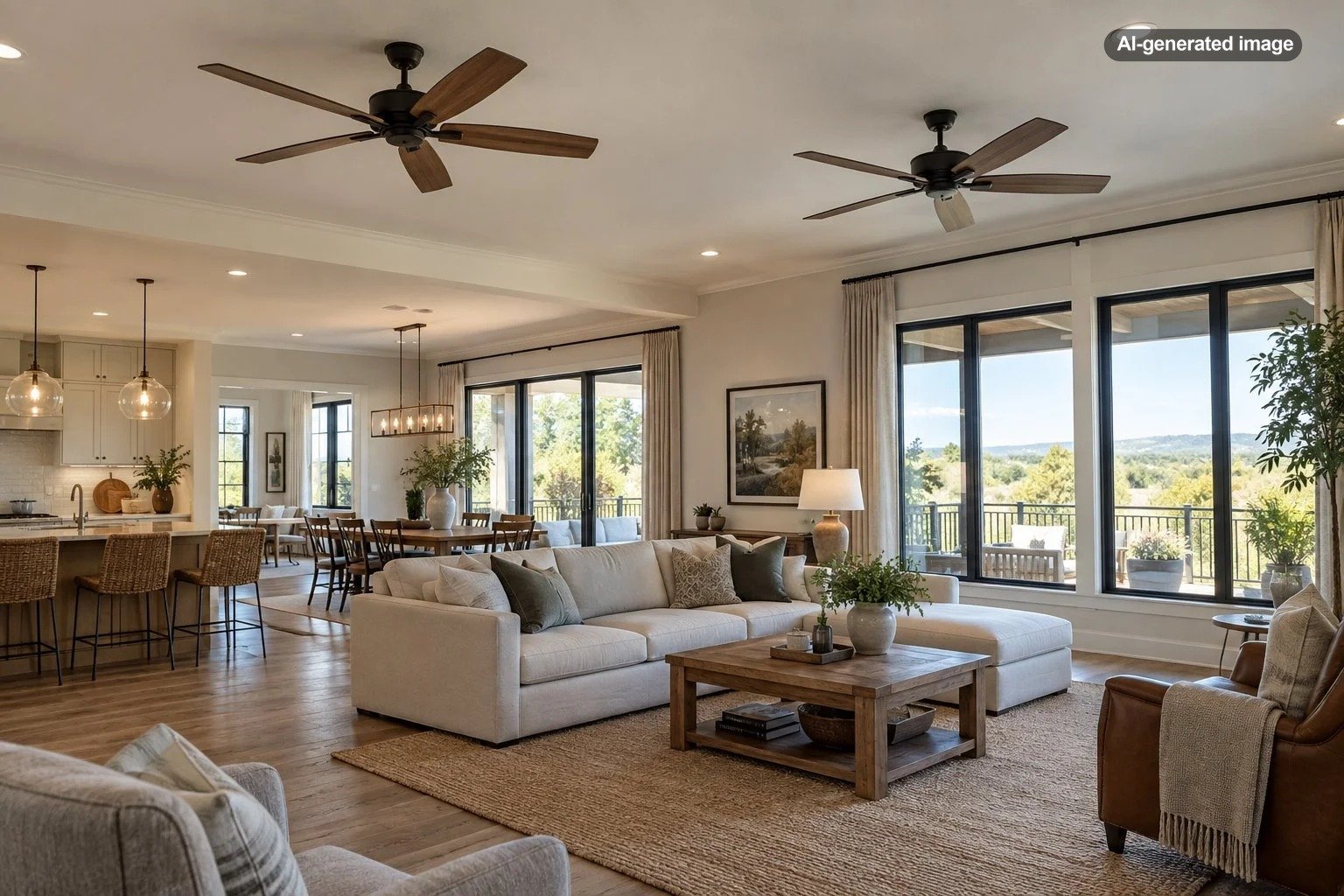
Yes, you can use two ceiling fans in one large room, and in the right space the arrangement can provide more even air movement than relying on a single fan. Two fans are especially useful in long rooms, open-concept spaces with distinct activity zones, unusually shaped rooms, and layouts where one centrally mounted fan would leave distant seating areas with noticeably less airflow.
The key is not simply adding a second fixture. The fans need to be sized and positioned for the actual room dimensions, ceiling height, furniture layout, and architectural features. They should also be installed on properly rated electrical boxes with suitable clearances, so electrical and structural details deserve the same attention as symmetry and style.
When Two Ceiling Fans Make More Sense Than One
The strongest argument for two fans is coverage. Ceiling fans do not lower a room’s air temperature; they create air movement that can make occupants feel more comfortable. Because that effect is most useful where people are actually sitting, working, dining, or gathering, an enormous room is not always best served by one fixture mounted at its mathematical center.
Hunter Fan specifically notes that larger spaces may benefit from multiple fans to increase air circulation and comfort. The company also notes that spaces larger than roughly 400 square feet may be candidates for either a larger fan or multiple fans, depending on the layout and product being considered.
Two fans can also suit L-shaped rooms, wide family rooms, converted lofts, long screened living spaces, or rooms interrupted by beams, lighting, or architectural features. In a more compact square room, however, one appropriately sized fan may look cleaner and perform perfectly well.
Start With Room Shape, Not Just Square Footage
Square footage is a useful starting point for fan sizing, but it does not explain how that square footage is distributed. A 20-by-20-foot room and a 10-by-40-foot room are both 400 square feet, yet they present very different airflow and placement challenges.
Measure the room’s length and width, note the ceiling height, and mark the primary seating or activity zones. For an irregular room, divide the floor plan into simpler rectangles so you can understand both total area and the dimensions of individual zones.
Manufacturer sizing guidance varies by model and product line, which is why the specifications for the fans you are considering matter more than a universal rule of thumb. Hunter’s current guidance, for example, generally moves toward larger blade spans as room area increases and explicitly suggests considering multiple fans in larger spaces.
The best fan arrangement follows the shape of the room and the places people use, not merely the center point of the ceiling.
How Far Apart Should Two Ceiling Fans Be?
There is no single spacing number that applies to every residential ceiling fan. Blade diameter, ceiling geometry, walls, light fixtures, beams, cabinets, and other obstructions all affect acceptable placement. The installation manual for the specific fan should therefore control the final layout.
As an example of how manufacturer requirements can differ, Big Ass Fans publishes guidance for certain models calling for a center-to-center distance between multiple fans of at least 2.5 times the fan diameter. That should not be treated as a universal formula for every brand or residential fan, but it illustrates why two large fans should not simply be placed as close together as the ceiling allows.
You also need enough clearance from walls and other obstructions so the blades can operate safely and airflow is not unnecessarily restricted. Different models specify different minimum distances. Check the installation documentation before locating electrical boxes, because shifting a fan after wiring and ceiling work is considerably more troublesome than adjusting the plan beforehand.
Before you decide
- Measure the room’s length, width, and ceiling height.
- Identify seating, dining, work, or gathering zones that need airflow.
- Check the blade span and clearance requirements for the exact fan model.
- Account for beams, recessed lights, pendants, sprinklers, cabinets, and tall furniture.
- Confirm that each mounting location can use an electrical box rated for ceiling-fan support.
- Plan switching or controls so the two fans are convenient to operate.
Should the Fans Be Identical?
They do not technically have to be identical, but matching fans are usually the easiest design solution when both fixtures are visible in the same open room. Equal blade spans, finishes, motor housings, and mounting heights create a deliberate rhythm rather than making the ceiling appear to have accumulated unrelated hardware over time.
There are exceptions. In an open-concept space where the kitchen, dining area, and living area have clearly different identities, closely related fans from the same design family can sometimes work better than exact duplicates. The safest visual approach is to repeat several important characteristics – such as finish, blade material, silhouette, or color – even if every detail is not identical.
Be especially cautious about mixing dramatically different diameters when the fans sit along the same visual axis. Unless the architecture clearly explains the difference, one fan can appear undersized rather than intentionally distinct.
One Extra-Large Fan vs. Two Smaller Fans
| Consideration | One large fan | Two fans |
|---|---|---|
| Visual effect | Creates one strong ceiling focal point | Creates repetition and architectural rhythm |
| Long rooms | May leave remote zones farther from airflow | Can serve separate zones more directly |
| Square rooms | Often simple and balanced | May be unnecessary unless the room is especially large |
| Installation | Requires one fan-rated mounting location | Requires two appropriate mounting and electrical locations |
| Control | One fixture to operate | Can potentially provide more flexible zone control |
Neither configuration is automatically superior. Hunter notes that a single large fan may suit some large rooms while multiple smaller fans can provide more targeted coverage. Room proportions are often the deciding factor.
A broad, nearly square great room may accommodate one substantial fan beautifully. A long rectangular room often makes a stronger case for two. Two fans may also help when architecture divides the room visually even though there are no walls between the zones.
Do Not Overlook Ceiling Height
Blade span is only part of the sizing question. Ceiling height determines which mounting configuration is appropriate. A fan mounted too high in a tall room may not provide the experience you expected, while a fan that hangs too low can create a serious clearance problem.
Hunter’s measuring guidance says fan blades should be at least 7 feet above the floor, while individual products and circumstances can call for additional clearance. Manufacturer instructions for mounting height, downrods, sloped ceilings, and nearby obstructions should be followed for the exact models being installed.
Plan the Fans Around Furniture and Lighting
Two fans become part of the room’s architecture, so study the entire ceiling before choosing positions. Recessed lights, chandeliers, pendants, track lighting, beams, skylights, vents, and other features can compete visually or physically with fan blades.
In a living-dining room, for example, centering one fan over a sofa grouping and another over a second seating zone may work well, while placing a fan directly beside a decorative chandelier could make both fixtures feel crowded. If a dining table depends on a central pendant, the second fan might make more sense over an adjacent living zone rather than directly over the table.
Furniture placement matters as well. If both fans are carefully centered over architectural zones that no longer match the way the room is furnished, their practical benefit may be limited. Think about likely long-term furniture arrangements before committing to new ceiling boxes.
Common Mistakes to Avoid
The first mistake is choosing two undersized fans simply because there are two of them. Each fan still needs enough capacity and blade span to serve its intended portion of the room. The opposite mistake is installing two very large fans in a space that cannot provide comfortable visual or physical clearance.
Another problem is treating symmetry as more important than function. Perfectly equal spacing may look pleasing on paper, but a slightly different arrangement could make more sense if the room has distinct zones or architectural constraints.
Finally, avoid selecting the fixtures before understanding the mounting conditions. Ceiling height, slope, junction-box location, framing, nearby obstructions, and manufacturer instructions can determine which configurations are practical.
So, Is Two the Right Number?
For many large rooms, yes. Two ceiling fans are particularly effective when the room is long, segmented into two major activity zones, or simply too expansive for one centrally positioned fan to provide comfortable airflow throughout the occupied areas.
But two should be a response to the room, not a rule. Measure first, compare the manufacturer’s sizing and clearance guidance for the exact fans you are considering, and sketch their relationship to furniture, lighting, and architectural features. A carefully chosen single oversized fan can be elegant in one great room, while a coordinated pair can look far more balanced and work more naturally in another.
Frequently Asked Questions
Can two ceiling fans run at the same time?
Yes, assuming both fans and their electrical installation are properly configured. How they are switched or controlled depends on the installation and chosen fan models.
Can two ceiling fans be controlled separately?
They can be designed for separate control, depending on the wiring and compatible control system. Decide how you want to operate the fans before installation so the electrical plan can accommodate that goal.
Do two fans need to rotate in the same direction?
For ordinary seasonal operation, follow the direction recommendations supplied by each fan’s manufacturer. Using matching operating settings generally creates the most predictable result when the fans serve the same room.
Are two 52-inch fans better than one very large fan?
Not universally. Two fans may provide better targeted coverage in an elongated or divided room, while one appropriately sized large fan may be simpler in a broad, symmetrical space. Compare the room geometry and the airflow guidance for the exact models.