
Is a Double Oven Worth Giving Up Cabinet Space?
A double oven is worth giving up cabinet space when you regularly cook multiple dishes at different temperatures, bake in batches, or host meals large enough to make one oven a bottleneck. For households that use a second oven only once or twice a year, the missing drawers, pantry shelves, or countertop-adjacent storage may be more valuable every day.
The decision is less about whether two ovens sound convenient and more about how often your cooking routine actually requires two independently controlled cavities. A thoughtful answer should account for storage, kitchen size, ergonomics, meal habits, ventilation, electrical requirements, and what else could occupy that tall cabinet.
What You Gain From a Double Oven
The clearest advantage is the ability to cook two foods under different conditions. A roast can remain at one temperature while vegetables, bread, or dessert cook at another. You can also use separate cooking modes when the model permits, such as conventional heat in one cavity and convection in the other.
That flexibility is particularly useful for frequent entertainers, enthusiastic bakers, large households, and anyone who prepares several components of a meal at once. It can reduce the scheduling puzzle of raising the temperature, waiting for the oven to adjust, and hoping the first dish stays warm without drying out.
Two cavities can also improve workflow when one dish has a strong aroma or requires frequent door opening. The second oven remains undisturbed, which is helpful for temperature-sensitive baking. None of these benefits require a lavish kitchen, but they become more persuasive as cooking volume and frequency increase.
Advantages
- Cook at two temperatures simultaneously
- Bake or roast multiple batches more efficiently
- Keep one dish warm while another finishes
- Reduce meal-timing conflicts when hosting
- Separate foods that need different cooking modes
Tradeoffs
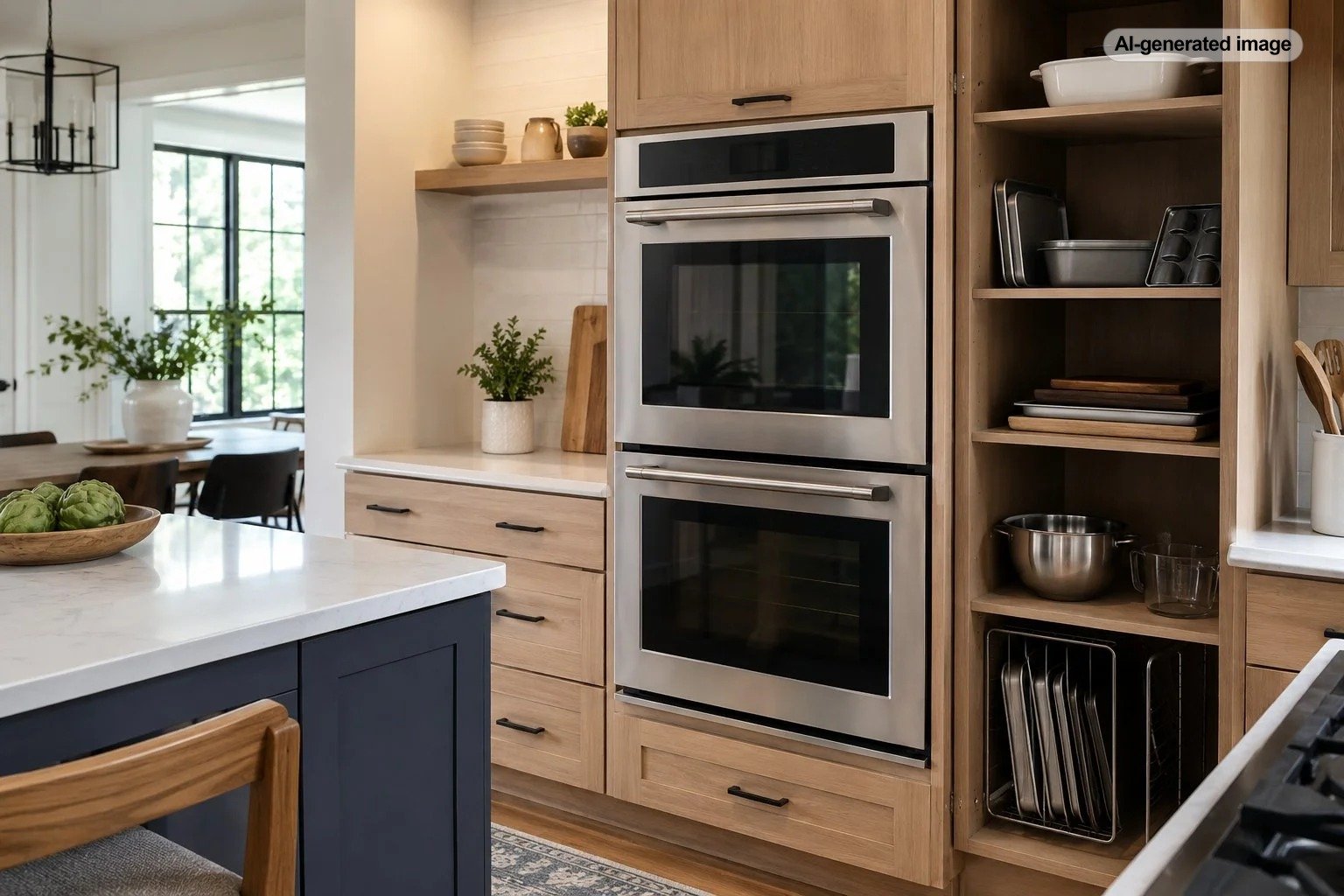
- Consumes a substantial section of tall cabinetry
- May eliminate drawers or pantry storage
- Can make upper controls or lower racks less comfortable to reach
- Requires careful cutout, utility, and clearance planning
- May provide more capacity than the household regularly uses
How Much Cabinet Space Does a Double Oven Use?
Double wall ovens commonly come in nominal widths such as 24, 27, and 30 inches, but the appliance label does not tell you the complete cabinet requirement. The exact cutout height, width, depth, door clearance, ventilation space, and support requirements vary by model.
As a general illustration, manufacturer guidance shows that many double wall ovens require a cutout roughly 50 inches tall, while a comparable single wall oven may require a cutout closer to 28 inches tall. That difference can consume the area that might otherwise hold several shelves, deep drawers, a microwave niche, or a landing zone for small appliances. Always use the installation instructions for the exact model rather than treating general dimensions as construction specifications.
Compare the Everyday Value, Not the Special-Occasion Value
A double oven is easy to justify while imagining a crowded holiday table. A better test is to review an ordinary month. Count how often you bake, roast, broil, or reheat foods that need incompatible temperatures or timing. Then compare that number with how often you reach for the cabinet space that would disappear.
| Household pattern | Likely better choice | Why |
|---|---|---|
| Frequent entertaining or batch baking | Double oven | Two cavities solve a recurring scheduling problem |
| Small kitchen with limited pantry storage | Single oven | Daily storage may outweigh occasional extra capacity |
| Large household cooking several dishes nightly | Double oven | Simultaneous temperatures can improve meal flow |
| Mostly stovetop, microwave, or countertop-appliance cooking | Single oven | The second cavity may remain underused |
| Cook who wants two ovens only during holidays | Single oven plus an alternative | A countertop appliance or warming solution may cover peak demand |
| Kitchen renovation with generous storage elsewhere | Double oven | The cabinet loss is easier to absorb |
Look Closely at Your Storage Plan
Before approving a double oven, assign a specific home to everything currently stored in the affected cabinet. Baking sheets, roasting pans, mixing bowls, serving platters, small appliances, and pantry staples do not disappear when the cabinet does. Moving them into distant cabinets may make cooking less convenient even as the second oven makes hosting easier.
Storage near the primary work zone is especially valuable. A cabinet beside a prep counter can be more useful than an equal amount of storage across the room. When evaluating a renovation plan, consider the location, accessibility, and shape of the lost storage rather than comparing cabinet volume alone.
Do Not Overlook Ergonomics
Stacked ovens place one cavity higher and the other lower than a single oven installed at a comfortable midpoint. Check whether the upper control panel is easy to see and operate and whether the lowest rack can be reached without excessive bending. Open both doors in a showroom when possible and mimic lifting a heavy roasting pan rather than judging the appliance with the doors closed.
Households planning for aging in place should give this step extra attention. An impressive cooking wall is less successful if the most-used cavity is awkward to reach. In some kitchens, two single ovens installed side by side can improve access, although that arrangement uses more horizontal cabinetry and requires model-specific planning.
Consider the Alternatives
A double oven is not the only way to gain secondary cooking capacity. A single wall oven can be paired with a range oven, countertop convection oven, microwave-convection combination, or other appliance suited to the foods you prepare. These options are not automatically equivalent, but they may handle side dishes, reheating, or small-batch baking without consuming a full-height oven cabinet.
A wall oven and microwave combination is another possibility, though it trades the second full oven for a microwave or combination cavity. A range with two oven compartments may preserve wall cabinetry, but compartment size, burner layout, controls, and bending height should be assessed carefully.
The right alternative depends on the bottleneck you are trying to solve. Someone who needs a second full-size cavity for sheet pans has different requirements from someone who merely wants a place to warm rolls while dinner finishes.
Plan the Installation Before Committing
Wall ovens require more than a correctly sized opening. The cabinet must meet the appliance manufacturer’s support and clearance instructions, and the electrical or gas connection must be suitable for the selected model. Cooktop-and-wall-oven combinations may also require approved pairings and specific clearances.
Because requirements differ among appliances and homes, have the exact model documentation reviewed before cabinetry is ordered or modified. A nominally similar replacement may not fit an existing opening without adjustment. Installation involving electrical, gas, or structural cabinet work should be handled by appropriately qualified professionals.
Before you decide
- Track how often you genuinely need two temperatures at once
- Identify exactly which cabinets, drawers, or shelves will be lost
- Assign new locations to every displaced item
- Check access to controls, doors, and the lowest rack
- Measure the room and compare it with the exact model instructions
- Confirm utility, support, ventilation, and clearance requirements
- Compare a double oven with less space-intensive alternatives
So, Is a Double Oven Worth It?
Yes, when it solves a frequent cooking-capacity problem and your kitchen can surrender the storage without becoming less functional. It is especially compelling for regular hosts, batch bakers, large households, and cooks who routinely prepare foods at different temperatures.
No, when the second cavity would mostly wait for holidays while the missing cabinet creates daily frustration. In a small kitchen, storage and work-zone efficiency often deliver more value than occasional extra oven capacity.
The best appliance layout is not the one with the most equipment; it is the one that removes the problems your household encounters most often.
Frequently Asked Questions
Does a double oven use twice as much energy?
Not automatically. Energy use depends on the model, cooking mode, temperature, duration, and whether one or both cavities are operating. Compare the applicable energy information and specifications for the exact appliances you are considering rather than assuming that cavity count alone determines consumption.
Can a double oven replace a range?
A double wall oven provides baking and roasting capacity but does not provide burners. It must be paired with a cooktop or another surface-cooking appliance.
Is a double oven useful for a small family?
It can be if the household bakes frequently, prepares several dishes at once, or entertains often. Household size matters less than cooking habits.
Can I replace a single wall oven with a double oven?
Possibly, but the taller cutout, cabinet support, clearances, utilities, and surrounding storage must be evaluated. Do not assume the existing cabinet can simply be enlarged without reviewing the new appliance’s installation instructions and the cabinet structure.