How Often Should You Start a Portable Generator if You Are Not Using It?
There is no universal rule that every portable generator must be started once a month when it is sitting unused. The correct interval depends on the specific generator and its owner’s manual. In many cases, proper fuel preparation, battery care, oil maintenance, and dry storage matter more than starting the engine according to an arbitrary calendar.
If your manufacturer specifies an exercise or periodic-start schedule, follow it. If the manual does not, avoid assuming that frequent idling is automatically beneficial. A generator that has been prepared correctly for storage may be better left stored than repeatedly started for a few minutes without bringing it through the operating procedure the manufacturer intended.
Why there is no single start-up interval for every portable generator
Portable generators vary considerably. Some use gasoline only, while others can run on gasoline and propane or additional fuels. Some have recoil starters; others include electric starting systems and batteries. Fuel systems, carburetors, storage procedures, maintenance schedules, and engine designs also differ.
That is why an owner’s manual should take priority over a general rule such as starting the generator every 30 days. Manufacturer instructions may divide storage into periods such as less than 30 days, several months, or long-term storage and prescribe different fuel-system procedures for each.
Generac, for example, advises owners of its portable generators to drain the fuel and run the carburetor dry when storing a unit for more than 30 days. Its published guidance also notes that gasoline can deteriorate during storage and discusses the use of fuel stabilizer. Honda likewise warns that gasoline can deteriorate rapidly under some conditions and directs owners to the storage section of the manual for the specific generator.
Fuel condition is often more important than simply starting the engine
A gasoline generator can have a perfectly healthy engine and still refuse to cooperate during an outage because old fuel has caused problems in the fuel system. Gasoline changes as it sits, and storage conditions can accelerate deterioration.
Honda notes that fuel deterioration problems may occur in less than 30 days under some conditions, including warm temperatures, high humidity, and fluctuating temperatures. Generac similarly recommends specific storage preparation when a portable generator will sit for more than 30 days.
This creates an important distinction: starting the generator occasionally is not the same thing as preparing its fuel system for storage. Starting an engine for a short period does not magically make aging gasoline fresh again.
If your manual calls for draining the tank or carburetor, adding an approved stabilizer, circulating stabilized fuel through the system, or following another storage procedure, that instruction should guide your routine. Fuel-storage requirements can also differ between gasoline, propane, and multi-fuel machines.
A generator’s readiness depends less on ritualistically starting it and more on storing and maintaining it the way its manufacturer intended.
If you do periodically start it, make the check meaningful
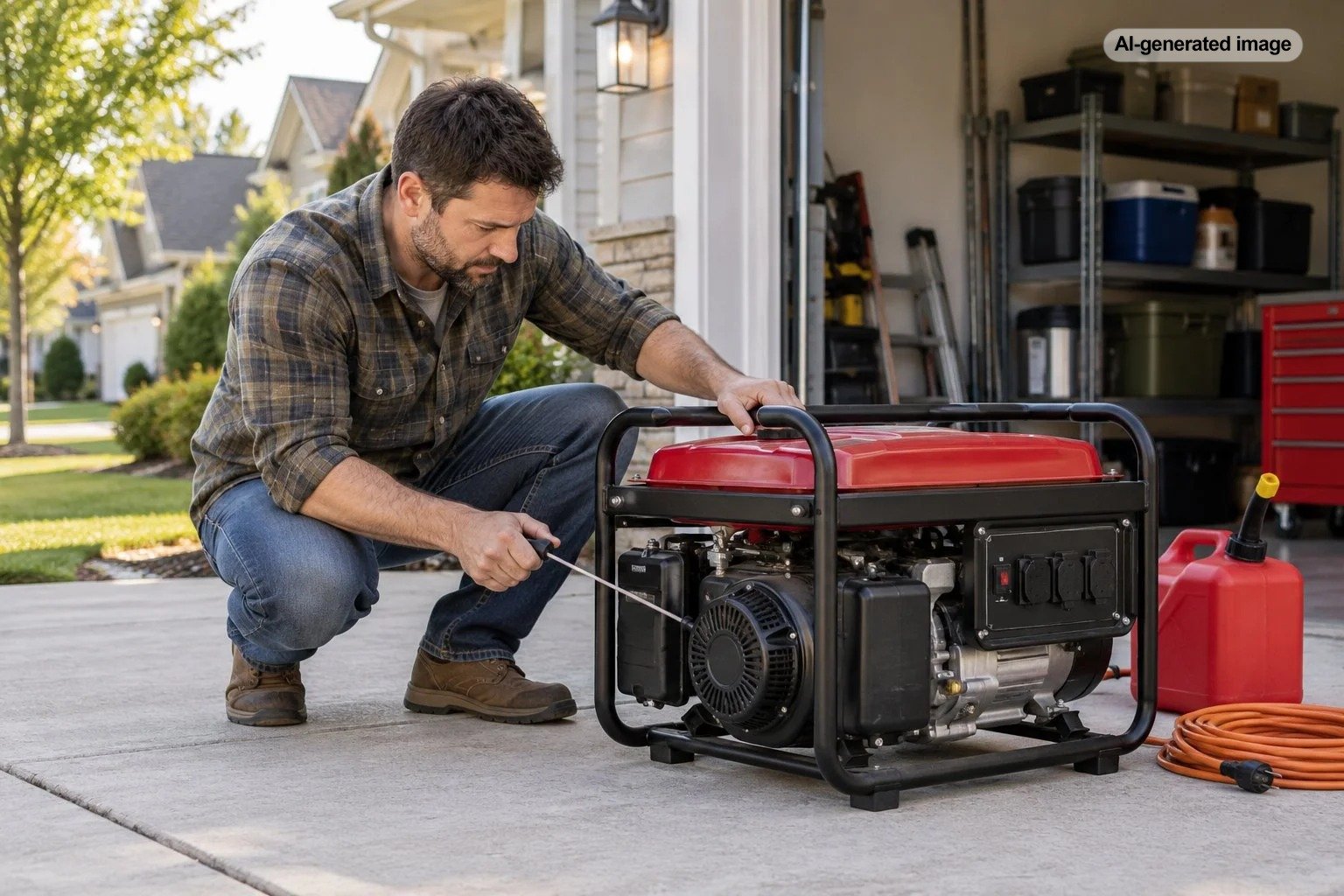
When a manufacturer recommends periodic operation, or when you are performing a readiness check allowed by the manual, do more than confirm that the engine makes noise. The goal is to discover problems before the generator is needed during an outage.
What to check
- Read the starting, operating, and storage instructions for your exact model before beginning.
- Move the generator to the safe outdoor operating location specified by the manufacturer. Never perform a test run inside a garage, shed, basement, or other enclosed space.
- Inspect for obvious fuel leaks, damaged cords, loose parts, blocked ventilation areas, animal nesting material, or other visible problems.
- Check engine oil and any other maintenance items required before starting.
- If the generator has an electric starter, verify that its starting battery is being maintained according to the manual.
- Start and operate the generator using the manufacturer’s procedure rather than improvising a short indoor test.
- Afterward, return the unit to the storage condition specified in the manual, including any required fuel procedure.
A generator that starts but immediately surges, leaks fuel, produces unusual smoke, repeatedly trips protection devices, or has damaged electrical components needs attention before an emergency. Testing ahead of time is valuable precisely because it gives you an opportunity to resolve those problems when the house still has utility power.
Do not run a generator in the garage just because it is only a test
This is the most important part of any periodic-start routine. A five-minute maintenance run is still generator operation, and the carbon monoxide risk is still present.
The U.S. Consumer Product Safety Commission says portable generators should be operated outdoors only, at least 20 feet from homes and buildings, with the exhaust directed away from windows, doors, vents, and other openings. CPSC also warns never to operate a generator inside a home, garage, basement, crawlspace, shed, or other enclosed area, even if doors or windows are open.
What about a generator with an electric-start battery?
An electric-start generator adds another storage concern: the battery can lose charge while the generator sits. Starting the engine periodically is not necessarily the manufacturer’s preferred method of maintaining that battery.
Some generators provide charging provisions or specify a battery-maintenance procedure. Battery type and charging requirements vary, so check the manual rather than attaching an arbitrary charger or assuming that a brief engine run will keep the starting battery ready indefinitely.
This is also a good reason to perform readiness checks before severe-weather season or another period when outages are more likely. Finding a weak battery while utility power is still available is much easier than discovering it after dark during an outage.
Long-term storage may call for preparation instead of repeated starting
If you know the generator will not be needed for months, the manual’s long-term storage procedure deserves more attention than a recurring start-up reminder. Depending on the model, that procedure may address the fuel tank, carburetor, engine oil, cylinder protection, battery, storage location, and protection from moisture.
For example, current Generac portable-generator guidance distinguishes storage lasting more than 30 days and recommends fuel-system preparation. Honda similarly provides model-specific storage instructions covering subjects such as stabilizing or draining fuel and preparing the carburetor.
Do not assume that leaving a gasoline generator full of untreated fuel and starting it occasionally is equivalent to proper long-term storage. Conversely, if the manufacturer instructs you to prepare the unit for dry storage, repeatedly adding fuel simply so you can conduct unnecessary test runs can undermine that storage strategy.
Before you store it
- Find the exact owner’s manual for the model and serial number.
- Determine whether the manufacturer specifies short-term and long-term storage procedures.
- Follow its instructions for gasoline, propane, or other approved fuels.
- Address the electric-start battery if the unit has one.
- Check the required oil-maintenance schedule.
- Store the generator in the location and condition specified by the manufacturer.
- Keep the operating instructions accessible so anyone who may use the generator during an outage can find them.
A practical readiness routine
Instead of relying only on a recurring reminder that says “start generator,” build a broader generator-readiness routine around the owner’s manual. Before periods when outages are more likely, inspect the unit, confirm that required maintenance is current, check fuel and battery storage arrangements, and make sure you still have the correct cords or professionally installed connection equipment your setup requires.
If the manufacturer’s schedule says to operate the generator periodically, put that exact interval on your calendar. If it does not prescribe an exercise interval, follow its storage instructions rather than inventing one.
Also remember that maintenance schedules may be based on operating hours as well as elapsed time. Oil changes, air-filter service, spark-plug checks, valve adjustments, and other work should follow the schedule for the specific machine. Starting the generator regularly does not substitute for those maintenance tasks.
Frequently asked questions
Should I start my portable generator every month?
Only if that schedule is appropriate for your model or is part of the manufacturer’s prescribed maintenance procedure. There is no universal monthly-start requirement covering every portable generator. Consult the owner’s manual for the correct storage and maintenance schedule.
Is it bad to leave a generator sitting for six months?
Not necessarily, provided it has been prepared for long-term storage according to its manufacturer’s instructions. Leaving gasoline in a unit without following the specified fuel-storage procedure, however, can create starting and fuel-system problems.
Can I start the generator for a few minutes in my garage?
No. CPSC says portable generators should never be operated inside garages or other enclosed spaces, even when doors or windows are open. Operate the generator outdoors at the appropriate distance from the home and direct exhaust away from openings.
Does running the generator keep gasoline fresh?
No. Running the engine consumes some fuel, but it does not reverse fuel deterioration. Follow the manufacturer’s instructions for fuel stabilizer, draining, carburetor preparation, and storage duration.
What if I cannot find the owner’s manual?
Look for the model and serial number on the generator and use the manufacturer’s official support or manual library. Storage procedures can differ even within one brand, so model-specific guidance is preferable to generic instructions.