How Long Does It Take an Air Purifier to Clean a Bedroom?
In a typical bedroom, a properly sized air purifier can begin reducing airborne particles as soon as it is running, but there is no single moment when the room suddenly becomes completely clean. A useful working range is roughly 15 to 60 minutes for substantial initial filtration in many bedroom-sized spaces, with the actual pace depending on the purifier’s clean air delivery rate, room volume, fan speed, doors and windows, and whether new particles are still entering the room.
The better question is not simply how many minutes the machine has been on, but how many times it can effectively filter a room-sized volume of air. That is where CADR and air changes per hour become much more useful than a timer.
Why there is no universal cleaning time
Portable air purifiers are constantly competing with what is happening in the room. Bedding sheds fibers, people and pets introduce particles, outdoor air enters through doors and windows, and central heating or cooling can move material between rooms. Even after the purifier has filtered a large volume of air, new particles may continue to appear.
The U.S. Environmental Protection Agency therefore treats portable air cleaners as a supplement to source control and ventilation rather than a way to remove every pollutant from a home. The EPA also notes that higher fan speeds and longer operating times generally increase the amount of air filtered.
This is why an air purifier is better thought of as an ongoing room appliance, much like a refrigerator maintaining a temperature, rather than a vacuum cleaner that finishes a defined job and switches off.
Use CADR to estimate how quickly a purifier can work
Clean air delivery rate, or CADR, describes how much filtered air a purifier delivers. A higher CADR means the purifier can process particles more rapidly or serve a larger space.
For particle filtration, the Association of Home Appliance Manufacturers recommends a smoke CADR of at least two-thirds of the room’s area in square feet. A 10-by-12-foot bedroom, for example, is 120 square feet, so that rule points to a smoke CADR of at least 80. A purifier with substantially more capacity can circulate filtered air through that bedroom more frequently, assuming it is operated at the speed associated with the rating.
| Bedroom size | Approximate minimum smoke CADR using the 2/3 rule | What it means |
|---|---|---|
| 100 sq. ft. | About 67 | Suitable starting point for a compact bedroom |
| 150 sq. ft. | About 100 | A practical target for many average bedrooms |
| 200 sq. ft. | About 133 | More airflow is needed as room area increases |
| 300 sq. ft. | About 200 | Look for a purifier intended for a larger room |
These are sizing guidelines, not promises that every pollutant will disappear on a particular schedule. Ceiling height matters, too. A bedroom with a 10-foot ceiling contains more air than a bedroom with the same floor area and an 8-foot ceiling.
Air changes explain the time more clearly
Another useful measure is air changes per hour, often abbreviated ACH. In simple terms, this estimates how many room-sized volumes of air can pass through the purifier during an hour. Five air changes per hour corresponds to a theoretical room-volume equivalent about every 12 minutes.
That does not mean every molecule of room air is perfectly filtered every 12 minutes. Clean air mixes with unfiltered air, furniture affects circulation, and particles can continue entering the room. Multiple passes therefore matter.
If you are trying to clear particles more quickly after making the bed, vacuuming, opening a window during a high-pollen period, or bringing a dusty item into the bedroom, running the purifier at a higher fan setting can speed filtration. Once the immediate particle load has fallen, a lower setting may be more comfortable for overnight use.
Room placement can make a capable purifier work better
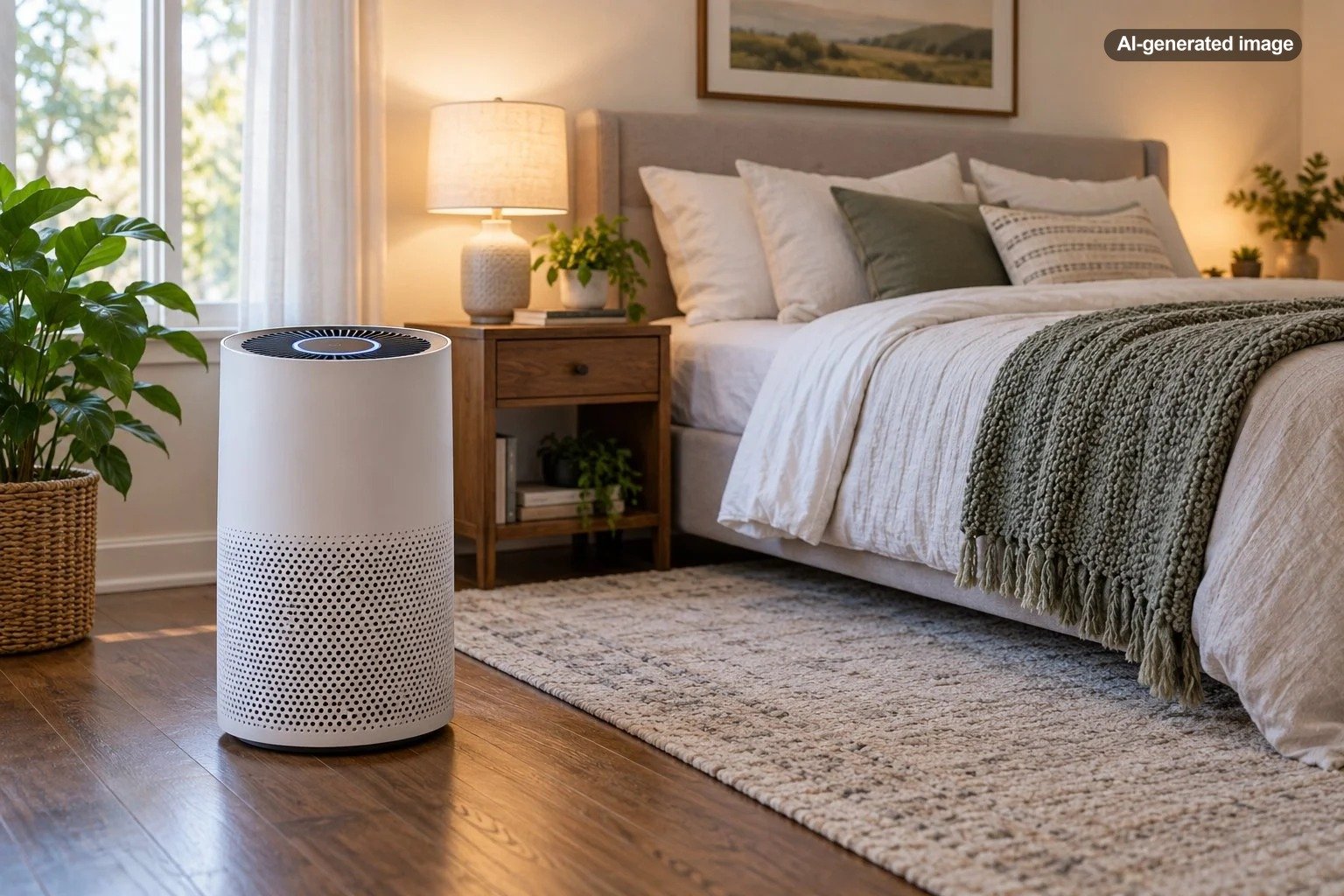
A purifier needs access to moving room air. Avoid wedging it tightly between furniture, covering its intake, or pressing an outlet against curtains or bedding. Follow the manufacturer’s placement instructions because intake and exhaust locations differ by model.
Closing the bedroom door can also give a portable purifier a more defined area to serve. With the door continuously open to a hallway or adjoining room, the effective air volume may be considerably larger than the bedroom dimensions suggest.
What to do
- Measure the bedroom’s length and width to calculate floor area.
- Check the purifier’s smoke CADR rather than relying only on a broad room-size claim.
- Allow extra capacity for unusually high ceilings or an open doorway serving additional space.
- Place the purifier where its intake and outlet are not obstructed.
- Use a higher fan speed when faster particle reduction matters, then reduce the speed if noise interferes with sleep.
- Maintain and replace filters according to the manufacturer’s instructions.
Should you leave an air purifier running all night?
For ongoing particle filtration, there is usually little benefit in treating the purifier as a machine that runs for 30 minutes and then has completed its job. Once it stops, filtration stops while particle sources and air exchange with the rest of the home can continue.
Many bedroom users therefore operate a purifier for extended periods, often choosing a lower or automatic setting overnight. The important tradeoff is straightforward: lower fan speeds are generally quieter but move less air, while higher speeds provide faster filtration but may be more noticeable while sleeping.
Timers and automatic modes can be convenient, but they change how much filtered air the machine actually delivers over the course of the night.
A real bedroom example
Consider a 12-by-12-foot bedroom with an 8-foot ceiling. Its floor area is 144 square feet, and its volume is 1,152 cubic feet. AHAM’s two-thirds guideline suggests looking for a smoke CADR of roughly 96 or greater. Choosing a purifier with extra capacity gives you the option of achieving useful airflow without always needing the machine at its maximum setting.
One example of a bedroom-capable unit is the Coway Airmega AP-1512HH Mighty. Coway currently lists a smoke CADR of 233 and a 361-square-foot coverage figure at 4.8 air changes per hour. Its specifications also include multiple airflow settings, automatic operation, a timer, a particle filter, and a deodorization filter. Those figures illustrate why the size of the machine relative to the bedroom matters: a purifier with substantial capacity for a modest bedroom can process a room-sized volume of air more frequently than an undersized unit.
Affiliate disclosure: CraneManor.com may earn a commission when you purchase through links on this page. This does not affect the price you pay. Learn more.
If those features suit your room and preferred level of automation, a Coway Airmega purifier is one established example of a room air purifier with automatic operation and air-quality monitoring. The appropriate choice still depends on room size, desired fan speed, noise tolerance, maintenance preferences, and the particles or gases you are trying to address.
What an air purifier will not do
A portable purifier should not be expected to remove every indoor pollutant. Particle filters and gas-removal filters solve different problems, and filtration does not replace eliminating a pollution source when that is practical.
For example, an air purifier is not a substitute for fixing a moisture problem, controlling an active source of smoke, cleaning accumulated dust, or providing appropriate ventilation. If odors are the main concern, a particle filter alone may have limited effect because many odors involve gases rather than airborne particles.
Filter condition matters as well. A neglected or overloaded filter can reduce performance, so maintenance is part of the answer to how quickly an air purifier works.
Frequently asked questions
Can an air purifier clean a bedroom in 30 minutes?
It can provide substantial filtration during that period if its CADR is appropriately matched to the room and it is operating at a sufficient fan speed. Thirty minutes should not be interpreted as a point at which every pollutant has disappeared, however. Air continues mixing and new particles can continue entering the room.
Is a bigger air purifier always faster?
A higher CADR generally means faster particle filtration in the same room, but usability matters. A powerful purifier that is so loud you rarely run it may be less useful than a well-sized unit you comfortably operate for long periods.
Should I run the purifier before going to bed?
Running it at a higher setting before bedtime can increase filtration before you settle in. You can then switch to a quieter setting for ongoing overnight filtration if desired.
Does opening the bedroom door slow purification?
Potentially. An open door connects the bedroom to additional air volume, so a purifier sized only for the bedroom may effectively be serving a larger space.
How do I know whether my purifier is large enough?
Measure the room, check the smoke CADR, and compare it with an established sizing guideline. Be more conservative when ceilings are higher than 8 feet or when the purifier is expected to serve connected rooms.
The practical answer
For most bedrooms, think in terms of repeated air filtration rather than waiting for a single finish time. A well-sized purifier can start making a meaningful difference relatively quickly, and roughly 15 to 60 minutes is a reasonable practical window for substantial initial filtration under many bedroom conditions. Continued operation is what helps maintain that improvement as new particles enter the space.
The most useful buying numbers are the room dimensions and the purifier’s CADR. Match those sensibly, provide the machine with unobstructed airflow, use enough fan speed for the job, and keep the filters maintained. Those choices matter more than trying to identify one exact minute when the bedroom becomes clean.