
How Much Drinking Water Should a Household Store for a Hurricane?
For hurricane preparation, a practical starting point is at least 1 gallon of water per person per day. The CDC recommends storing enough for a minimum of three days and trying to build toward a two-week supply when space and circumstances allow. That means a household of four should have at least 12 gallons for three days, while a two-week reserve would be 56 gallons.
That gallon-per-person figure is best understood as an emergency potable-water allowance rather than simply the amount someone expects to drink. Stored safe water may also be needed for cooking, brushing teeth, preparing food, taking medications, and other essential uses when the normal water supply is unavailable or potentially contaminated.
Start with 1 gallon per person per day
The arithmetic is refreshingly uncomplicated. For each person in the household, plan on at least 1 gallon of safe water for every day the emergency supply needs to last. According to the CDC, a three-day supply is the basic preparedness target, while a two-week supply is preferable when it is practical to store that much.
| Household size | 3-day supply | 7-day supply | 14-day supply |
|---|---|---|---|
| 1 person | 3 gallons | 7 gallons | 14 gallons |
| 2 people | 6 gallons | 14 gallons | 28 gallons |
| 4 people | 12 gallons | 28 gallons | 56 gallons |
| 6 people | 18 gallons | 42 gallons | 84 gallons |
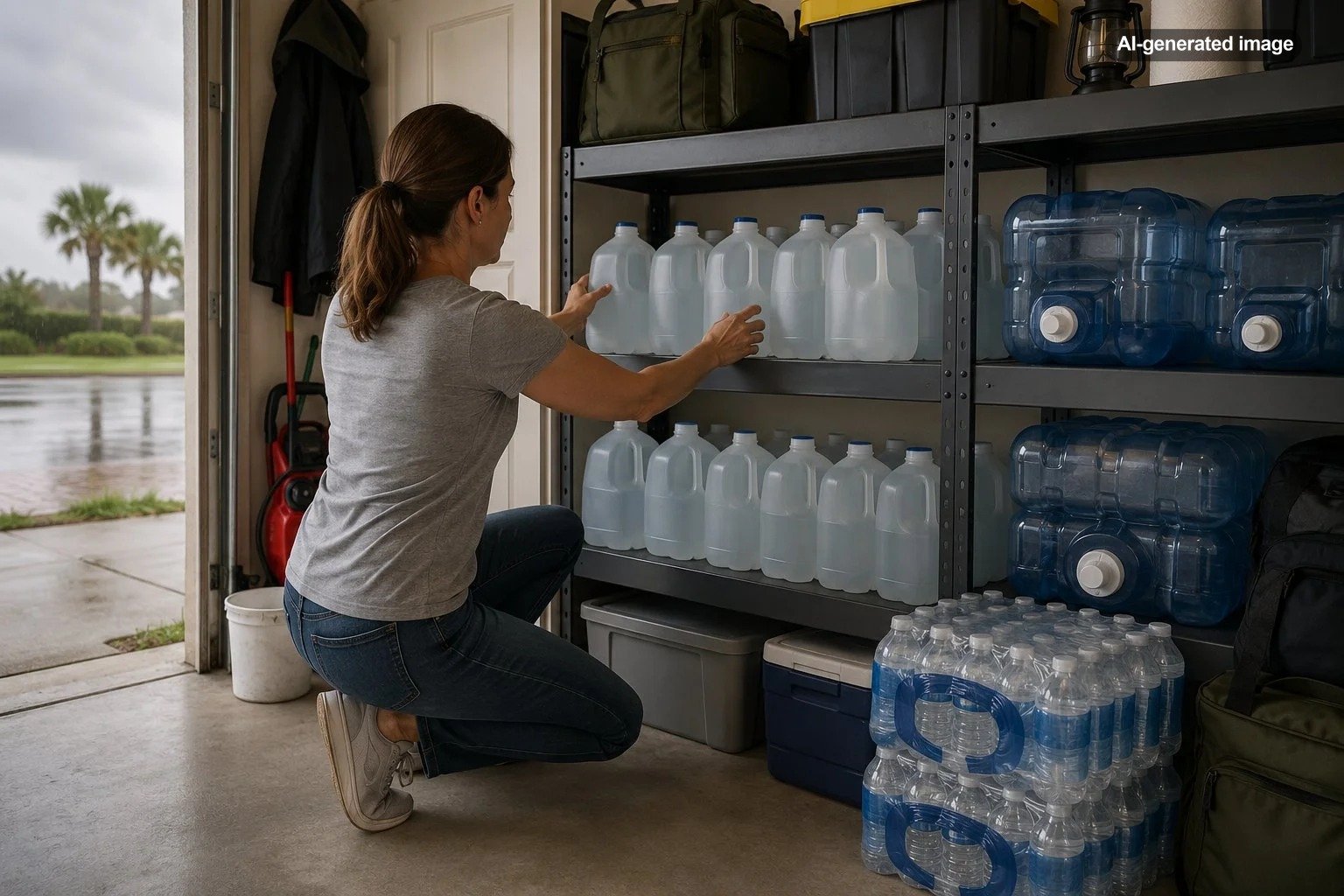
Those numbers can look modest at the three-day end and surprisingly large at the two-week end. That is normal. Water is heavy and bulky, so a long-duration reserve often works better when it is divided among several manageable containers rather than concentrated in one enormous vessel.
Ready.gov also advises at least 1 gallon per person per day for several days and notes that individual requirements vary with age, health, activity, diet, and climate. In very hot conditions, water needs can rise significantly. Hurricane-prone households in warm climates should therefore treat the basic calculation as a starting point rather than an absolute ceiling.
Remember that emergency water is not only for drinking
A common planning mistake is to picture the gallon-per-day recommendation as a jug reserved exclusively for glasses of water. During an interruption to municipal or well service, however, safe water may have several jobs. The CDC specifically includes uses such as drinking, cooking, and brushing teeth in an emergency supply.
That distinction matters because a household can burn through its reserve faster than expected once meals, oral hygiene, medications, and food preparation enter the picture. If you stock exactly the minimum and then use it as though every normal household water task can continue unchanged, the supply may disappear quickly.
For nonessential cleaning and similar tasks, conserving potable water becomes important during an extended interruption. The goal is not to recreate an ordinary day of unlimited tap use from a stack of emergency containers. It is to preserve safe water for the uses in which water quality matters most.
Build toward a longer reserve if your home can accommodate it
A three-day supply is far better than no dedicated water reserve, but hurricanes can create disruptions that last beyond the storm itself. Power failures, flooding, damaged infrastructure, boil-water advisories, blocked roads, and delayed access to stores can complicate the days after severe weather. The CDC therefore recommends trying to store a two-week supply when possible.
You do not necessarily have to purchase or fill the entire two-week amount in one afternoon. A household can build its reserve gradually. Start by reaching the three-day minimum, then add enough for several more days until the supply matches your available storage space and local risk.
Renters and residents of smaller homes may need to be particularly deliberate. Water should not create a tripping hazard, obstruct an evacuation route, or be placed where a leaking container could damage belongings. Smaller containers are often easier to distribute and move, while larger containers can be useful where suitable storage space and safe handling are available.
Add extra water for heat, health needs, and pets
The basic household equation is intentionally simple, but not every household has basic needs. The CDC advises considering extra water for pregnant people, people who are sick, pets, and households in hot climates. Ready.gov similarly notes that children, nursing mothers, sick people, and people facing medical emergencies may require additional water.
If someone in the home relies on water for medication, medical equipment, formula preparation, or another essential purpose, build that requirement into the emergency plan separately rather than assuming the general household allowance automatically covers it. When medical care or a device has specific water-quality requirements, follow the instructions from the appropriate health-care provider or equipment manufacturer.
Pets also need their own supply. Their needs vary considerably with species, size, diet, health, and temperature, so simply adding another human gallon without considering the animal is not especially useful. The more practical approach is to determine the normal safe-water needs of the household’s animals and add an emergency margin to the human supply.
A good hurricane water plan is not the smallest number you can technically store; it is the amount your household can realistically protect, rotate, access, and use when normal routines stop working.
Store the water so it remains usable
Commercially bottled water in its unopened original container is a straightforward emergency option. The CDC describes unopened commercially bottled water as the safest and most reliable emergency source and recommends observing the expiration date on store-bought water.
If you fill your own containers, use containers intended for food or water storage rather than repurposing vessels that previously held chemicals. The CDC advises using food-grade water-storage containers when possible and warns against containers previously used for toxic substances such as pesticides or bleach.
Before you store it
- Label filled containers as drinking water and include the storage date.
- Use tightly closing, durable containers intended for safe water or food storage.
- Keep stored water away from gasoline, pesticides, and other toxic substances.
- Protect containers from direct sunlight and excessive heat.
- Keep the reserve accessible enough that household members can reach it during an outage.
- Include the supply in your regular hurricane-season preparedness check.
For water that you fill yourself, the CDC recommends replacing it every six months. Ready.gov gives the same replacement interval for water that was not commercially bottled. Rotating on a simple calendar schedule prevents an emergency stash from becoming something everyone vaguely remembers placing in a closet years ago.
The CDC recommends keeping home-filled containers in a cool location, away from direct sunlight and toxic substances. It also advises avoiding hand contact with the stored water or the inside of the container during use, since careless handling can contaminate a supply that began clean.
Do not wait for a hurricane warning to start calculating
Water is one of the least glamorous hurricane supplies and one of the easiest to postpone. It is also inconvenient to buy in large quantities when everyone else is preparing at the same time. The better approach is to decide on your household target before a storm threatens your area.
What to do
- Count every person who normally stays in the home.
- Multiply that number by 3 gallons to establish the minimum three-day reserve.
- Calculate the 14-day target by multiplying the household size by 14 gallons.
- Add an appropriate amount for pets and any special health, dietary, or climate needs.
- Choose safe storage locations and containers that are manageable for the people who may need to move them.
- Label home-filled containers and schedule six-month replacement reminders.
It can also be useful to separate water intended to remain at home from a smaller evacuation supply. If authorities direct you to evacuate, follow official instructions rather than staying solely because you have accumulated emergency supplies. A home preparedness reserve is not a reason to ignore an evacuation order.
Be cautious with water after the storm
After a hurricane or flood, tap water that looks normal is not automatically safe. Local officials may issue boil-water or other drinking-water advisories if the system has been compromised. Follow current instructions from your local water utility, public health department, and emergency-management authorities rather than relying on appearance, taste, or smell to judge safety.
Ready.gov advises treating water of uncertain quality before using it for drinking, food preparation, dishwashing, brushing teeth, or making ice when reliable clean sources are unavailable. Because emergency water treatment depends on the nature of the contamination and official instructions, this is not an area for improvising from memory when authoritative guidance is available.
Frequently asked questions
How much water should a family of four store for a hurricane?
Using the minimum guideline of 1 gallon per person per day, a family of four needs 12 gallons for three days. A seven-day reserve is 28 gallons, and a two-week reserve is 56 gallons, before adding extra water for pets or special needs.
Is three days of water enough?
Three days is the CDC’s minimum preparedness recommendation. The agency advises trying to store a two-week supply when possible. Your practical target should also reflect climate, household health needs, pets, storage space, and the possibility of prolonged local disruptions.
Does the gallon per day include cooking?
Yes. The CDC describes the stored emergency supply as water that can be used for drinking, cooking, brushing teeth, and other needs. It should not be interpreted only as the amount poured into drinking glasses.
How often should stored water be replaced?
For commercially bottled water, follow the date and storage information on the product. For water you fill into storage containers yourself, the CDC and Ready.gov recommend replacing it every six months.
Where should emergency water be stored?
Choose a cool location protected from direct sunlight and separated from gasoline, pesticides, and other toxic materials. Containers should also be accessible, securely closed, and positioned where their weight or a possible leak will not create an avoidable household hazard.