What MERV Rating Is Best for a Home With Pets?
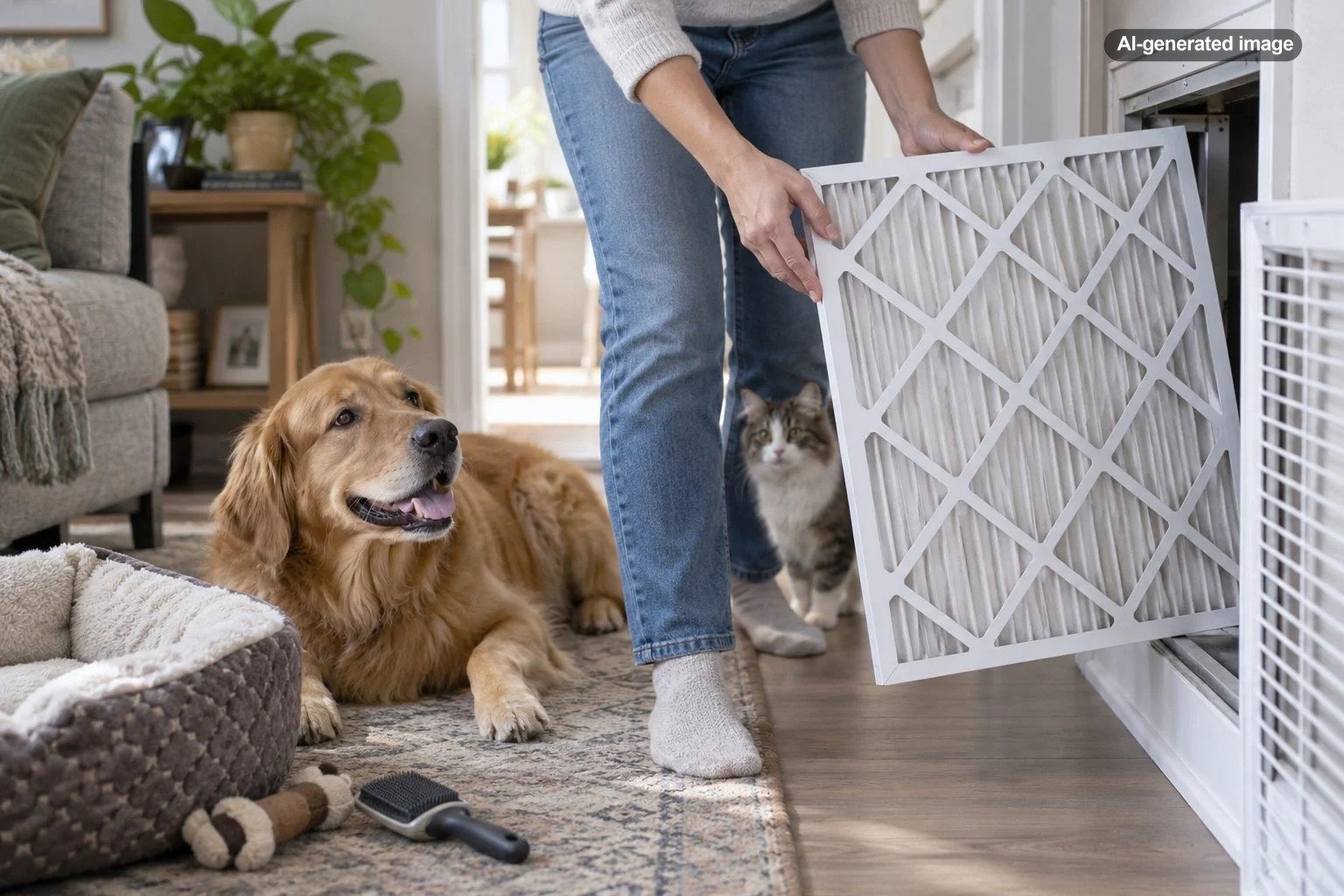
If you share your home with dogs, cats, or other furry companions, MERV 13 is a strong filtration target when your HVAC system can accommodate it. The U.S. Environmental Protection Agency recommends choosing a furnace or HVAC filter rated MERV 13, or the highest efficiency filter the system’s fan and filter slot can support. That makes MERV 13 a sensible starting point for households trying to capture more airborne pet-related particles without simply assuming that the highest number on the shelf is always appropriate.
The important qualification is compatibility. A higher-efficiency filter can create more resistance to airflow than a less restrictive filter, and HVAC systems differ in what they are designed to handle. If your equipment cannot comfortably use MERV 13, a lower rating such as MERV 11 may be the more practical choice. The goal is effective filtration and proper airflow, not a heroic filter wedged into a system that dislikes it.
What MERV Actually Measures
MERV stands for Minimum Efficiency Reporting Value. It is a standardized way to compare how effectively an air filter captures particles in several size ranges between 0.3 and 10 microns. In general, a higher MERV rating indicates greater capture efficiency for the particle sizes included in the test.
This distinction matters in a pet household because the visible fur floating across the floor is only part of the issue. Pet allergens can be associated with dander, saliva, urine, feces, and hair, according to the EPA. Some allergen-bearing particles are small enough to remain airborne and circulate through a forced-air system. A better filter can capture more of those particles when they actually pass through the filter.
MERV should not be confused with a promise that a filter removes every pet allergen from the house. Filtration affects particles that reach the HVAC return and pass through the filter. Allergens can also settle into upholstery, rugs, bedding, dust, and other surfaces, which is why housekeeping and source control still matter.
MERV 8, MERV 11, and MERV 13 for Pet Homes
The differences between common residential ratings become clearer when you look at the particle-size ranges in the MERV test. EPA data show that MERV 8 filters are rated to capture at least 20 percent of particles in the 1.0-to-3.0-micron range and at least 70 percent in the 3.0-to-10.0-micron range. MERV 11 increases those minimum efficiencies and is also rated for the smaller 0.3-to-1.0-micron range. MERV 13 raises efficiency again, including at least 50 percent capture in the 0.3-to-1.0-micron test range.
| Filter rating | Practical fit in a pet home | Main tradeoff |
|---|---|---|
| MERV 8 | Basic filtration for larger airborne particles and a common starting point in residential systems | Less effective than higher MERV ratings at capturing smaller airborne particles |
| MERV 11 | A useful middle ground when improved particle capture is wanted but MERV 13 is not appropriate for the system | Does not capture the smallest tested particle range as efficiently as MERV 13 |
| MERV 13 | A strong target for better filtration of smaller airborne particles in a compatible residential HVAC system | System compatibility and airflow must be considered |
The practical conclusion is not that every pet owner must use the same filter. A relatively modern system with a properly sized filter cabinet may be perfectly comfortable with MERV 13. Another home may have older equipment, a restrictive filter slot, duct limitations, or an airflow issue that deserves attention before a higher-efficiency filter is installed.
Why Pet Hair Is Not the Whole Story
It is tempting to judge a filter by how much fur you can see on it, but visible hair is relatively easy to understand and often settles before reaching the HVAC system. The less obvious concern is the collection of much smaller airborne particles associated with a pet household.
The EPA specifically identifies pet allergens, including proteins associated with dander, saliva, hair, urine, and feces, as possible asthma triggers for sensitive people. Enhanced filtration can help remove some of these particle-bound contaminants from circulating air. That is one reason MERV 13 is frequently discussed in indoor-air-quality guidance rather than simply recommending a coarse filter that catches obvious debris.
That does not make a central HVAC filter a substitute for cleaning. Vacuuming appropriate surfaces, washing pet bedding, controlling accumulated dust, and keeping return-air grilles unobstructed all help address material that may never become airborne long enough to reach the HVAC filter.
Do Not Choose a Filter by MERV Alone
A MERV number tells you about filtration efficiency under a standardized test. It does not tell you whether a particular filter is physically suitable for your furnace or air handler. Filter dimensions, depth, construction, airflow resistance, equipment design, duct conditions, and the condition of the existing system can all influence the real-world result.
EPA guidance advises homeowners upgrading to higher-efficiency filtration to choose MERV 13 or as high a rating as the system fan and filter slot can accommodate. When compatibility is uncertain, the equipment documentation or a qualified HVAC technician can help establish an appropriate limit.
The best pet-home filter is not the highest MERV number you can buy; it is the highest useful efficiency your HVAC system can support properly.
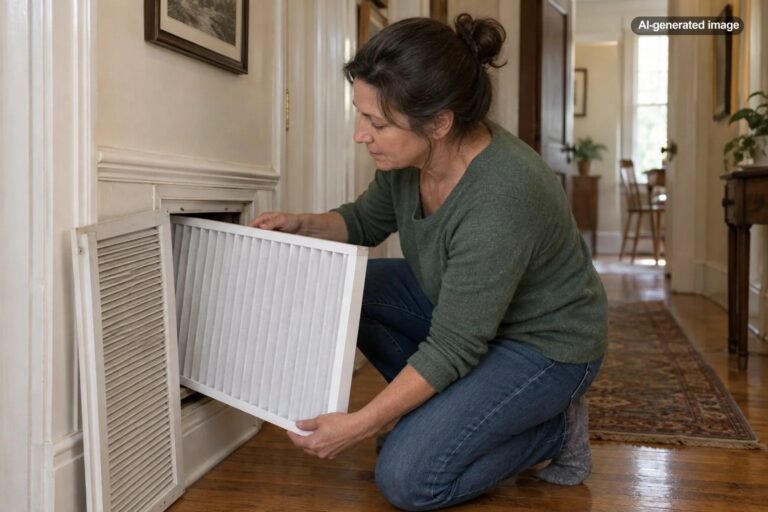
Also pay attention to fit. Air that leaks around a poorly fitted filter is not being filtered by the media at all. The filter should sit correctly in the intended rack or cabinet without being crushed, folded, or improvised into place.
How Often Should a Pet Household Check the Filter?
There is no responsible one-size-fits-all replacement calendar for every home. Filter construction, filter depth, HVAC runtime, number of pets, shedding, remodeling dust, outdoor air conditions, and the manufacturer’s instructions can all change how quickly a filter loads.
A household with several shedding pets may find that a filter accumulates debris faster than it would in a comparable pet-free house. Rather than relying only on an arbitrary calendar reminder, inspect the filter regularly and follow the replacement guidance supplied by the filter and HVAC manufacturers. A visibly loaded filter or a documented airflow concern deserves attention.
Before you decide
- Check the furnace or air-handler documentation for filter requirements.
- Confirm the exact length, width, and depth your filter cabinet accepts.
- Choose MERV 13 when the system is designed to accommodate it.
- If MERV 13 is unsuitable, use the highest compatible efficiency instead of forcing the issue.
- Install the filter in the correct airflow direction and make sure it fits properly.
- Inspect it regularly, especially in a home with multiple or heavily shedding pets.
Would a Portable Air Cleaner Help Too?
It can. Central HVAC filtration works only when air is moving through the system, so it does not continuously capture particles from every corner of the house. A properly selected portable air cleaner can supplement central filtration in rooms where pets and people spend substantial time.
For portable air cleaners, the buying language changes. Instead of focusing only on MERV, look at the unit’s clean air delivery rate, or CADR, and whether it is sized for the room. EPA guidance provides room-size recommendations for portable air cleaners and explains that central filtration and portable units can be used together when additional particle removal is desirable.
This can be especially practical when one bedroom, home office, or living area needs more filtration than the rest of the house. It is often more sensible than trying to make the central HVAC filter perform every indoor-air-quality job by itself.
What If Someone in the Home Has Allergies or Asthma?
Pet allergens can trigger symptoms in sensitive people, but an HVAC filter should not be treated as a diagnosis, treatment, or guarantee of symptom control. Filtration is one piece of indoor air management. People with asthma, significant allergies, or other respiratory concerns should follow guidance from their healthcare professionals about managing their individual triggers.
From the home-systems side, the sensible approach remains the same: improve particle filtration where the equipment allows it, reduce accumulated allergens on household surfaces, and avoid compromising HVAC performance in pursuit of a higher filter number.
The Bottom Line
For a home with pets, MERV 13 is the most useful general target when the HVAC system is compatible with it. It captures smaller particles more effectively than MERV 8 or MERV 11 under the MERV testing standard, which can be valuable in a household where pet-related particles contribute to indoor air concerns.
If your system cannot accommodate MERV 13, that does not mean you have failed the pet-hair Olympics. Use the highest appropriate rating the equipment can support, keep the filter properly fitted and maintained, and combine filtration with sensible cleaning and source control. A well-matched MERV 11 filter in a properly operating system is preferable to an incompatible upgrade chosen solely because the number on the package is higher.