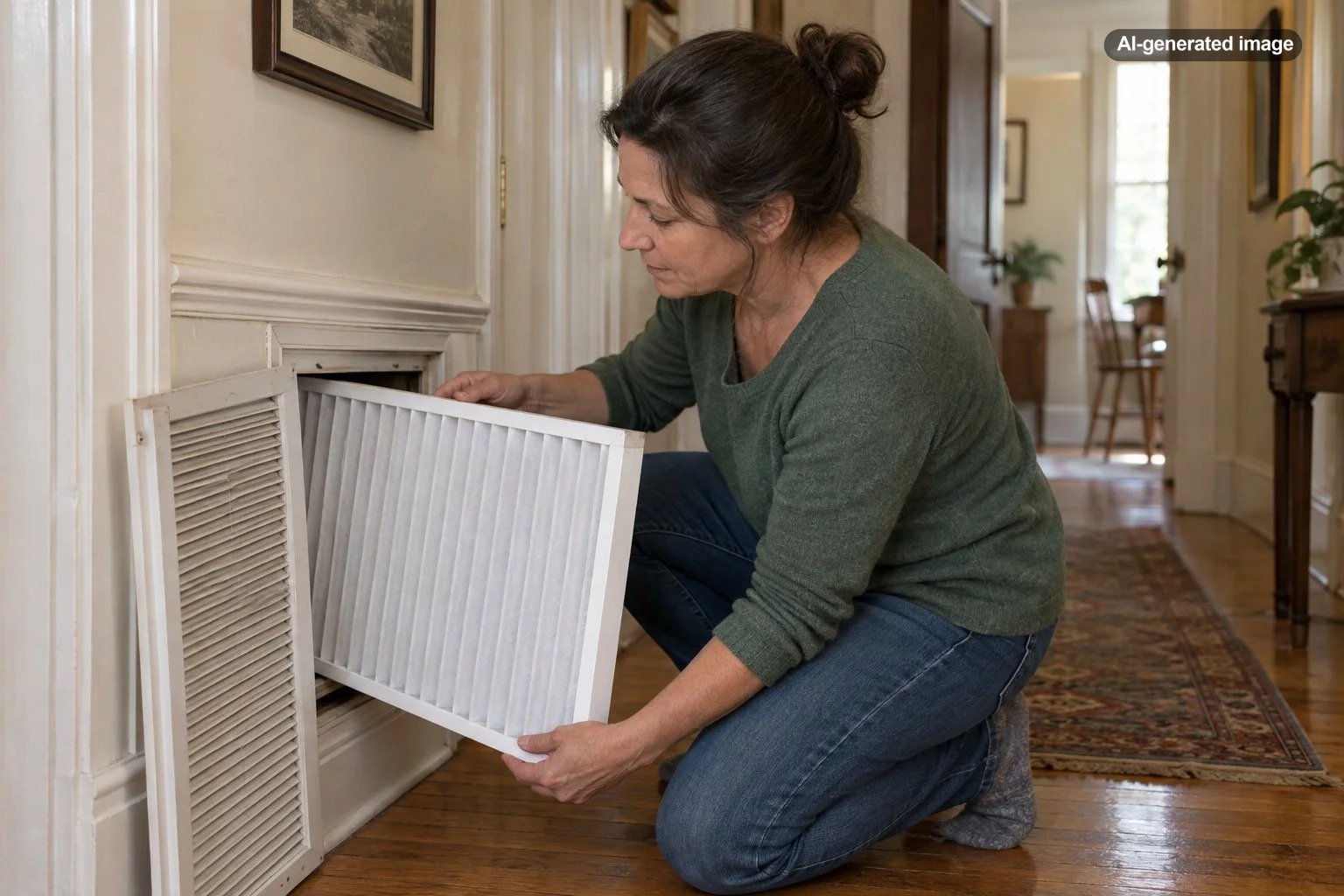
Can You Use a MERV 13 Filter in an Older Home?
Yes, you can often use a MERV 13 filter in an older home, but the age of the house itself is not the deciding factor. What matters is whether the heating and cooling system can move enough air through the filter without creating excessive resistance. The filter rack, blower, ductwork, and condition of the system all play a role.
The U.S. Environmental Protection Agency recommends using a filter rated at least MERV 13, or the highest efficiency filter the system’s fan and filter slot can accommodate. That last qualification is especially important in an older furnace or air-conditioning system, where airflow may already be limited by narrow ducts, an undersized return, a restrictive filter slot, accumulated dirt, or equipment that was never designed around higher-efficiency filtration.
What MERV 13 Actually Means
MERV stands for Minimum Efficiency Reporting Value. It is a standardized way of describing how effectively an air filter captures particles within specified size ranges. Higher MERV ratings generally indicate better particle capture.
According to the EPA, MERV ratings are useful for comparing filters used in central heating and cooling systems. MERV 13 filters can capture substantially smaller particles than the low-efficiency filters historically installed in many residential systems, making them attractive to homeowners who want better particle filtration.
There is an important distinction, however: filtration efficiency and airflow resistance are not the same thing. Two filters with the same MERV rating can have different pressure drops because of differences in filter depth, surface area, media design, and construction. A MERV number by itself does not tell you exactly how hard your blower must work to move air through a particular filter.
The right filter is not simply the highest MERV number you can fit into the slot; it is the most effective filter your HVAC system can operate with while maintaining proper airflow.
Why Older HVAC Systems Deserve a Closer Look
An older home may have a relatively new HVAC system, while a newer-looking house could still have aging equipment. That is why equipment condition matters more than the home’s construction date.
Older forced-air systems can present several complications. The blower may have limited ability to overcome additional resistance. Return ducts may be smaller than would be preferred in a modern installation. Filter racks may accept only thin filters with relatively little media surface area. Ducts, coils, or blower components may also have accumulated debris that contributes to existing airflow problems.
ASHRAE guidance emphasizes that higher-efficiency residential filters should be selected with pressure drop in mind. It also notes that deeper filters can sometimes provide greater filtration efficiency with less resistance than might be expected from a thinner filter because the additional pleated surface area gives air more media through which to pass.
How to Tell Whether Your System Can Handle MERV 13
Start with the HVAC equipment documentation if it is available. Look for guidance about filter size, permissible filter resistance, airflow requirements, or recommended filtration. The EPA advises consulting the HVAC manual or a professional when determining the highest-efficiency filter the system can accommodate.
What to do
- Confirm the correct filter dimensions. Use the size designed for the rack rather than forcing a thicker or differently sized filter into the opening.
- Check the equipment documentation. Look for filtration and airflow requirements from the furnace, air handler, or HVAC manufacturer.
- Inspect the existing filter setup. A damaged rack, gaps around the filter, crushed media, or a filter installed backward should be corrected regardless of MERV rating.
- Notice how the system performs now. Weak airflow, unusually long heating or cooling cycles, rooms that are difficult to condition, or a system that already seems airflow-starved deserve investigation before increasing filtration resistance.
- Have static pressure or airflow checked when there is doubt. A qualified HVAC technician can evaluate how the complete duct-and-equipment system responds rather than guessing from the filter rating alone.
Signs a Higher-Efficiency Filter May Be Too Restrictive
A filter change should not cause a noticeable collapse in airflow. If supply registers suddenly deliver much less air after a filter upgrade, that deserves attention. Other symptoms can include comfort problems or unusually long run times, although those symptoms have many possible causes and should not be treated as proof that the filter is responsible.
Restriction becomes more likely as a filter loads with captured material, which is one reason routine replacement matters. The EPA notes that filters require periodic replacement to function properly. Replacement timing should follow the equipment and filter manufacturer’s instructions rather than an arbitrary schedule that assumes every household produces the same particle load.
Filter Thickness Can Matter as Much as the Rating
One of the most useful upgrades in some homes is not simply moving from a lower MERV rating to MERV 13, but improving the filter arrangement itself. A deeper media filter can offer substantially more surface area than a typical one-inch filter. More surface area can help reduce resistance for a given level of filtration, depending on the specific filter design.
That does not mean you should install a deeper filter in a rack that was not designed for one. Modifying ductwork or a filter cabinet is a job that should be planned around the equipment, available space, service access, and airflow requirements. If the existing rack accepts only a thin filter, an HVAC professional can determine whether a larger media cabinet is practical.
What If Your Older System Cannot Comfortably Use MERV 13?
If the system cannot accommodate MERV 13, that does not mean you should abandon filtration. The EPA recommends using the highest-rated filter the system can accommodate. A properly fitted filter that maintains appropriate airflow is preferable to choosing a nominally higher rating that creates an operational problem.
You can also address indoor particle levels in other ways. Source control, appropriate ventilation, regular housekeeping, and properly sized portable air cleaners can complement central HVAC filtration. A portable air cleaner can be particularly useful when better filtration is needed in a specific room but the central system has limited capacity for a higher-resistance filter.
Remember that a central HVAC filter works on air passing through the system. Better filter efficiency does not help much while the blower is off, and operating the fan for longer periods has its own energy-use and humidity-control considerations. Whole-house filtration should therefore be treated as one part of an indoor-air-quality strategy rather than as a standalone solution.
Does an Older Home Need MERV 13?
Not every household has the same filtration priorities. MERV 13 may be particularly appealing when reducing fine airborne particles is a goal, but the sensible choice still depends on the HVAC system’s capabilities.
Homeowners should also avoid assuming that a high MERV number fixes unrelated indoor-air problems. Filtration does not correct moisture intrusion, combustion-safety problems, inadequate exhaust ventilation, dirty ductwork, or an HVAC system that is improperly sized or maintained. Those issues require their own diagnosis and solutions.
Before you decide
- Verify the filter size and orientation required by the system.
- Check manufacturer guidance when available.
- Compare filter pressure-drop information rather than relying only on the MERV number.
- Consider whether the system already has weak airflow or comfort problems.
- Keep replacement access and maintenance practical.
- Ask an HVAC professional to evaluate airflow or static pressure when compatibility is uncertain.
Frequently Asked Questions
Will a MERV 13 filter damage an old furnace?
Not necessarily. Many systems can operate with MERV 13 filtration, but compatibility depends on the filter’s resistance and the HVAC system’s airflow capability. Consult the equipment documentation or have the system evaluated if you are unsure.
Is MERV 13 always more restrictive than MERV 8?
No. Higher filtration efficiency can increase pressure drop, but MERV rating alone does not determine resistance. Filter design, depth, media area, and construction all affect pressure drop, and some higher-efficiency filters are designed to maintain relatively low resistance.
Can I simply put a MERV 13 filter in the existing one-inch slot?
Only if the filter fits properly and the HVAC system can handle its airflow resistance. Physical fit alone does not establish compatibility.
Should I use the highest MERV rating available?
Use the highest efficiency that your system can accommodate while maintaining proper airflow. The EPA specifically frames its guidance this way rather than recommending that every homeowner install the highest numerical rating available.
The Bottom Line
An older home can often use a MERV 13 filter successfully. The critical question is not how old the house is, but whether the HVAC system, filter rack, blower, and ductwork can handle the particular filter without compromising airflow.
Check the equipment requirements, use a correctly sized filter, pay attention to pressure drop, and do not ignore existing airflow problems. When the system’s capabilities are unclear, a professional airflow or static-pressure assessment is a much better basis for choosing a filter than guessing from the MERV number alone.