Can a Nearby Air Vent Affect a Smart Thermostat Reading?
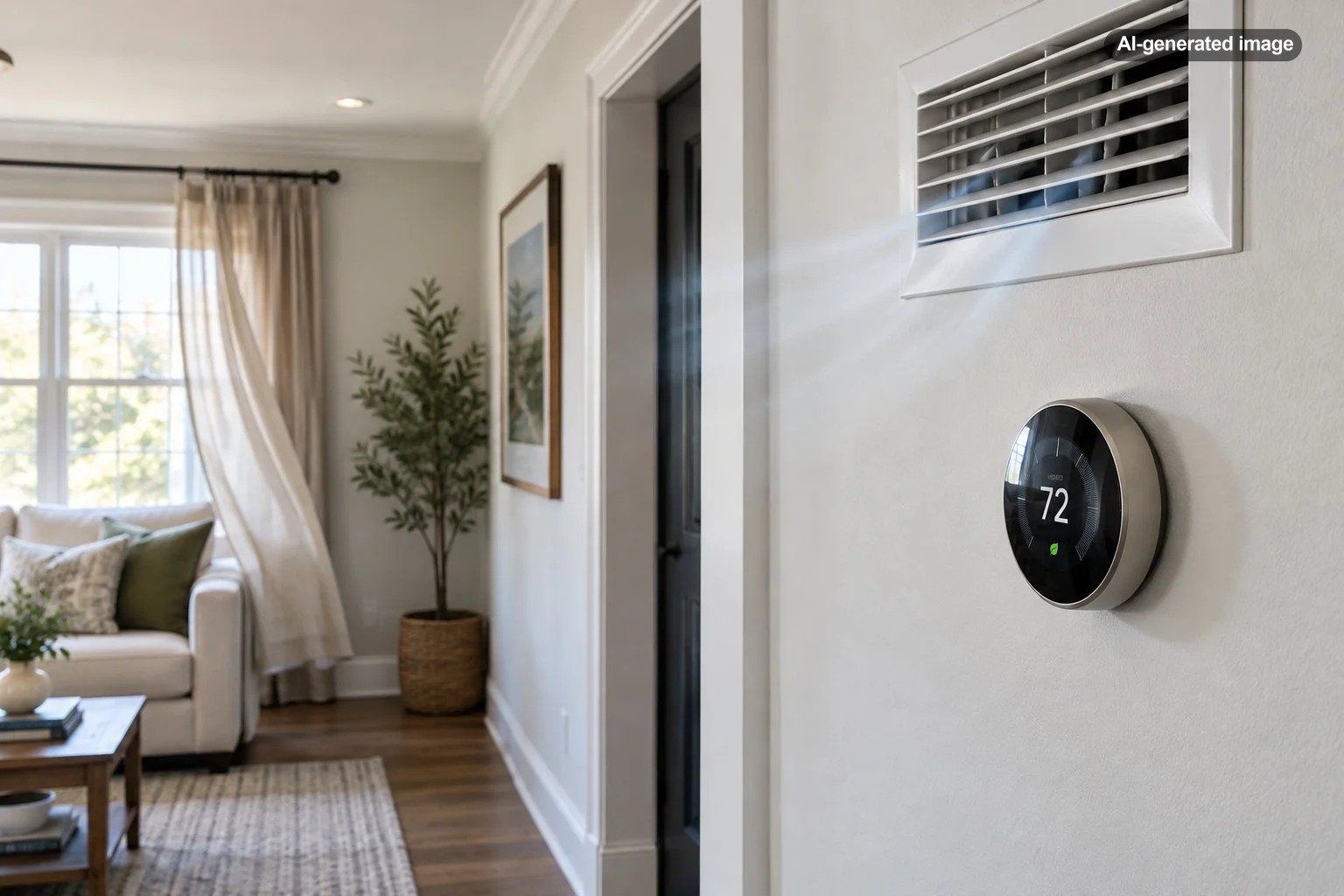
Yes. A nearby heating or cooling vent can affect a smart thermostat’s temperature reading, especially when conditioned air blows toward the thermostat or creates a pocket of unusually warm or cool air around it. The thermostat may be working correctly while measuring a temperature that does not represent the room as a whole.
That matters because the HVAC system typically responds to the temperature where its controlling thermostat or active sensor is located. If that location heats up or cools down faster than the occupied part of the room, the system can shut off too soon, run longer than expected, or leave other areas feeling uncomfortable.
Why a nearby vent can change the reading
A thermostat does not measure the average temperature of an entire house. Its internal sensor measures the air and surrounding conditions at one location. When a supply vent sends heated or cooled air near that location, the thermostat can experience a different temperature from someone sitting several feet away.
Cooling provides an easy example. Suppose a wall thermostat is close to a ceiling or wall register and the register’s air stream reaches the thermostat. When the air conditioner starts, the air immediately around the thermostat may cool relatively quickly. The thermostat can reach the set temperature before the center of the room, a neighboring room, or furniture-level occupied areas have caught up.
Heating can create the opposite version of the same problem. Warm supply air may cause the thermostat area to reach the heating setpoint while the rest of the space still feels cool. The exact result depends on vent direction, room layout, air circulation, HVAC runtime, and where the thermostat sits within the airflow pattern.
This placement principle is not unique to smart thermostats. Resideo installation guidance for thermostats calls for a location with good air circulation at an average temperature and specifically warns against locations affected by hot or cold air from ducts. Google gives similar placement guidance for Nest temperature sensors, advising against placement near heating vents and other heat sources.
How close is too close to an air vent?
There is no single distance that works for every house because airflow depends on the type of register, its direction, fan speed, ceiling height, furniture, and room geometry. A vent several feet away can sometimes matter if it throws air directly toward the thermostat, while a closer register may have little effect if its airflow is directed elsewhere.
Instead of concentrating only on distance, look at airflow exposure. The more important question is whether conditioned air reaches the thermostat significantly earlier or more directly than it reaches the occupied part of the room.
Thermostat placement guidance commonly favors an interior wall with good circulation and a representative room temperature. Installation documents from Resideo also identify drafts, doors, corners, direct sunlight, ducts, and unconditioned areas behind the wall as conditions that can influence readings. ENERGY STAR educational guidance similarly advises placing thermostats away from heating or cooling vents and drafts.
Signs the vent may be influencing the thermostat
A vent-related placement problem usually shows up as a pattern rather than one strange temperature reading. Look for differences that repeat when the HVAC system operates.
- The thermostat reaches the cooling setpoint quickly, but the room still feels warm farther from the thermostat.
- The heat turns off while seating areas or adjacent spaces still feel noticeably cooler.
- The displayed temperature changes unusually quickly soon after airflow begins.
- A separate room thermometer consistently differs from the thermostat during active heating or cooling but becomes closer after the system has been off for a while.
- The problem is strongest when a nearby adjustable register points toward the thermostat.
Those clues do not prove that the vent is the cause. Poor air balance, duct issues, insulation differences, solar gain, thermostat calibration, zoning, equipment operation, and ordinary temperature differences between rooms can produce similar symptoms.
A simple way to investigate the problem
What to do
- Observe the airflow. With the system running, determine whether air from the nearby register travels toward or across the thermostat.
- Compare locations. Place a reliable room thermometer near the main occupied area, away from direct sun, supply air, exterior doors, and obvious heat sources. Allow time for it to stabilize before comparing readings.
- Watch a complete HVAC cycle. Note how the thermostat and comparison thermometer change before, during, and after the system runs. A repeated difference during active airflow is more useful than one isolated reading.
- Check other local influences. Look for sunlight, lamps, electronics, exterior-wall effects, nearby doors, concealed drafts, or blocked airflow around the thermostat.
- Consider placement rather than compensating endlessly. If the thermostat clearly sits in an unrepresentative microclimate, an HVAC professional can evaluate whether relocating it, changing the sensing strategy, or addressing airflow is appropriate.
Avoid using a single handheld temperature check as definitive proof. Small differences between devices are possible, and temperatures within the same room are rarely perfectly uniform. The useful question is whether the thermostat location repeatedly behaves differently enough to affect comfort or HVAC operation.
Should you close or redirect the nearby vent?
Redirecting an adjustable register slightly away from the thermostat may help determine whether direct airflow is part of the problem, but closing vents aggressively is not a universal solution. HVAC systems are designed around airflow, and substantial changes to register positions can affect pressure, comfort, noise, and system performance.
If several vents need to be closed to make one thermostat behave properly, the better next step is usually to investigate thermostat placement and overall air distribution rather than treating the registers as permanent correction devices. Google likewise cautions in its Nest sensor troubleshooting guidance that changing adjustable vents can have system consequences and recommends professional guidance when making meaningful airflow changes.
Would a remote temperature sensor help?
Sometimes. Certain smart thermostat systems support remote room sensors that allow temperature to be measured somewhere other than the thermostat itself. That can be useful when the thermostat’s existing wall location is inconvenient to change or when comfort in a particular occupied room matters more at certain times.
A remote sensor still needs thoughtful placement. Google’s guidance for Nest temperature sensors recommends locations with representative conditions and specifically advises against vents, direct sunlight, poorly insulated surfaces, enclosed spaces with inadequate air circulation, and other unusually hot or cold locations.
A sensor is therefore not a shortcut around placement principles. It simply gives a compatible system another location from which to measure temperature.
Affiliate disclosure: CraneManor.com may earn a commission when you purchase through links on this page. This does not affect the price you pay. Learn more.
If you are considering replacing an older control rather than adding a remote sensor, a compatible smart thermostat such as the Google Nest Thermostat can provide app-based control and scheduling features. Verify that the thermostat is compatible with your HVAC equipment and wiring before purchasing or installing it; compatibility is not universal.
What if the thermostat cannot easily be moved?
Moving a thermostat can involve low-voltage wiring, wall repair, system configuration, and choosing a genuinely better sensing location. Simply shifting it to the closest visually convenient wall may trade one problem for another.
If relocation is impractical, there may still be options. Depending on the system, these can include a compatible remote sensor, professional airflow adjustments, correcting a draft behind or around the thermostat, or addressing another source of local heating or cooling. The appropriate fix depends on what is actually distorting the reading.
Other placement problems that can look like a vent problem
Supply-air exposure is only one way to create a misleading thermostat reading. Before relocating hardware, consider whether any of these conditions are more important:
- Direct sunlight: Solar heating can make the thermostat area warmer than the room.
- Exterior doors or drafts: Outdoor air can create short-lived temperature changes around the sensor.
- Exterior or poorly insulated walls: The wall surface itself may be warmer or cooler than interior conditions.
- Appliances and electronics: Nearby heat-producing equipment can influence a sensitive temperature sensor.
- Dead-air locations: Corners, enclosed shelving, curtains, or other obstructions can prevent representative room air from reaching the sensor.
- Different room loads: Large windows, high ceilings, upper floors, and room orientation can create legitimate temperature differences even when the thermostat is well placed.
The goal is not to make every corner of the house display exactly the same temperature. It is to ensure that the temperature controlling the HVAC system reasonably represents the area whose comfort matters.
When professional evaluation makes sense
Consider an HVAC professional when a thermostat may need relocation, wiring changes are involved, the system cycles abnormally, multiple rooms have persistent comfort problems, or adjusting registers causes new airflow issues. An HVAC technician can assess thermostat placement as part of the larger system rather than treating the displayed temperature in isolation.
For a newly installed smart thermostat, also follow the manufacturer’s installation and compatibility instructions. Do not assume that inaccurate-looking room temperatures are automatically caused by software, calibration, or a defective thermostat when the physical sensing location may be the underlying issue.
A smart thermostat can make sophisticated decisions only from the temperature information available at the place where that temperature is being measured.
FAQ
Can an air vent make a thermostat read colder than the room?
Yes. During air-conditioning operation, cool supply air reaching the thermostat can make its immediate location cool faster than the rest of the room. The displayed temperature may therefore be accurate locally while being unrepresentative of the occupied space.
Can a heating vent make the thermostat shut the heat off early?
It can if warm supply air significantly affects the thermostat’s sensing area. The thermostat may reach the setpoint before more distant parts of the room have warmed sufficiently.
Should a thermostat be placed directly above a vent?
Generally, a thermostat should not be placed where hot or cold supply air directly influences its sensor. Manufacturer installation guidance commonly favors good air circulation at an average room temperature and avoidance of ducts, drafts, direct sunlight, and other local temperature influences.
Does a smart thermostat automatically compensate for poor placement?
Do not assume that it will. Smart features can improve scheduling, control, and sensing options, but the thermostat or active remote sensor still needs temperature information from a representative location.