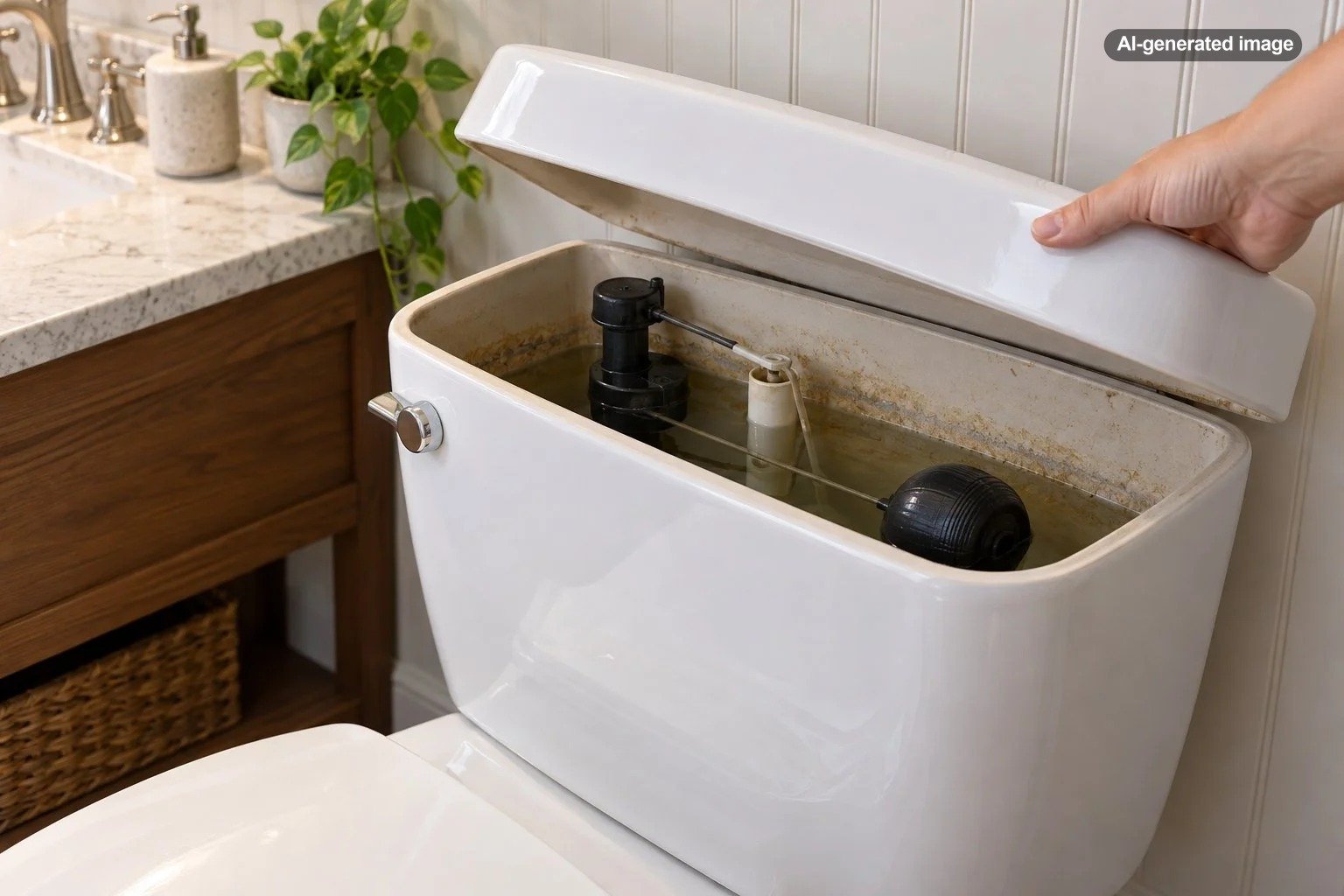
Why Does Toilet Tank Water Smell Musty?
A musty smell coming from toilet tank water usually points to a buildup of organic residue or microbial film inside the tank, water that has been sitting unused, or an odor already present in the household water supply. The tank may look reasonably clean from the outside while its submerged surfaces hold a thin film or sediment. Fortunately, an isolated tank odor can often be investigated with a few straightforward checks before assuming that something more serious is wrong.
The important distinction is where the smell actually originates. An odor concentrated inside the tank calls for a different response than one coming from the toilet bowl, the bathroom floor, or every cold-water faucet in the house.
What Causes a Musty Smell Inside a Toilet Tank?
A toilet tank is a reservoir that repeatedly fills with cold water. Although a functioning toilet replaces much of that water with each flush, the tank still contains submerged surfaces, seals, mechanical parts, and sheltered corners where deposits can collect.
Several conditions can make the water or the air immediately above it smell unpleasant.
1. Biofilm on the tank walls and components
Biofilm is a layer of microorganisms and accumulated material that can develop on wet surfaces. Inside a toilet tank, it may appear as a slippery coating, discolored film, or deposits around the fill valve, overflow tube, and other components.
The organisms and organic material associated with a film may contribute to an earthy or musty odor. However, the presence of an odor alone cannot identify a particular microorganism, and a discolored surface does not automatically establish that hazardous mold is present.
Biofilm is more likely to become noticeable where surfaces are difficult to clean or where deposits have accumulated over time.
2. Water sitting in a rarely used toilet
A guest bathroom, seasonal residence, or second-floor toilet may go unused for long stretches. During that time, tank water is not replenished as frequently, and existing deposits remain in contact with the water.
One useful clue is whether the odor is strongest when the tank is opened after an extended period of inactivity. If several normal flushes noticeably reduce the smell, infrequent water turnover may be contributing.
Flushing does not remove deposits attached to the tank, so an odor that repeatedly returns may still require cleaning.
3. Sediment and mineral deposits
Depending on the water supply, a toilet tank may accumulate mineral scale, rust-colored particles, or other sediment. These materials do not necessarily smell musty by themselves, but rough deposits can provide places for organic residue to collect.
Check the tank bottom and the area around the waterline. A light layer of sediment calls for a different response than thick accumulations, heavy corrosion, or material that repeatedly returns soon after cleaning.
4. Aging rubber and plastic components
Flappers, seals, and other internal components can deteriorate with age or chemical exposure. Some produce a noticeable rubbery or stale smell, while degraded surfaces may also collect residue.
If the odor seems strongest near a particular component, inspect it for cracking, softness, warping, or visible deterioration. Do not replace a part solely because it smells unusual; determine whether its condition or operation actually warrants replacement.
5. An odor entering with the water supply
Sometimes the tank is simply where a household water odor becomes noticeable. Naturally occurring compounds associated with aquatic organisms can give water an earthy or musty smell. The EPA identifies geosmin and 2-methylisoborneol as examples of compounds associated with these odors.
Such odor compounds are not necessarily evidence of a health hazard, but smell alone cannot establish that water is safe. A newly developed odor in multiple fixtures deserves attention, particularly in a home supplied by a private well.
How to Tell Whether the Smell Comes From the Tank, Bowl, or Water Supply
Before cleaning anything, take a moment to narrow down the source. This prevents unnecessary chemical treatments and helps distinguish an ordinary maintenance problem from a plumbing or water-quality concern.
What to check first
- Compare the bowl and tank. Notice whether the smell is present around the closed toilet, becomes stronger when the tank lid is lifted, or is concentrated near the bowl.
- Check nearby cold water. Run cold water from the bathroom sink into a clean glass. Move away from the drain before checking whether the water itself has a similar odor. Never taste water you suspect may be contaminated.
- Flush and compare. If the toilet has been unused, flush normally a few times and notice whether the tank odor changes.
- Inspect visible surfaces. Look for film, sediment, staining, deteriorated parts, and moisture outside the tank.
- Check another fixture. If the same smell appears in another bathroom or kitchen faucet, consider a wider water-supply issue.
For example, a guest bathroom toilet that smells stale after several weeks of nonuse, while every faucet smells normal, points toward a localized tank condition. A musty odor appearing simultaneously at multiple cold-water fixtures suggests that cleaning one toilet is unlikely to resolve the underlying cause.
Can a Musty Toilet Tank Mean There Is Mold?
It can, but the smell alone is not enough to make that determination. Mold and other microorganisms can grow on persistently damp surfaces, and a toilet tank provides moisture. Nevertheless, brown, black, pink, or gray residue is not reliable proof of a specific organism.
Mineral staining, sediment, bacterial films, and deteriorating materials can create similar visual clues. Trying to identify a substance by its color is less useful than establishing where it forms, whether it returns after cleaning, and whether moisture is escaping beyond the tank.
A small amount of removable residue inside an otherwise functioning tank is generally a different situation from extensive growth on surrounding walls, persistent leaks, or contamination affecting household water.
How to Clean a Toilet Tank That Smells Musty
For ordinary accessible residue, mechanical cleaning is a sensible starting point. The goal is to remove the buildup without damaging the toilet’s seals, valves, protective surfaces, or flushing mechanism.
Start with a simple inspection
Put on household cleaning gloves and carefully lift the tank lid with dry hands. Ceramic lids are heavy and can break, so place the lid on a stable, protected surface.
Use good lighting to examine the tank. If you notice a strong chemical smell, damaged plumbing, or substantial contamination, stop and determine the cause before proceeding.
Drain enough water to reach the affected surfaces
Locate the toilet’s shutoff valve, usually near the wall or floor behind the toilet. If it operates normally, gently turn off the water and flush to lower the water level. Do not force a stuck or corroded valve.
Some water will generally remain at the bottom of the tank. A sponge or cloth can help remove accessible water if necessary. Keep electrical devices and powered cleaning tools away from the wet area.
Remove deposits with gentle cleaning
Use a soft cloth or nonabrasive sponge with a small amount of mild soap or a manufacturer-approved cleaner suitable for the tank materials. Gently wipe accessible tank walls and areas with visible deposits.
Avoid bending the float, moving the fill-valve adjustment, pulling on the flush chain, or disturbing rubber seals. Do not scrub aggressively around fragile or deteriorated components.
Remove loosened debris with a cloth or sponge rather than intentionally pushing large amounts of sediment through the flush mechanism.
Rinse, refill, and recheck
After cleaning, remove remaining soap and loosened material with clean water and a sponge. Reopen the shutoff valve and allow the tank to refill. Flush normally, confirm that the toilet stops filling, and inspect around the supply connection and tank base for leakage.
Check the odor again after normal use. If it disappears and the toilet operates correctly, routine observation may be all that is needed.
What Should You Avoid Putting in a Toilet Tank?
It is tempting to pour a strong cleaner directly into the tank, especially when a smell has been lingering. However, aggressive chemical treatments can cause more trouble than the original odor.
Do not mix bleach with ammonia, acids, vinegar, toilet bowl cleaners, or other cleaning products. Dangerous vapors can result. The CDC advises against mixing household bleach or disinfectants with other cleaners.
Do not assume that a cleaner formulated for the toilet bowl is also suitable for prolonged contact with tank parts. Some in-tank chemical tablets and harsh cleaning agents may degrade rubber and plastic components or conflict with toilet manufacturer instructions.
Also avoid boiling water, metal scrapers, aggressive abrasives, and improvised mixtures of multiple disinfectants. Cleaning should focus on removing deposits, not subjecting every internal component to a chemical soak.
Why Does the Musty Smell Return After Cleaning?
When an odor returns quickly, consider what the cleaning may not have addressed. A wiped tank wall does not necessarily eliminate sediment beneath components, deposits around the waterline, or material attached to aging seals.
Recurring smells can also indicate that the odor is arriving with incoming water or originates somewhere other than the tank.
The timing offers useful clues:
- Odor returns after long periods without flushing: Infrequent use and recurring deposits may be involved.
- Odor returns immediately after the tank refills: Check whether the incoming cold water has the same smell.
- Odor continues despite a clean-looking tank: Recheck the bowl, bathroom drain, surrounding surfaces, and plumbing connections.
- Odor returns along with visible leaks or deteriorated components: Arrange a plumbing inspection rather than repeatedly cleaning around damaged parts.
Persistent recurrence is a reason to refine the diagnosis, not necessarily to increase the strength of the cleaning solution.
When Is a Musty Water Smell a Larger Water-Quality Concern?
A musty odor limited to one toilet is generally approached as a localized maintenance problem first. A widespread change in water smell deserves a different response.
If your home receives municipal water, contact the water utility when an unexplained odor affects several cold-water fixtures, particularly if it begins suddenly or accompanies discoloration. The utility can explain known water-quality conditions and advise whether further investigation is warranted.
For private wells, the EPA recommends additional water testing when owners notice a change in odor, color, or taste. A qualified laboratory or local health department can help identify appropriate tests. An odor cannot reliably identify all possible contaminants, and some important water-quality problems have no noticeable smell.
Until a significant unexplained water-quality concern has been evaluated, follow guidance from the water supplier or local health department about drinking, cooking, and other household uses.
How to Prevent Musty Odors From Returning
Once the tank is clean and the cause has been reasonably identified, prevention is usually more about ordinary maintenance than specialized equipment.
A practical maintenance checklist
- Flush toilets in infrequently used bathrooms periodically to refresh the water.
- Inspect the inside of the tank occasionally for visible residue and sediment.
- Address running toilets, slow leaks, and faulty fill or flush components.
- Use cleaning products only where the toilet manufacturer permits them.
- Keep the tank lid properly seated to limit dust and debris entering from above.
- Investigate unexpected moisture around the toilet instead of assuming it comes from routine condensation.
In bathrooms that are rarely used, it can also help to inspect the area around the toilet for slow supply-line leaks. Water accumulating outside the tank is a separate problem that can damage flooring and nearby materials.
Affiliate disclosure: CraneManor.com may earn a commission when you purchase through links on this page. This does not affect the price you pay. Learn more.
For households that want an additional warning for unexpected water on the floor, a set of water leak detectors can provide local audible alerts in leak-prone areas near toilets and other fixtures. These alarms are not a solution for musty tank water, and they do not diagnose water quality. Their purpose is to alert someone nearby when water reaches a sensor.
Frequently Asked Questions
Is it normal for toilet tank water to smell earthy?
A faint earthy smell may occur when residue accumulates or water sits unused, but a persistent or newly developed odor is worth investigating. Compare the tank with nearby faucets before deciding whether the issue is localized.
Can a toilet tank smell musty even when the water looks clear?
Yes. A film on submerged surfaces, accumulated deposits, or odor compounds in the incoming water can affect smell without making the tank water visibly cloudy. Clear appearance alone does not establish water quality.
Will flushing several times remove the smell?
Flushing may help when infrequent use is contributing to the problem. It will not reliably remove biofilm, mineral deposits, or deteriorated material attached to tank surfaces.
Should I replace the toilet if the tank smells musty?
Usually not as a first step. Start by identifying the odor source, cleaning accessible residue, and checking the condition of internal components. Replacement may be considered for significant physical damage or persistent mechanical problems that cannot reasonably be corrected.
Can a musty toilet tank make the whole bathroom smell?
It is possible for a noticeable tank odor to contribute to the overall bathroom smell, particularly when the lid is removed. However, a strong odor throughout the room may also originate from the bowl, a drain, damp surrounding materials, or another moisture source.
The Bottom Line
Musty toilet tank water most often calls for a careful inspection of residue, water turnover, and the condition of internal components. The most useful first move is to determine whether the smell is isolated to the tank or appears in the home’s water supply.
Gentle cleaning and normal flushing may resolve a localized issue. If the odor keeps returning, occurs throughout the home, or accompanies leakage or other warning signs, further plumbing or water-quality evaluation is more useful than repeatedly adding chemicals to the tank.
Sources & Further Reading
- U.S. Environmental Protection Agency: Secondary Drinking Water Standards – Background on aesthetic water-quality concerns, including taste and odor.
- U.S. Environmental Protection Agency: Protect Your Home’s Water – Guidance for private well owners, including when changes in odor warrant testing.
- U.S. Environmental Protection Agency: Potable Reuse Compendium – Discussion of naturally occurring compounds responsible for earthy and musty water odors.
- Centers for Disease Control and Prevention: Cleaning and Disinfecting with Bleach – Safety guidance on disinfectants, ventilation, and the dangers of mixing cleaners.