
Why Does My Screen Door Slam Shut?
Your screen door probably slams shut because its closer is set too fast, the closer has worn out, the door is out of alignment, or a spring is applying more force than the door needs. Wind, temperature changes, loose mounting hardware, and a latch that requires extra momentum can make the problem worse.
The good news is that many slamming doors can be improved with a careful adjustment and a few minutes of inspection. The important part is identifying which type of closing mechanism you have before turning screws or moving brackets.
The door closer is adjusted too fast
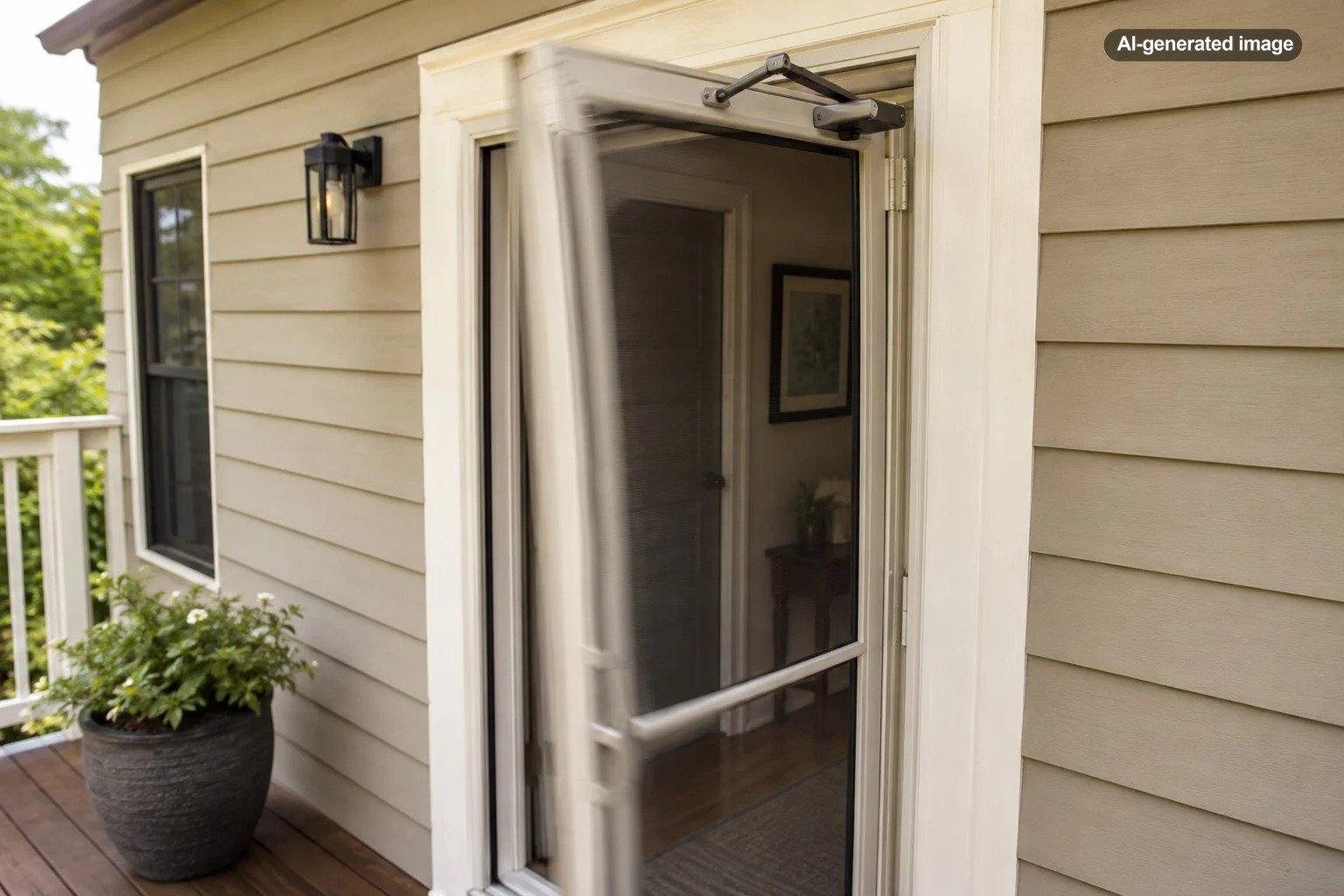
Many storm and screen doors use a pneumatic or hydraulic-style closer: a narrow cylinder mounted between the door and its frame. The closer controls how quickly the door returns after you release it.
A small adjustment screw or knob usually regulates the closing speed. When the setting allows the door to move too freely, it can accelerate through the final part of its swing and hit the frame with an impressive amount of enthusiasm.
Adjustment directions vary by closer design, so look for the manufacturer’s instructions when possible. On many common pneumatic closers, turning the adjustment clockwise slows the door and turning it counterclockwise speeds it up. That convention is common, but it is not universal enough to justify forcing an unfamiliar screw.
What to do
- Open and close the door while watching the closer, hinges, and latch.
- Locate the speed-adjustment screw or knob at the end of the closer.
- Turn it only about one-quarter turn toward the slower setting.
- Release the door from a normal opening angle and observe the full swing.
- Repeat in small increments until the door closes smoothly and still latches.
Avoid removing the adjustment screw completely. Depending on the design, doing so may release internal pressure or fluid and leave the closer unusable.
The closer is worn, bent, or leaking
An adjustment cannot correct a closer that is physically failing. If the cylinder is bent, the rod is scored, the mounting points are distorted, or oily residue appears around the closer, replacement may be more sensible than continued tweaking.
A worn closer may also behave inconsistently. The door might close gently during one test and slam during the next, especially after the door has been opened farther. Inconsistent resistance is a useful clue that the internal mechanism is no longer controlling the swing properly.
Before replacing anything, confirm that the closer itself is the problem. Disconnecting a closer for inspection changes how the door moves and can allow it to swing freely, so support the door and follow the applicable product instructions.
A spring hinge or tension spring is too strong
Not every screen door uses a cylinder closer. Lightweight wood, aluminum, and vinyl doors may use spring-loaded hinges or a long tension spring attached to the frame. These systems pull the door closed mechanically rather than cushioning its movement through a cylinder.
Excess spring tension can make the door snap shut. A spring may have been installed in the wrong position, shortened too aggressively, or adjusted to compensate for a latch problem. The result is a door that closes forcefully even though its hinges move freely.
Spring-hinge adjustments are highly design-specific. Some hinges have a tension pin and adjustment holes; others require a particular tool or disassembly sequence. Do not improvise with pliers on a loaded spring. Stored tension can move parts suddenly and damage the hardware or your hands.
The hinges or frame are out of alignment
A door that hangs unevenly may drag for part of its movement and then break free, creating a sudden burst of speed. Look at the gaps around the door while it is closed. Ideally, the spacing should appear reasonably even rather than tight at one corner and wide at another.
Loose hinge screws are a common place to begin. Tighten them carefully, but do not overtighten screws in thin aluminum or damaged wood. A screw that spins without tightening may no longer have enough material to grip, and repeatedly driving it harder can enlarge the hole.
Also check whether the closer bracket is pulling at an angle. A crooked bracket can make the closer bind, flex, or operate differently through various parts of the swing. Bent hinges, a twisted door slab, or a frame that has shifted may require more than a simple adjustment.
The latch needs too much force
Sometimes a door is intentionally set to close quickly because it will not latch otherwise. That solves one symptom by creating another.
Close the door slowly by hand and notice what happens near the latch. If the latch bolt strikes the edge of the plate, rubs heavily, or stops before engaging, the strike plate and door may be misaligned. Dirt, paint buildup, loose handle hardware, or a sagging door can also create resistance.
The goal is not to make the door slam hard enough to overcome a bad fit. The better approach is to correct the alignment or obstruction so the latch engages with moderate closing force.
Wind and pressure changes are accelerating the door
A screen door can behave differently depending on wind direction and whether the main entry door is open. A breeze can push a lightweight door, while air pressure between the screen door and entry door can alter the final part of the closing motion.
Test the door on a calm day and with the main door in different positions. If slamming occurs only during strong winds, adjustment may help, but it may not eliminate every forceful closure. Do not depend on a small closer to restrain a door in severe weather.
Seasonal temperature changes can also affect some closer mechanisms. A setting that felt right in mild weather may become faster or slower as conditions change. That does not always mean the closer has failed; it may need a modest seasonal adjustment.
The closer bracket is mounted in the wrong position
Closer performance depends partly on geometry. If a replacement closer or bracket was installed too far forward, too far back, or at the wrong angle, the unit may apply excessive force or reach the end of its travel before the door closes.
Look for warning signs such as a rod that appears fully extended while the door is still moving, a bracket that flexes, or screws pulling out of the frame. Compare the installation with the instructions for the exact closer rather than assuming every model uses the same hole locations.
A properly adjusted door should close with control, meet the frame without a crash, and use only enough final force to engage the latch.
What not to do
- Do not remove an adjustment screw completely unless the manufacturer’s instructions specifically direct you to do so.
- Do not add stronger springs merely to overcome a dragging door or misaligned latch.
- Do not place fingers near loaded spring hinges while adjusting tension.
- Do not keep tightening screws that are spinning in damaged wood or stripped metal.
- Do not disconnect the only restraint on a door during windy conditions.
- Do not assume a forceful closing door is harmless around children, pets, or anyone with limited mobility.
How to keep the problem from returning
Inspect the door several times a year and after major weather changes. Tighten accessible hardware as needed, clean debris from the threshold, and check that the latch engages without requiring a hard impact.
Lubricate hinges only with a product suitable for the hinge material and finish. Avoid coating the closer rod unless its manufacturer specifically recommends it, since sticky lubricants can attract grit or interfere with seals.
When replacing a closer, choose one intended for the door’s size, weight, and mounting arrangement. A heavier unit is not automatically better. Too much closing force can stress the frame, while too little may prevent reliable latching.
Frequently asked questions
How fast should a screen door close?
It should return steadily without racing through the swing, striking the frame hard, or pausing so long that people push it closed. It should have enough controlled force at the end to engage the latch.
Can I adjust the door closer myself?
Many standard closer-speed adjustments are straightforward when the hardware is intact and the correct instructions are available. Make very small changes and test after each one. Bent, leaking, spring-loaded, or poorly mounted hardware deserves more caution.
Why does the door still slam after I tighten the adjustment screw?
The closer may be worn, the adjustment valve may no longer work, or the slamming may come from spring tension, wind, alignment, or mounting geometry rather than closing speed alone.
Why does my screen door close slowly but slam at the end?
The closer may have a separate final-latching phase, or the latch may require too much force. Check the closer setting and confirm that the latch and strike plate align without heavy contact.
Should I replace the closer or the entire door?
Replace the closer when the door and frame remain sound but the closer is bent, leaking, or unresponsive. Consider broader repair or replacement when the door is warped, the frame is deteriorated, hinges cannot hold alignment, or mounting points are badly damaged.