What Size Extension Cord Should You Use With a Portable Generator?
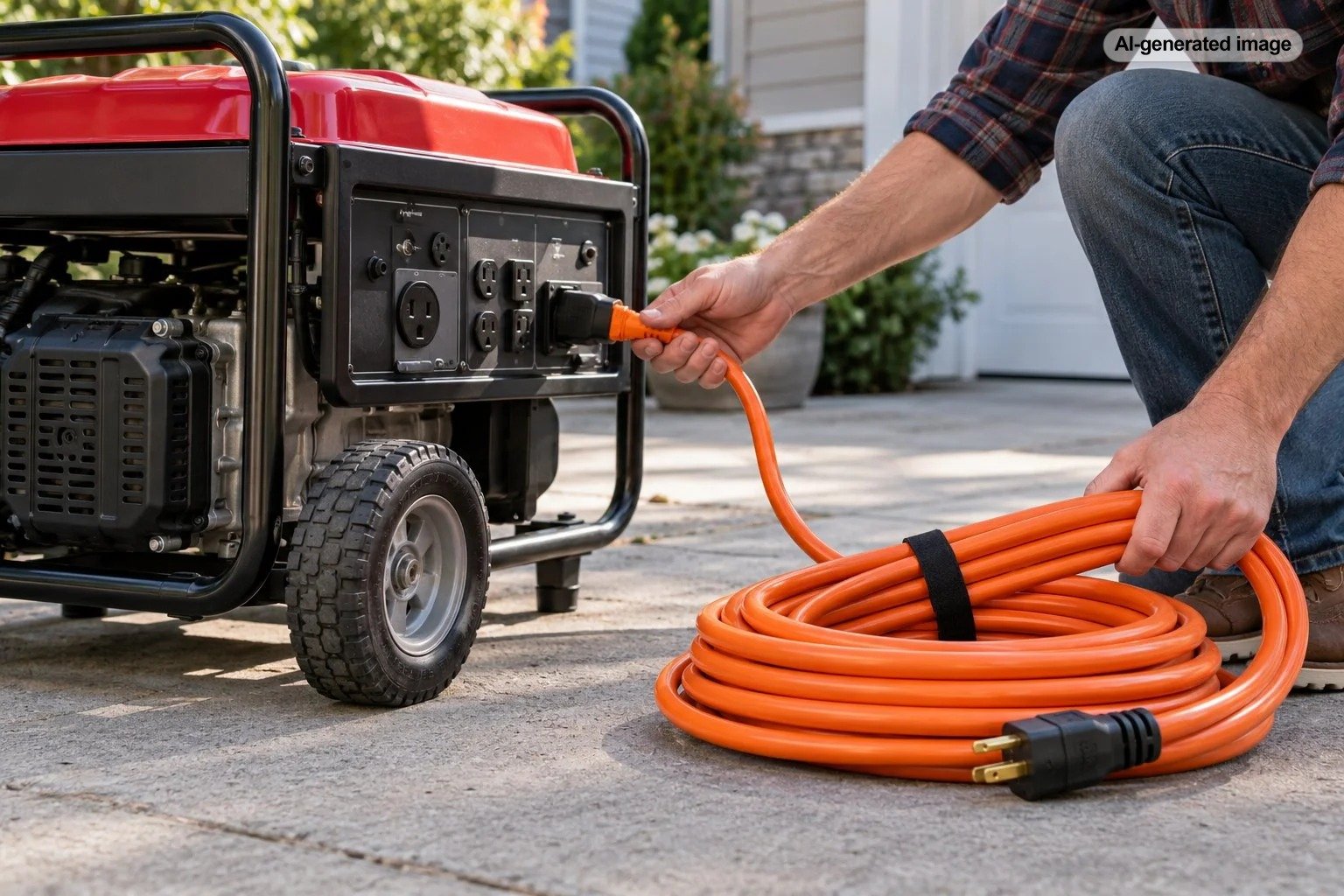
A portable generator needs more than an extension cord that simply reaches the appliance. The cord must be heavy enough for the electrical load, rated for outdoor use, equipped with the correct grounded connectors, and long enough to let the generator remain safely outside and away from occupied spaces. For many household generator loads, that leads homeowners toward heavy-duty 12 AWG or 10 AWG cords rather than ordinary light-duty household extension cords.
The correct size ultimately depends on three things: the amperage of the load, the length of the cord, and the rating of the generator outlet you are using. A cord should never be treated as a way to increase the capacity of an outlet or generator circuit. Its rating needs to meet or exceed the load it will actually carry.
Start With Amps, Not Generator Wattage Alone
The wattage printed on a generator is useful for determining how much equipment the generator can support overall, but it does not by itself tell you which extension cord belongs on every outlet. A generator may have several receptacles with different voltage and amperage ratings. The cord connected to one of those receptacles must be appropriate for that particular circuit and for the appliances connected to it.
For a 120-volt appliance, amperage can be estimated by dividing watts by volts. A 1,200-watt load at 120 volts is approximately 10 amps, for example. Appliances with motors or compressors can also draw substantially more power while starting, so the equipment instructions and nameplate ratings matter when planning a generator load.
The U.S. Consumer Product Safety Commission advises using heavy-duty, outdoor-rated extension cords and making sure each cord’s wattage rating exceeds the total wattage of the appliances connected to it. The agency also recommends inspecting the full length of the cord for damage and using plugs with all three prongs intact.
What Do 12 Gauge and 10 Gauge Mean?
Extension-cord wire size is commonly expressed in American Wire Gauge, or AWG. The numbering can feel backward at first: a lower AWG number means a thicker conductor. A 10 AWG conductor is therefore heavier than a 12 AWG conductor, and a 12 AWG conductor is heavier than a 14 AWG conductor.
Thicker conductors are useful when a cord must carry more current or cover a longer distance. Every conductor has electrical resistance, and excessive resistance creates voltage drop and heat. Choosing a cord that is undersized for the load can therefore create both performance and safety problems.
| Cord size | Useful reference point | Typical decision |
|---|---|---|
| 14 AWG | Common on lighter-duty cords | Do not assume it is suitable for a generator load simply because the plug fits. Verify the cord’s marked amp rating, length, and equipment requirements. |
| 12 AWG | Southwire identifies 12 gauge as heavy duty and lists a 15-amp rating at 25, 50, and 100 feet in its published cord guidance. | A practical starting point for many 15-amp household loads when the cord and connectors are otherwise appropriate. |
| 10 AWG | Southwire identifies 10 gauge as extra heavy duty and lists a 20-amp rating at 25, 50, and 100 feet. Generator manufacturers also offer certain 30-amp generator cords using 10 AWG conductors. | Often appropriate when more current capacity is required, but the complete cord rating and connector configuration still control. |
Those examples are useful reference points rather than a universal substitution chart. Cord construction, insulation, conductor count, plug configuration, voltage, temperature rating, manufacturer instructions, and the electrical equipment being supplied all matter. Read the markings on the cord itself rather than choosing by color or thickness alone.
Longer Cords Deserve More Attention
A generator should be positioned based on safe operation, not on how short an extension cord happens to be. CPSC guidance specifically says generator extension cords should be long enough to let the generator remain outdoors and far away from windows, doors, vents, and other openings to occupied structures.
At the same time, adding unnecessary cord length increases resistance and voltage drop. That is why the goal is not simply to buy the longest cord available. Use enough properly rated cord to place the generator safely, then choose a conductor size that is suitable for the load and that distance.
Outdoor Rating and Grounding Matter as Much as Gauge
Wire gauge is only one part of the label. CPSC recommends extension cords specifically designed for outdoor use, and OSHA guidance for portable generators calls for heavy-duty extension cords with a grounding conductor, meaning a three-wire cord with three-prong connectors.
Inspect the cord before each use. Cuts, crushed sections, damaged insulation, loose connectors, missing grounding prongs, or evidence of overheating are reasons to remove a cord from service rather than improvising a repair during an outage. Keep connections protected from excessive moisture and follow the generator manufacturer’s instructions regarding ground-fault protection and operation in wet conditions.
If a cord must pass through a doorway or similar opening, avoid pinching or crushing it. CPSC specifically warns about protecting generator cords from damage where they pass through doors and windows.
Match the Cord to the Generator Receptacle
A standard 120-volt household-style receptacle on a generator and a larger locking generator receptacle are not interchangeable simply because adapters exist. The receptacle rating tells you how much current that circuit is designed to provide, while the plug and cord configuration determine how that electricity is carried.
Generator manufacturers sell purpose-built cords for higher-capacity receptacles. For example, Generac documentation lists a 20-amp, 125-volt generator extension cord using 12/3 cable, while one of its 30-amp, 125/250-volt generator cords uses 10/4 cable. Champion likewise lists several 25-foot, 30-amp generator cords built with 10-gauge conductors. These examples illustrate why amperage, voltage, conductor count, and connector style need to be considered together.
Do not copy a cord specification from an unrelated generator and assume it fits yours. Check the receptacle markings and the owner’s manual for the generator you actually own.
Do Not Use an Extension Cord to Backfeed a House
An extension cord should never be used to send generator power into household wiring through a wall receptacle. This practice, commonly called backfeeding, can energize wiring in unexpected places and expose utility workers and others to electrocution hazards.
CPSC warns against plugging a generator into a home outlet, and OSHA states that a generator should not be connected to a structure unless an appropriate transfer switch has been installed. A home backup connection is therefore a different project from running individual appliances on extension cords and should be handled with equipment designed for that purpose and qualified electrical installation where required.
A Practical Way to Choose Your Generator Cord
What to do
- Identify the exact generator receptacle you intend to use and note its voltage and amperage rating.
- List the appliances that will share that cord and determine their running electrical load, allowing for starting requirements where applicable.
- Choose a cord specifically rated for outdoor, heavy-duty use.
- Make sure the cord’s marked amp or watt capacity is at least sufficient for the connected load.
- Use a three-wire grounded cord and keep the grounding prong intact.
- Choose enough length to keep the generator outdoors and safely separated from windows, doors, vents, and occupied areas.
- If the necessary length or electrical load pushes the limits of the cord you are considering, move to an appropriately rated heavier cord rather than accepting an undersized cable.
- Confirm the final choice against the generator manual and the instructions for the equipment being powered.
What Size Is Best for Common Household Generator Use?
For a conventional 15-amp load, a properly rated 12 AWG heavy-duty outdoor cord is a sensible benchmark and provides more conductor capacity than lighter household cords. For loads approaching 20 amps, 10 AWG is a stronger reference point; Southwire’s published guidance rates its 10-gauge extra-heavy-duty category at 20 amps through 100 feet.
If you are using a 30-amp generator receptacle, use a purpose-built generator cord whose plug configuration, voltage rating, amperage rating, conductor count, and wire gauge match that application. Several manufacturer examples use 10-gauge conductors for 30-amp generator cords, but that does not mean any random 10 AWG extension cord is automatically appropriate for a 30-amp connection.
The right generator cord is determined by the load, length, rating, and connection – not by whether the plug happens to fit.
FAQ
Is 12 gauge extension cord good for a generator?
It can be for many 15-amp loads when the cord is heavy duty, outdoor rated, grounded, long enough for safe generator placement, and rated for the connected equipment. Verify the cord markings and generator manual rather than relying on gauge alone.
Should I use 10 gauge instead of 12 gauge?
A 10 AWG cord uses thicker conductors and can be appropriate when the load or cord length calls for greater capacity. It may also be used in purpose-built generator cords for higher-amperage receptacles. Match the entire cord specification to the application.
Can I run a refrigerator and freezer on the same generator extension cord?
Only if the combined electrical demand, including relevant starting loads, stays within the ratings of the generator receptacle and extension cord. When there is uncertainty about simultaneous appliance loads, separate appropriately rated circuits or professional guidance can be safer than guessing.
Can I connect two extension cords together to reach farther?
A single properly sized cord of adequate length is generally a cleaner choice because every additional connection creates another point that can loosen, become wet, or be damaged. More importantly, never shorten the required generator-to-house distance simply to avoid buying a suitable cord.
Can a portable generator stay in a garage with the door open?
No. CPSC guidance says portable generators should not be operated inside a home, garage, basement, crawlspace, shed, or other enclosed or partially enclosed area. Follow the generator manufacturer’s placement instructions and current CPSC carbon-monoxide safety guidance.
Sources & further reading
- U.S. Consumer Product Safety Commission: Portable Generator Hazards
- Occupational Safety and Health Administration: Grounding Requirements for Portable and Vehicle-Mounted Generators
- Southwire: Extension Cord Product and Amp-Rating Guidance
- Generac: Heavy Duty Generator Extension Cord Specifications
- U.S. Consumer Product Safety Commission: 2026 Male-to-Male Extension Cord Warning