
What Should You Put Under a Fire Pit on Pavers?
If you are placing a portable fire pit on a paver patio, the safest general approach is to use the fire pit exactly as its manufacturer directs and add a manufacturer-approved stand, heat shield, insulated base, or other surface-protection system when required. Pavers provide a noncombustible surface, but that does not mean every paver can tolerate prolonged, concentrated heat without discoloring, cracking, or otherwise being damaged.
The right layer underneath depends on the fire pit design, its clearance beneath the burn chamber, the amount of heat directed downward, and the type of paver. A raised metal fire pit may need little more than its specified stand or base, while a low wood-burning bowl can justify considerably more thermal protection.
Why pavers may still need protection
Concrete, brick, and stone pavers do not burn like a wood deck, which makes a properly installed paver patio a far more sensible location for many outdoor fire pits. NFPA guidance for outdoor fires recommends placing a fire pit on even, level ground that will not catch fire, giving patio blocks, bricks, and concrete as examples of suitable surfaces.
Noncombustible, however, is not the same thing as immune to heat damage. Belgard notes that direct heat from wood-burning fire pits can crack or discolor pavers and recommends appropriate insulation and protection when installing fire features on existing patios. The specific risk varies with the paver material, construction, moisture conditions, fire intensity, and the design of the fire pit.
A paver patio can be an appropriate fire pit surface without being an expendable one.
The best things to put under a portable fire pit
A manufacturer-approved stand or base
Start here whenever the fire pit manufacturer offers or requires a stand. A properly designed stand creates separation between the hot fire pit body and the patio surface and is engineered for that particular appliance or fire pit configuration.
This distinction matters because portable fire pits handle downward heat differently. Some have elevated burn chambers and generous airflow underneath; others sit much closer to the ground. Solo Stove, for example, specifically offers stands intended to elevate its compatible fire pits and help protect heat-sensitive surfaces. That does not mean a Solo Stove accessory belongs under another brand of fire pit. Match the protection system to the product instructions.
A purpose-built fire pit heat shield
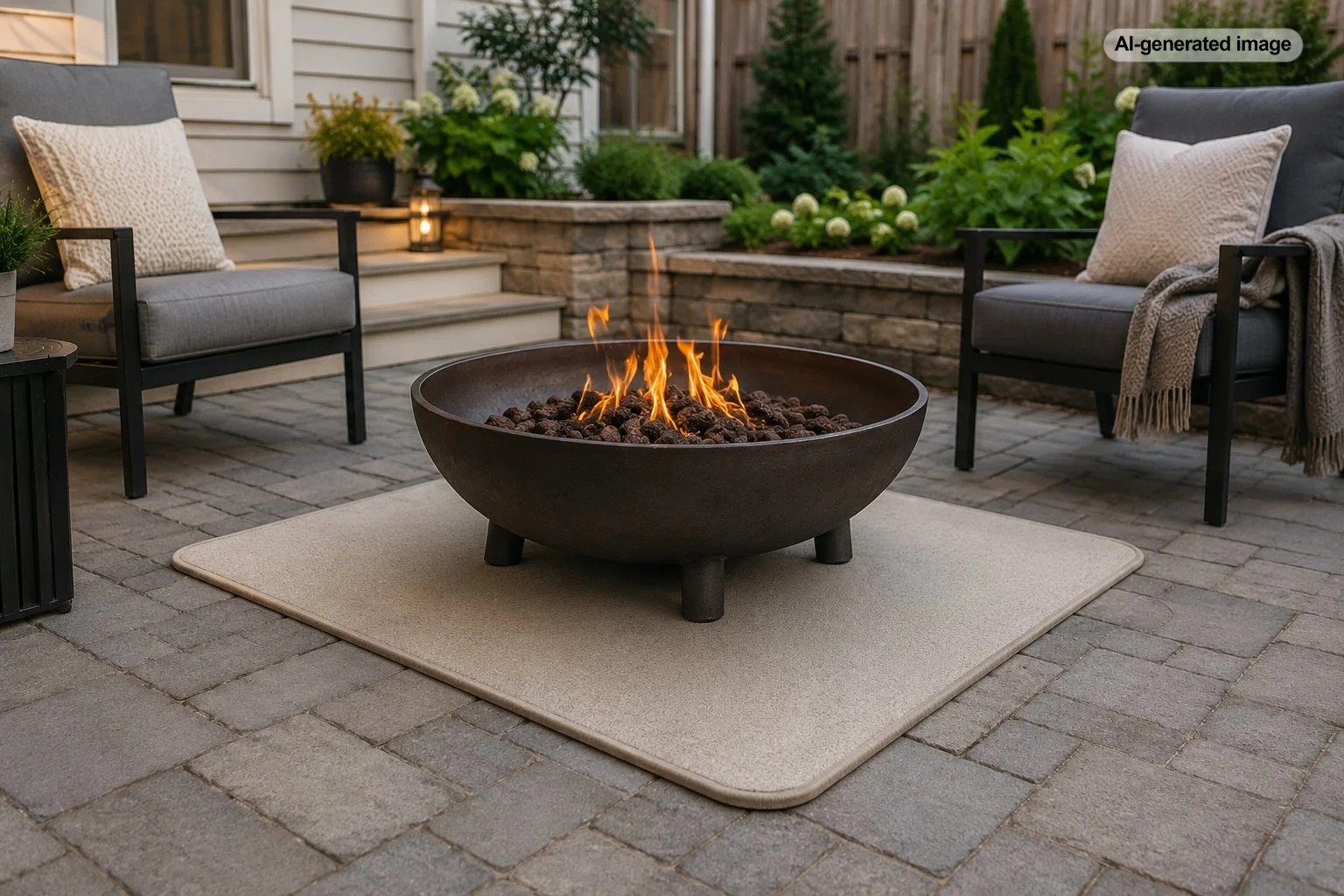
If the manufacturer’s instructions allow it, a dedicated heat shield can provide another layer of protection between a portable fire pit and the patio. Look for a product specifically designed for use beneath fire pits rather than a generic outdoor mat. The important issue is thermal performance, not simply whether the material itself is labeled nonflammable.
Many effective designs use an air gap, reflective layer, insulation, or a combination of these strategies to reduce the amount of heat reaching the surface below. Size also matters. The shield should be appropriate for the dimensions and heat pattern of the fire pit rather than barely covering its footprint.
An engineered fire pit base
Some manufacturers offer substantial bases specifically intended to protect patios and other surfaces. These can be useful with heavy or high-output fire pits because they combine stable support with thermal separation. Breeo, for example, offers a purpose-built base for compatible fire pits that is intended to protect the surface underneath.
Again, compatibility comes before improvisation. The safest accessory is not simply the thickest-looking one; it is one designed for the fire pit and surface conditions involved.
| Option | Best use | Main consideration |
|---|---|---|
| Manufacturer-approved stand | Portable fire pits with a matching accessory | Follow the fire pit instructions and compatibility requirements |
| Purpose-built heat shield | Additional patio surface protection when permitted | Choose one intended for fire pit temperatures and the correct size |
| Engineered fire pit base | Heavy or high-heat portable units | Confirm compatibility and provide a stable, level surface |
| Fire-rated construction system | Permanent masonry fire pits | Use the specified liner, refractory materials, and construction details |
What about a built-in fire pit on pavers?
A permanent masonry fire pit is a different project from setting a portable metal bowl on the patio. The pavers underneath are only one part of the assembly. The fire chamber, liner, surrounding blocks, foundation, drainage, ventilation, and fuel type can all affect the appropriate construction.
Belgard’s installation guidance states that the inside of certain masonry fire pits must be lined with heat-resistant material and explains that landscape blocks exposed to extreme heat can crack. Its guidance identifies fire-rated brick or a steel liner as possible protective approaches for applicable designs.
If you are building rather than placing a portable unit, follow the fire pit system manufacturer’s installation details rather than assembling ordinary patio materials into a burn chamber. Gas fire features introduce additional installation and ventilation considerations, so their manufacturer’s instructions and applicable local requirements should guide the project.
Materials that are easy to overestimate
A plain metal sheet
Metal does not burn, but it conducts heat. A sheet of steel placed directly on pavers can become extremely hot and transfer substantial heat to the patio. Unless a particular metal barrier is part of an engineered or manufacturer-approved system, its presence alone does not establish adequate protection.
Ordinary outdoor rugs or decorative mats
A patio rug may define a seating area beautifully, but it should not be treated as fire protection unless it is explicitly designed and approved for the intended fire pit application. Keep combustible furnishings and accessories outside the clearances specified for the fire pit.
Loose sand
Sand can play a useful role in some permanent fire pit assemblies, but scattering a thin layer beneath a portable fire pit is not a substitute for a required stand or tested surface-protection system. It can also create an unstable base if the appliance is meant to sit on a hard, level surface.
Extra patio pavers
Stacking a few leftover pavers beneath a fire pit may appear to provide insulation, but it introduces questions about stability, heat transfer, and whether those units are suitable for repeated concentrated heat. A purpose-built solution is generally a more predictable choice.
How to protect the patio before the first fire
What to do
- Read the fire pit manual and identify the permitted surfaces, required clearances, stand requirements, and any surface-protection instructions.
- Check the patio for loose, rocking, cracked, or badly settled pavers so the fire pit can sit level and stable.
- Install the manufacturer’s stand, base, or other required protection before adding an aftermarket heat shield.
- Keep the fire pit outdoors and well away from structures, overhangs, furniture, vegetation, and other combustible material according to the manufacturer’s instructions and applicable local requirements.
- Keep appropriate fire-extinguishing equipment readily available and never leave the fire unattended.
- After the fire pit and surface have fully cooled, periodically check the pavers for new discoloration, cracking, movement, or other heat-related changes.
NFPA recommends locating outdoor fire pits at least 10 feet from anything that can burn and placing them on a level surface that will not catch fire. Product instructions or local rules may require different or greater clearances, so treat general guidance as a starting point rather than a substitute for the manual or local fire requirements.
What if the pavers are already discolored?
Darkening or staining does not automatically mean the patio has become structurally unsafe, but it is useful evidence that the surface has been receiving heat, soot, ash, or other residue. First allow everything to cool completely, then inspect the affected units for cracking, surface deterioration, rocking, or movement.
If the issue is only cosmetic, cleaning may improve the appearance depending on the paver material and finish. Follow the paver manufacturer’s cleaning recommendations rather than attacking the mark with an aggressive acid, wire brush, or other method that could permanently change the surface.
If damage keeps appearing after each fire, changing the setup is more sensible than repeatedly repairing or cleaning the patio. Increase protection only in ways allowed by the fire pit manufacturer, or relocate the fire pit to a more appropriate location.
Frequently asked questions
Can a fire pit sit directly on concrete pavers?
Some portable fire pits may be used on noncombustible patio surfaces when their manufacturers permit it, but direct placement is not universally appropriate. Heat can still discolor or damage concrete products. Follow the specific fire pit instructions and use the required stand, base, or surface protection.
Do I need a fire pit mat on pavers?
Not necessarily. A manufacturer-approved stand or base may be the specified solution. If you want additional protection, use a heat shield or pad designed for fire pit use and make sure adding it does not conflict with the manufacturer’s operating instructions.
Are pavers better than a wood deck for a fire pit?
A stable paver patio provides a noncombustible surface, making it a more appropriate location for many fire pits than combustible decking. That does not eliminate the need to follow clearances, surface-protection instructions, and manufacturer requirements.
Should I put fire bricks underneath a portable fire pit?
Fire-rated brick is commonly relevant to the construction or lining of certain permanent fire pits, but it is not automatically required underneath a portable unit. Use the portable fire pit manufacturer’s specified setup rather than building an improvised platform unless the instructions allow it.
What is the simplest answer?
Use a level, noncombustible patio surface and the stand, base, heat shield, or other protective system specified for your fire pit. Pavers are a good starting surface, but the fire pit’s design determines how much additional protection belongs between the heat and the patio.