

How Far Should Nightstands Be From the Bed?
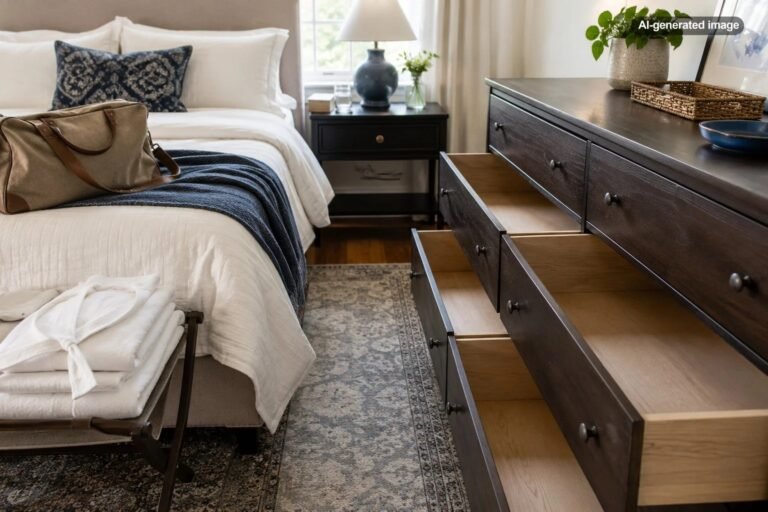
For most bedrooms, place a nightstand about 2 to 5 inches from the side of the bed. Around 3 inches is a practical starting point: close enough that a lamp, glass of water, book, or alarm is easy to reach, but not so close that bedding rubs against the furniture or drawers become awkward to use.
That measurement is a guideline rather than an ironclad decorating rule. The best distance depends on the width of the nightstand, the shape of the bed frame, drawer and door clearance, mattress height, and how much walking space the room gives you. A slim table beside an upholstered platform bed may work beautifully with a narrow gap, while a nightstand with projecting hardware or a bed with a wide frame may need more breathing room.
Why a small gap usually works best
A nightstand is one of the few pieces of furniture you regularly use while lying down, so convenience matters as much as appearance. Position it too far away and reaching for a lamp switch can feel surprisingly awkward. Push it directly against the bed and you may create a different set of annoyances: squeezed bedding, blocked drawers, rattling furniture, or a narrow crevice that becomes difficult to clean.
A modest gap visually connects the bed and bedside table without making them look fused together. It also gives sheets and comforters room to fall naturally. In a carefully arranged bedroom, that sliver of space can make the furniture feel intentional rather than crowded.
The right bedside spacing is close enough for an easy reach and generous enough for the furniture to function normally.
Measure from the part of the bed that actually sticks out
One reason nightstand-spacing advice can become confusing is that beds are not simple rectangles. The mattress may sit inside a frame, rest on top of a platform, or be surrounded by upholstered rails that extend several inches beyond it. A substantial headboard may also project farther sideways than the mattress.
For practical placement, measure the gap from the nearest physical edge of the bed or frame to the nearest edge of the nightstand. Then sit or lie on the bed and check the reach to the tabletop. A measurement that looks ideal on a floor plan is less useful if the lamp is inconvenient to reach in real life.
Nightstand height matters almost as much as distance
Horizontal spacing gets most of the attention, but vertical alignment has a major effect on comfort. A bedside table that is roughly level with the top of the mattress tends to be easier to use than one that sits dramatically above or below it. Current bedroom-design guidance from major design publications likewise emphasizes choosing a nightstand close to mattress height.
Measure from the floor to the top of your mattress after the bed is fully assembled. Then compare that measurement with the nightstand rather than relying on generic furniture dimensions. Thick mattresses, platform frames, adjustable bases, and tall foundations can all change the working height considerably.
Adjust the spacing for drawers and doors
A beautiful gap is not useful if the nightstand cannot open. Pull every drawer out completely and check whether handles, knobs, bedding, or an projecting bed frame interfere. Nightstands with cabinet doors may need additional clearance, particularly when the door swings toward the mattress.
Also consider what happens when the bed is occupied. A comforter may extend farther sideways at night than it does when the bed is neatly made. If fabric repeatedly catches on a knob or gets trapped in a drawer, increasing the gap by an inch or two can be more sensible than preserving a perfectly symmetrical arrangement.
| Situation | Spacing approach | What to check |
|---|---|---|
| Typical nightstand | Start around 2 to 5 inches | Comfortable reach and drawer clearance |
| Very small bedroom | Use the smallest workable gap | Bedding, outlets, and cleaning access |
| Wide bed frame | Measure from the outer frame | Do not judge distance from the mattress alone |
| Cabinet-style nightstand | Allow extra room if needed | Door swing and hardware clearance |
| Floating bedside shelf | Prioritize reach and height | Placement relative to the mattress edge |
What about very small bedrooms?
In a compact room, ideal spacing sometimes gives way to simple geometry. If the bed barely fits between two walls, leaving a textbook-size gap on each side may sacrifice valuable bedside storage. A narrower table, floating shelf, wall-mounted lamp, or single nightstand can be more useful than forcing two full-size pieces into the room.
When every inch matters, prioritize function in this order: make sure the room’s main walking path remains usable, keep the bedside surface within comfortable reach, confirm drawers or doors can open, and then refine the visual spacing. It is perfectly reasonable for a small bedroom to use a tighter gap than a spacious primary bedroom.
Should both nightstands be the same distance from the bed?
Symmetry usually looks polished, particularly when matching nightstands flank a centered bed. If the room allows it, use approximately the same gap on both sides. You do not need to chase fractions of an inch, however. Bedrooms are working spaces, and walls, doors, radiators, outlets, windows, and floor vents have a habit of disrupting perfect geometry.
If one side requires a slightly different gap, look at the composition from the foot of the bed. Small differences are often far less noticeable than expected, especially when lamps or wall-mounted lighting create visual balance above the nightstands.
Do nightstands have to touch the wall?
No. A nightstand can sit against the wall, slightly forward of it, or align with the face of the headboard depending on the bed design and room layout. What matters is that it feels connected to the bed and does not obstruct a walkway.
Deep headboards sometimes create an awkward situation in which pushing the nightstand completely against the wall leaves its front edge well behind the mattress. Moving the nightstand forward can make the surface easier to reach. Just make sure the placement remains stable and does not create an inconvenient obstacle beside the bed.
Remember lamps, outlets, and charging cords
Before deciding that the furniture placement is finished, look at everything connected to the nightstand. A table lamp may need room for its shade without bumping the headboard. Charging cables should reach their outlets without being stretched across a walking path. If an outlet sits directly behind the nightstand, allow enough clearance for plugs and cords rather than crushing them between furniture and the wall.
Wall-mounted sconces can simplify bedside planning in especially narrow rooms because they free the tabletop from a lamp base. Even then, keep the nightstand close enough to the mattress that reaching for everyday items remains comfortable.
Before you decide
- Start with roughly 2 to 5 inches between the bed and nightstand.
- Measure from the outermost part of the actual bed frame.
- Keep the tabletop reasonably close to the top of the mattress.
- Open drawers and doors completely before finalizing placement.
- Check the fall of blankets, quilts, and comforters.
- Confirm lamps, outlets, plugs, and charging cords have enough room.
- Test the reach while sitting and lying in bed.
Common nightstand placement mistakes
The most common mistake is treating one measurement as more important than the room itself. A precisely measured 3-inch gap does not help if the nightstand blocks a closet door or leaves an uncomfortable walkway. Likewise, pushing a nightstand tightly against the mattress just to squeeze in a larger piece can make the arrangement feel crowded and interfere with daily use.
Another frequent issue is choosing nightstands before measuring the completed bed. The width may look right, but the height can feel noticeably off once the mattress, foundation, and frame are assembled. Finally, remember that bedside furniture does not have to come as a matching pair. In an unusually shaped or compact bedroom, two different pieces with compatible heights and visual weight can solve the layout more gracefully.
The bottom line
About 2 to 5 inches from the bed is a useful starting range for most nightstands. From there, let reach, mattress height, drawer clearance, bedding, electrical access, and room size determine the final position. If you can comfortably reach the table, operate it normally, make the bed without a wrestling match, and move through the bedroom easily, the spacing is doing its job.
The goal is not to satisfy a rigid furniture formula. It is to make the bed and nightstand read as a coordinated pair while leaving just enough room for everyday life to happen comfortably.