
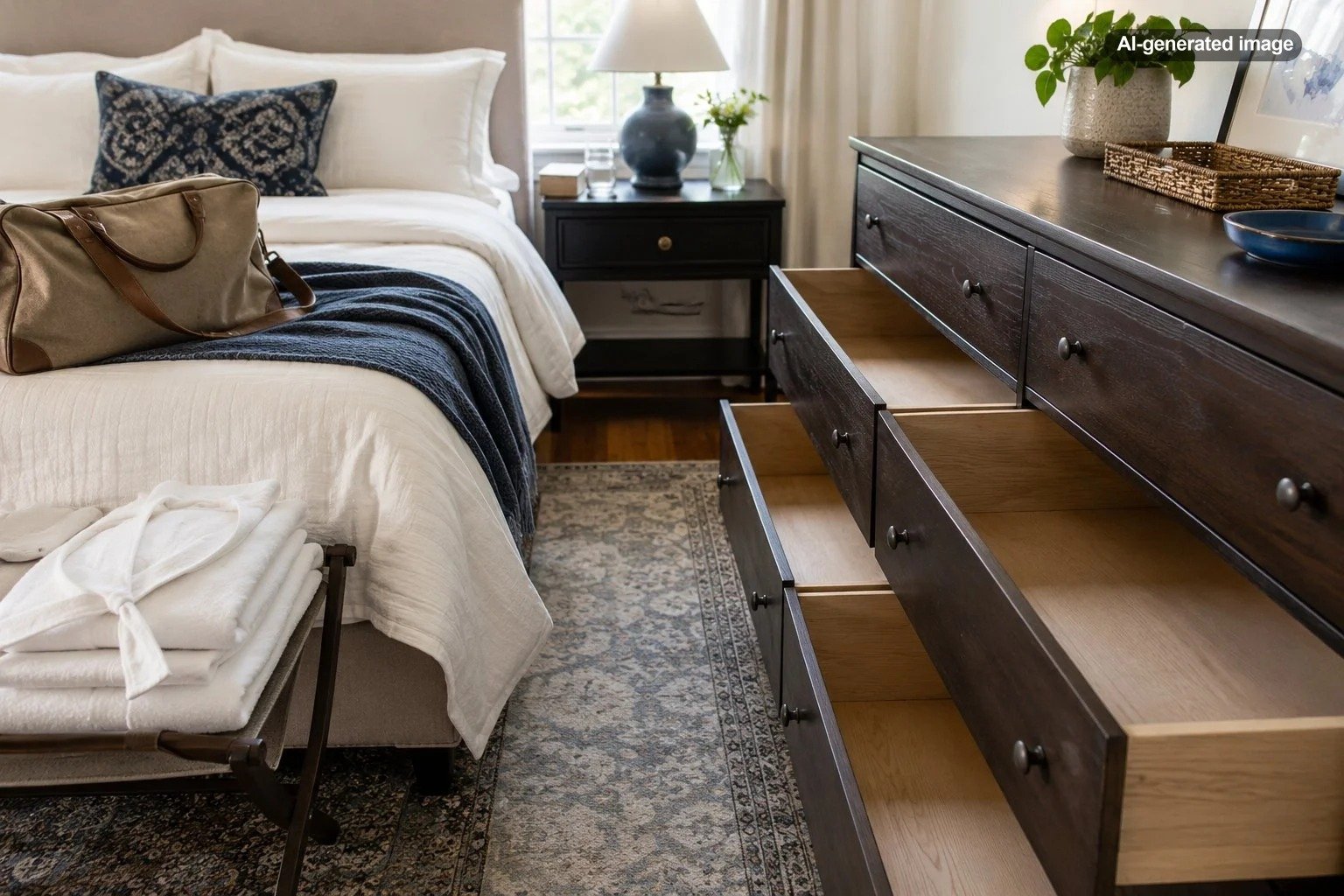
Should You Leave Empty Drawers for Houseguests?
Yes, in most cases it is thoughtful to leave at least one or two empty drawers for houseguests, especially when someone will be staying for more than a night or two. You do not need to clear an entire dresser, and your guest room does not have to imitate a hotel. The goal is simply to give visitors an obvious place for the belongings they would rather not keep folded inside a suitcase.
How much drawer space you should offer depends on the length of the visit, the size of the room, and whether the bedroom also functions as your office, hobby room, or household storage zone. A weekend guest may barely touch a dresser. Someone staying for a week is much more likely to appreciate it.
Empty drawers are an invitation, not a requirement
Providing drawer space is less about formal etiquette than about removing small inconveniences. A guest who wants to unpack should not have to wonder whether a dresser is decorative, private, or stuffed with your winter scarves.
That distinction matters because guests generally do not want to rummage through someone else’s storage looking for permission. Even an apparently empty dresser can feel off-limits if there are personal items in neighboring drawers. Making the available space obvious is often more useful than providing a large amount of it.
A simple comment such as telling your guest that the top two drawers are theirs removes the guesswork. If you prefer not to discuss it, leaving those drawers visibly empty when the guest settles in accomplishes much the same thing.
Good guest-room storage is not about providing acres of space; it is about making the available space unmistakably usable.
How much drawer space is enough?
There is no universal number because a two-night visit and a two-week visit create very different storage needs. A practical approach is to think about what the guest will reasonably need to put away rather than trying to empty furniture simply because it is in the room.
| Type of stay | Useful storage | What can remain yours |
|---|---|---|
| One night | Clear bedside surface and suitcase space | Most dresser storage |
| Weekend | One empty drawer or accessible shelf | Other drawers and part of the closet |
| Several days | One or two drawers plus some hanging room | Clearly separate household storage |
| Extended stay | Several drawers or equivalent shelves and closet space | Storage that does not compete with daily guest needs |
These are practical guidelines rather than rules. Some people happily live from a suitcase for a week, while others start unpacking five minutes after arrival. Giving guests options works better than assuming everyone travels the same way.
What should you remove from a guest drawer?
An available drawer should be genuinely available. Leaving a thin layer of household odds and ends at the back makes the space feel borrowed rather than offered. Remove personal clothing, paperwork, medications, valuables, sentimental objects, spare electronics, and anything you would be uncomfortable having a visitor encounter accidentally.
Give the empty drawer a quick cleaning as part of preparing the room. Check corners for dust, make sure the drawer opens smoothly, and confirm that nothing has migrated behind it. There is no need for elaborate liners, scented sachets, or decorative filling unless those are already part of how you maintain the furniture.
You do not have to sacrifice all of your own storage
Many guest bedrooms work double duty, particularly in apartments, condos, and smaller homes. The room might also hold seasonal clothing, office supplies, linens, craft materials, or items that simply have nowhere else sensible to live. Hospitality does not require relocating half your house every time someone visits.
Instead, divide the storage deliberately. You might reserve the upper two dresser drawers for guests and use the lower drawers for household items. Another option is to dedicate one side of a closet to visitors while keeping labeled bins or less frequently used belongings on the other side.
The important detail is separation. A guest should not have to move your possessions to make room for theirs. If your storage remains neatly contained and the guest’s space is obvious, the room can comfortably serve both purposes.
What if you do not have any drawers to spare?
Drawers are convenient, but they are not essential. What matters is giving guests somewhere besides the floor, bed, and nearest chair to manage their belongings.
A clear shelf can hold folded clothes. A section of closet rod with several empty hangers works well for garments that wrinkle. A sturdy bench, luggage rack, low table, or other suitable surface can keep a suitcase accessible without requiring constant lifting from the floor to the bed.
In a very small guest space, maintaining one good suitcase zone may be more useful than squeezing in an unnecessary dresser. Guests who prefer to keep everything packed can open their luggage there while still having the bed and seating surfaces free.
Before your guest arrives
- Clear at least one useful storage area.
- Remove personal or private belongings from guest-accessible spaces.
- Leave several hangers if closet space is available.
- Provide an easy place for a suitcase.
- Clear part of the nightstand or bedside surface.
- Make sure the guest knows which storage areas are available.
Do bedside drawers count?
A nightstand drawer is useful, but it serves a slightly different purpose. It is better suited to glasses, chargers, medication, a book, or other small items a guest may want nearby at night. It generally does not replace dresser space for clothing during a longer visit.
If the room has no dresser, however, an empty nightstand drawer is still worth providing. Combine it with closet space, a shelf, hooks, or a suitcase surface so the guest has several small storage options rather than one overloaded spot.
Small details matter more than a perfectly staged guest room
A beautifully decorated bedroom can still feel inconvenient if every surface is occupied and every cabinet is full. Conversely, a simple room can be extremely comfortable when there is space to set down a phone, hang a jacket, open a suitcase, and put away a few clothes.
Before guests arrive, look at the room from that practical perspective. Is there somewhere for a bag? Can someone reach an outlet without moving furniture? Is at least part of the closet, dresser, shelf, or nightstand obviously available? Can personal belongings stay organized without spreading across the bed?
Those questions are more useful than trying to achieve an idealized guest-room setup. The best arrangement is one that respects both the visitor’s comfort and the realities of how your home functions every day.
Frequently asked questions
Should I empty an entire dresser for a weekend guest?
Usually not. One clean drawer, along with somewhere to place a suitcase and perhaps a little hanging space, is generally a considerate setup for a short visit.
Should I tell guests which drawers they can use?
Yes. A quick explanation is helpful when only part of a dresser or closet is available. It prevents guests from wondering which areas are private.
Is it rude to use the guest room for household storage?
No. A guest room can reasonably serve more than one purpose. Try to keep your belongings contained and leave visitors enough clearly designated space for the length of their stay.
What if my guest never unpacks?
That is perfectly fine. Providing storage gives them a choice; it does not create an obligation to use it. A convenient suitcase surface may end up being the feature they appreciate most.
What matters most when preparing storage for houseguests?
Clarity and usability. Whether you offer drawers, shelves, closet space, or simply a good place for luggage, guests should be able to tell immediately which areas are theirs to use without moving your belongings first.