Why Do Towel Edges Curl After Drying?
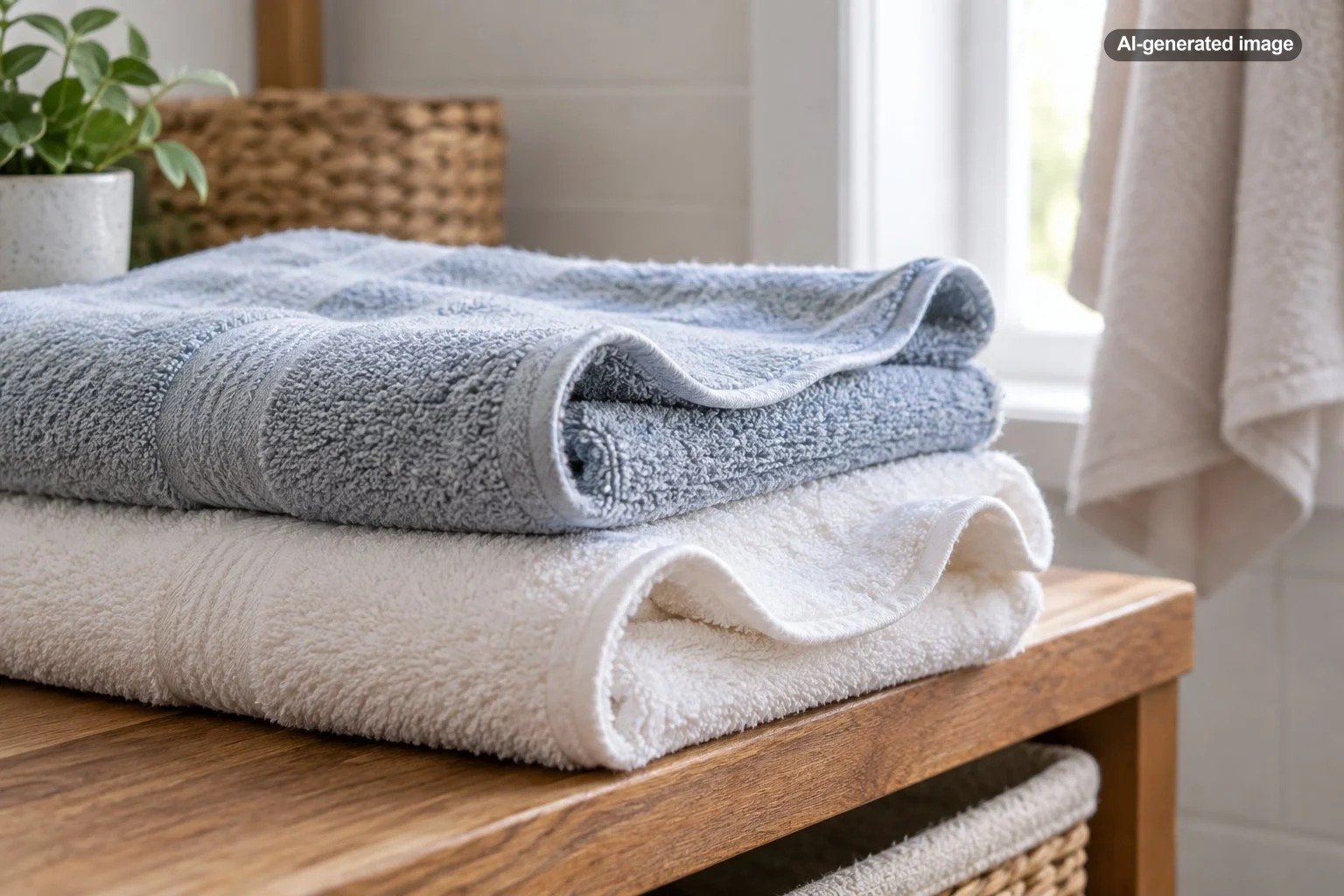
Towel edges usually curl after drying because the flat woven border, hem, and absorbent terry body do not shrink or relax at exactly the same rate. Water, agitation, and dryer heat make those structural differences more visible. The result is a border that pulls against the towel body and rolls, ripples, or cups toward one side.
A little curling is generally cosmetic, especially with thick cotton towels. It does not mean the towel is dirty or unusable. Persistent, sharply twisted edges, however, can point to uneven construction, excessive heat, crowded laundry loads, or a hem that has begun to distort.
The towel border and body behave differently
A typical terry towel is not one completely uniform piece of fabric. Its main body contains thousands of raised loops that create softness and absorbency. The decorative border near each end is usually flatter and more tightly woven, while the hem folds multiple layers of fabric together and holds them with stitching.
Those sections respond differently during laundering. The open terry body may relax, contract, and fluff in one way, while the denser border changes dimensions in another. The stitching can add still another level of tension. When one section becomes slightly shorter than the section beside it, the extra fabric has nowhere to lie flat, so it bows or curls.
A curled towel edge is often a small geometry problem created by several fabric structures sharing one rectangle.
Why drying makes the curl more noticeable
Washing begins the dimensional change, but drying tends to set the towel into its most visible shape. Tumbling repeatedly flexes the border and hem. Heat removes moisture and encourages cotton fibers and yarns to settle into their relaxed dimensions. If the load is packed tightly, the towels have less room to unfold and tumble freely, allowing edges to dry while bent or folded.
High heat can intensify the effect, particularly when towels remain in the dryer long after they are dry. More heat is not necessarily better care. The correct setting depends on the manufacturer’s label, but a moderate setting is often sufficient for routine drying. Removing towels when dry, rather than baking them through an unnecessarily long cycle, is gentler on both the borders and the terry loops.
Common reasons some towels curl more than others
| Likely factor | What it does | What you may notice |
|---|---|---|
| Different fabric structures | The border and terry body shrink at different rates | A regular wave along both ends |
| High dryer heat | Encourages stronger dimensional change and overdrying | Curling becomes more pronounced over repeated cycles |
| Overloaded machines | Restricts movement and even rinsing or drying | Edges dry folded, wrinkled, or twisted |
| Uneven stitching tension | A tight seam draws the fabric inward | A narrow, persistent roll beside the hem |
| Mixed fabric content | Different fibers react differently to moisture and heat | The border may pucker while the body stays relatively flat |
| Air-drying without reshaping | The towel dries in the position in which it was hung | A bent edge or center crease becomes crisp |
Quality and construction matter, but price alone does not predict perfect dimensional stability. A substantial towel with a handsome decorative band can still curl if the band and terry ground behave differently. Conversely, a simpler towel with a narrow, well-balanced hem may dry quite flat.
How to flatten curled towel edges
Start with the least aggressive correction. Repeatedly applying very high heat may temporarily press an edge while also encouraging further shrinkage, so the goal is to relax and reshape the fabric gently.
What to do
- Check the care label. Follow its washing, drying, and ironing limits before trying any adjustment.
- Dampen the border. If the towel is already dry, lightly mist or wet the curled area rather than soaking the entire towel.
- Smooth it by hand. Lay the towel flat and gently draw the border back into alignment without stretching it forcefully.
- Dry it in an open position. Hang the towel evenly or place it in a dryer with enough room to tumble, using an allowed moderate setting.
- Remove and reshape promptly. Smooth the edge while the towel retains a trace of warmth or moisture, then let it finish cooling flat.
- Press only if permitted. If the label allows ironing, press the flat border from the reverse side at the recommended temperature. Avoid crushing the terry pile.
A steam iron can improve the appearance of a flat woven band, but it will not permanently correct incompatible shrinkage or excessively tight stitching. Do not pull hard on a wet hem; wet fabric can distort, and aggressive stretching may make the towel uneven in a different direction.
How to prevent the edges from curling again
Leave enough space in the washer for towels to circulate and rinse. Use the amount of detergent recommended for the product and load conditions rather than adding extra in hopes of producing a cleaner result. Heavy residue can make towels feel stiff, although residue is not usually the primary cause of a geometrically curled border.
After washing, snap each towel gently once or twice and straighten the ends before transferring it to the dryer or drying rack. This quick reshaping step separates folded edges before they dry in place. When machine drying, choose a care-label-approved setting and take the towels out promptly. When line-drying, distribute the towel’s weight evenly instead of clipping one heavy corner and allowing the fabric to pull diagonally.
When the curl is probably permanent
If an edge returns to the same tight roll after every wash, even after careful reshaping and moderate drying, the cause is probably built into the towel. The border may have greater residual shrinkage than the body, or the hem stitching may be under enough tension to keep drawing the edge inward.
That does not automatically make the towel defective for everyday use. Mildly curled edges are mostly an appearance and folding issue. You might keep those towels for regular family use while reserving flatter ones for open shelving or guest display. If a recently purchased set becomes severely distorted after being washed exactly as directed, consult the retailer’s return policy rather than experimenting with hotter cycles or cutting the hem.
Replace or retire a towel when the hem is unraveling, stitching has broken, or the edge has become rough enough to be uncomfortable. Curling alone is rarely a reason to discard an otherwise absorbent, intact towel.
Frequently asked questions
Why do only the short ends curl?
The short ends usually contain the decorative woven bands and folded hems. Because those structures differ from the central terry field, dimensional changes concentrate there.
Can air-dried towels develop curled edges?
Yes. Air drying avoids tumble heat, but a towel can still shrink during washing and then dry in a folded, stretched, or uneven position. Reshaping it before hanging helps.
Will washing towels in cold water stop curling?
Cooler washing may reduce stress on some fabrics, but it cannot eliminate differences created by weave, fiber content, finishing, or seam tension. Follow the care label and combine the proper wash temperature with moderate drying and prompt reshaping.
Can a curled towel border be resewn?
A skilled sewer may be able to release and reconstruct a badly tensioned hem, but altering a thick terry edge is not always worthwhile. Reseaming also will not solve a decorative border that has shrunk differently from the towel body.
Does curling mean the towel is poor quality?
Not necessarily. Severe distortion after correct care may indicate poor dimensional balance, but mild waviness can occur even in substantial cotton towels because their borders and pile use different constructions.
The practical answer is pleasantly unglamorous: give towels room to wash and dry, use only the heat their labels permit, and straighten the borders before they become crisp. A perfectly flat stack is never guaranteed, but thoughtful laundering can keep most towel edges from developing a dramatic personality of their own.