Can You Put a Fire Pit on a Wood Deck?
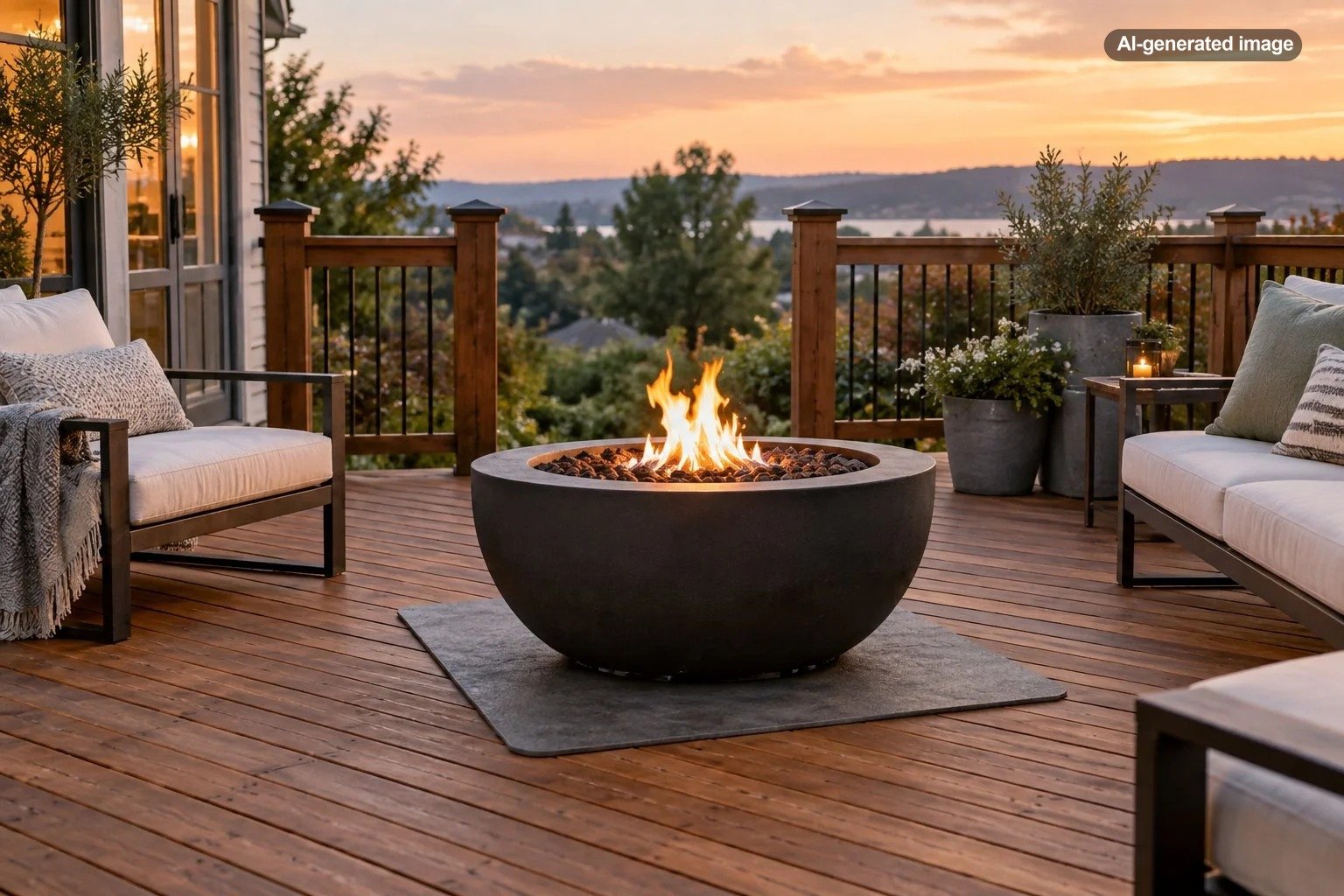
Yes, you may be able to put certain fire pits on a wood deck, but only when the appliance is explicitly approved for that surface and every manufacturer, fire-code, and local-use requirement is satisfied. A wood-burning bowl that releases sparks is a very different proposition from a listed gas fire table designed to control both flame and downward heat. The word outdoor does not automatically mean deck-safe.
The safest decision begins with the fire pit manual, the deck material, the available clearance, and the rules where you live. If any one of those pieces is uncertain, use the fire pit on a level noncombustible surface away from the deck instead.
Why a wood deck changes the risk
A deck is both a floor and part of the house. Its boards, joists, railings, furniture, cushions, leaves, and nearby siding can all be exposed to radiant heat, escaping sparks, or hot debris. Gaps between boards can also allow a small ember to fall into a space that is difficult to inspect.
Heat below the fire pit deserves as much attention as the visible flame. Some appliances have insulated bases or elevated burners that limit downward heat; others do not. A surface protector may shield the finish from discoloration without providing enough protection from sustained heat. That is why a generic claim such as “safe for patios” is not enough. Look for written instructions that address installation on wood or another combustible surface.
A fire pit belongs on a deck only when the entire setup is approved, stable, clear of combustibles, and easy to supervise.
Wood-burning, propane, and natural-gas fire pits are not interchangeable
| Fire-pit type | Main deck concern | Practical assessment |
|---|---|---|
| Wood burning | Sparks, embers, ash, intense radiant heat, and shifting fuel | Generally a poor choice for placement directly on wood decking unless a purpose-built installation is expressly approved by the manufacturer and permitted locally. |
| Portable propane | Downward heat, cylinder placement, hose damage, and gas leaks | Potentially suitable when the exact model is listed for combustible surfaces and used precisely as directed. |
| Permanent natural gas | Clearances, fuel-line installation, ventilation, and structural integration | Can be appropriate as a planned installation, but it should be designed and installed by qualified professionals under applicable requirements. |
| Liquid alcohol | Nearly invisible flames, spills, flame jetting, and refueling hazards | Avoid products that rely on pooled liquid fuel. The CPSC has warned consumers about serious burn hazards associated with this category. |
Wood-burning models
Traditional wood fires create unpredictable embers and sparks. A spark screen can reduce escaping material, but it cannot capture every ember or eliminate radiant heat. The U.S. Fire Administration recommends using a metal screen over wood-burning fires and keeping backyard fire pits at least three feet from the house and anything that can burn. A deck crowded by railings, seating, an umbrella, or an overhang may not offer that basic separation.
A pad underneath the bowl addresses only part of the problem. It does not protect nearby railings from heat, stop sparks from traveling on the wind, or make a low ceiling safe. For most portable wood-burning pits, a level masonry area in the yard is the more forgiving location.
Propane fire pits and fire tables
Propane models do not normally send wood embers into the air, which makes them easier to manage on a deck. They still produce substantial heat and an open flame. Confirm that the manual permits use on wood decking, follow the stated side and overhead clearances, and use only the fuel arrangement specified for that model.
Keep the cylinder upright and properly secured. Do not route a hose through a pinch point or across a walking path. If you smell gas, hear unexpected hissing, see a damaged connection, or cannot obtain a normal flame, shut the unit down according to its instructions and have the problem evaluated before using it again.
Built-in gas installations
A built-in fire feature should be treated as part of the deck project rather than furniture placed after construction. The design must account for the appliance listing, ventilation, noncombustible materials, fuel supply, service access, deck structure, and local requirements. This is a job for qualified professionals, particularly when a gas line or alteration to the structure is involved.
Check these conditions before placing any fire pit
Before you decide
- Read the manual for an explicit statement about combustible surfaces or wood decks.
- Confirm the required clearance from walls, railings, furniture, umbrellas, branches, roofs, and overhangs.
- Check local fire restrictions, burn bans, permit rules, lease terms, and association requirements.
- Verify that the deck is stable, level, and capable of supporting the complete installation.
- Remove dry leaves, rugs, pillows, covers, firewood, and other combustible items from the surrounding area.
- Plan an unobstructed route away from the fire and keep an appropriate extinguishing method readily accessible.
- Keep children and pets outside the appliance’s safety zone and maintain continuous adult supervision.
Clearance numbers are not universal. The appliance manual may require more distance than general fire-safety guidance, and local rules may be stricter still. Use the most restrictive applicable requirement rather than choosing whichever number fits the available space.
What a deck protector can and cannot do
A purpose-made noncombustible or heat-resistant base can help when the fire-pit manufacturer requires or permits one. It should extend as directed, lie flat, and remain stable under the appliance. An improvised collection of loose pavers may introduce tipping hazards or concentrate weight in a way the deck was not designed to carry.
More importantly, a protector is not a permission slip. It cannot compensate for an appliance that prohibits combustible surfaces, insufficient clearance, an unsafe fuel system, or airborne sparks. It may also trap water against the boards, mark the finish, or conceal heat damage. Inspect the area after each use once everything is completely cool.
How to arrange the surrounding deck
Allow more breathing room than the furniture layout seems to need. Chairs tend to migrate toward warmth, and blankets or loose clothing can move closer to the flame as people settle in. Keep circulation paths open so no one must squeeze between a hot fire feature and a railing.
Choose stable seating without trailing cushions or throws near the flame. Protect nearby furnishings between gatherings, but remove every cover from the fire-pit clearance zone before lighting the appliance. Never cover the fire pit itself until it has been shut down and cooled as directed by the manufacturer.
Safe operation matters every time
What to do
- Inspect the appliance, fuel connections, deck surface, and surrounding area before ignition.
- Remove combustible clutter and confirm that weather conditions are suitable.
- Position the unit exactly as required and keep the protective screen or guard in place when specified.
- Have a responsible adult remain present for the entire burn.
- Shut down or extinguish the fire fully before leaving the area.
- Allow the unit and any ash to cool completely before handling, covering, or disposing of material.
Do not use a fire pit during high winds or when a burn ban or other restriction is active. Never add gasoline or another unapproved accelerant. Do not move a hot appliance, refill a hot fuel reservoir, or leave a smoldering wood fire unattended. The deck should also have working access to the home’s exits rather than allowing the fire pit or furniture to block them.
When the answer should simply be no
Do not put the fire pit on the deck when the manual is missing or ambiguous, the product prohibits combustible surfaces, required clearances cannot be achieved, or local rules do not permit it. The answer is also no when the deck is deteriorated, unstable, crowded, under a low cover, or regularly exposed to strong winds.
Renters and condominium residents should obtain permission rather than assuming that a small flame is exempt from property rules. Homeowners should also consider whether their insurer has relevant conditions. These requirements vary, so general online advice cannot settle the question for a particular address.
Frequently asked questions
Is a propane fire pit safe on a wood deck?
It can be when the exact model is approved for combustible decking, installed with all required protection, and operated with the specified clearances. Propane alone does not make an appliance deck-safe.
Can concrete pavers protect the deck?
Pavers may form part of an approved installation, but they do not automatically make an unsuitable fire pit safe. Follow the appliance instructions and consider the pavers’ stability, weight, heat transfer, and effect on drainage.
Can a fire pit sit under a pergola?
Only if the appliance instructions allow covered use and every overhead and side clearance can be met. Fabric canopies, vines, string lights, and decorative wood members all count as nearby materials that may be damaged or ignited.
How far should a fire pit be from the house?
The U.S. Fire Administration provides a general minimum of three feet from the house and anything combustible for backyard fire pits. The manufacturer or local authority may require substantially more, so the larger applicable distance controls.