

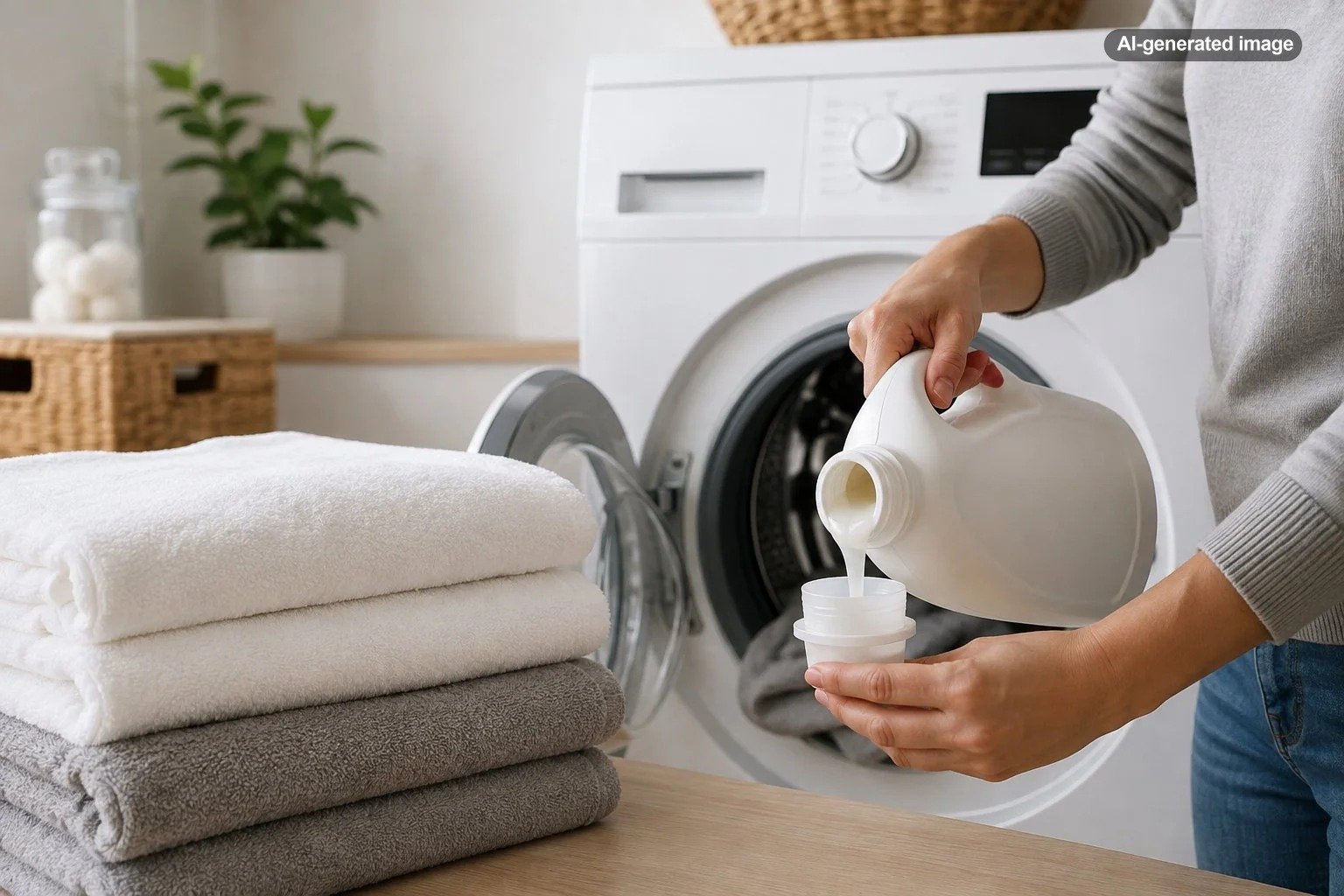
How Much Laundry Detergent Should You Use for Towels?
For most towel loads, you do not need extra detergent simply because you are washing towels. Use the detergent manufacturer’s recommended dose for the actual load size, soil level, washer type, and water conditions. For lightly to normally soiled towels, starting with the lowest recommended dose that matches your load is usually more sensible than automatically filling the measuring cap.
Towels are wonderfully absorbent when they are doing their job after a shower, but that same dense construction can make thorough rinsing especially important. Using more detergent than the wash requires can leave residue behind rather than making towels cleaner. Over time, that buildup may contribute to towels that feel stiff, rinse poorly, or seem less fresh even after laundering.
There is no universal tablespoon rule for towels
A fixed instruction such as “use one tablespoon” sounds convenient, but modern detergents vary considerably in concentration and format. A tablespoon of one liquid detergent may not represent the same dose as a tablespoon of another, and powders, detergent sheets, concentrated liquids, and premeasured packs are designed differently.
The washer matters, too. High-efficiency machines are designed to clean with less water and require an HE-compatible detergent. Because there is less water available during parts of the cycle, adding excess detergent can make rinsing more difficult rather than more effective. The most reliable measuring tool is therefore the dosing guidance supplied with the detergent, combined with the instructions for your washing machine.
Think of the label dose as your starting point. A modest load of everyday bath towels that are normally soiled does not automatically deserve the maximum dose. Save higher recommended amounts for the conditions the detergent maker actually identifies, such as a larger load, heavier soil, or certain hard-water situations.
More detergent is not a shortcut to cleaner towels; the useful amount is the amount your washer can wash and rinse away effectively.
Load size matters more than the fact that the load contains towels
A few hand towels and washcloths are not the same laundry load as a drum filled with bath sheets. Detergent dosing should follow the size of the load rather than a mental rule that all towel washes need a heavy dose.
Just as important, avoid packing the washer too tightly. Towels become substantially heavier once saturated, and they need room to move through the wash and rinse process. An overloaded washer can produce disappointing results even when the detergent amount itself is correct. Adding another splash of detergent does not solve a lack of space for water and mechanical action.
A simple dosing routine
- Check the towel care labels and your washer instructions before choosing the cycle and water temperature.
- Estimate the actual load size rather than dosing by habit.
- Measure the detergent using the manufacturer’s directions for that load size.
- Adjust only when the product directions specifically account for heavy soil or your water conditions.
- If towels repeatedly feel coated or rinse poorly, review both detergent quantity and washer loading before adding anything else.
Why too much detergent can make towels feel worse
It is easy to assume that a little extra detergent provides a little extra cleaning. Laundry chemistry is not quite that accommodating. Excess detergent can be difficult to rinse away, and washer manufacturers specifically identify overuse as a possible contributor to detergent residue, excessive suds, poor rinsing, and reduced cleaning performance.
That is particularly noticeable with towels because texture and absorbency are part of their function. A towel can look clean while still feeling less pleasant than it should. If freshly washed towels feel unusually stiff, slick, coated, or soapy, detergent buildup is one reasonable possibility to investigate.
Visible white residue can also be associated with excess detergent or detergent that has not dissolved and rinsed properly. Washer guidance recommends checking detergent use, load conditions, cycle selection, and laundering instructions rather than simply adding more product at the next wash.
When it makes sense to adjust the dose
There are legitimate reasons detergent needs can change from one towel load to another. A small load of lightly used guest towels is a different cleaning job from heavily soiled utility towels. Water hardness can also affect detergent performance, and detergent manufacturers may provide separate dosing guidance for harder water. Tide, for example, advises matching the dose to factors including load size, soil level, water hardness, and detergent type.
The key is to make those adjustments according to the detergent instructions rather than improvising a large dose. Concentrated formulas in particular can make eyeballing deceptive. A seemingly small amount may already be the correct full dose.
Before you change the detergent amount
- Is this actually a larger load than usual?
- Are the towels heavily soiled rather than simply used once or twice?
- Does your detergent label provide different hard-water dosing?
- Are you using an HE detergent in an HE washer?
- Is the drum overloaded enough to interfere with washing and rinsing?
- Have you changed detergent formulas or concentrations recently?
What to do if you have probably been using too much
You do not need to panic or launch an elaborate laundry rescue operation. For the next wash, measure carefully according to the product directions instead of pouring by eye. Make sure the washer is not overloaded and choose a cycle appropriate for the towels and their care labels.
If towels come out with obvious detergent residue, an additional rinse can help remove material that remains in the fibers. Manufacturer laundry guidance also notes that excess detergent can accumulate over time, making careful dosing worthwhile as an ongoing habit rather than a one-load fix.
Be cautious about responding to every towel problem with more laundry additives. If the issue is residue, layering additional products into the wash can complicate the problem. Correcting the basic variables – detergent amount, load size, cycle, water conditions, and drying – is the cleaner place to begin.
Do new towels need more detergent?
Usually, no. New towels may release lint during early washes, and their care instructions may recommend laundering before first use, but that does not create a general need for an oversized detergent dose. Follow the towel label and use the detergent amount appropriate for the load.
Washing similar towels together can also make laundry management easier. Separating very linty new towels from garments that readily attract lint, for example, may be more useful than changing the detergent quantity.
Should you use less detergent for just a few towels?
Yes, when the detergent instructions specify a smaller dose for a smaller load. A partial washer load normally should not receive the same amount automatically used for the largest load the machine can handle.
This is where measuring instead of pouring by instinct pays off. Detergent caps can be much larger than the amount required for some loads, and concentrated formulas can require surprisingly modest quantities. Read the markings rather than assuming that one capful equals one normal wash.
What if towels still smell after washing?
Do not immediately double the detergent. Persistent odor can have several causes, including inadequate drying, an overloaded washer, residue buildup, leaving damp towels sitting too long, or a washing machine that needs routine cleaning. Start with the simplest possibilities and change one variable at a time.
Make sure towels dry thoroughly after both use and laundering. Review your washer’s cleaning instructions if the machine itself has an odor or visible residue. If you have already been generous with detergent, reducing excess and improving rinsing may be more productive than adding still more.
The simplest rule to remember
Use enough detergent to clean the load, but not so much that your washer has to struggle to remove it. For towels, that generally means following the detergent’s measured dose for your load size and conditions instead of adding an extra “towel allowance.”
If your towels feel clean, rinse well, remain absorbent, and come out without detergent residue, there is little reason to increase the amount. If they do not, troubleshoot load size, detergent measurement, washer compatibility, water conditions, and drying habits before assuming that more soap is the answer.