Should an Air Purifier Run All Day?
For most homes, an air purifier can run all day, and continuous operation is often the most practical way to keep filtering airborne particles as they enter or are generated in a room. That does not mean every purifier needs to run at full speed around the clock. A lower fan setting, automatic mode, or scheduled operation may provide a better balance of filtration, sound, and electricity use.
The key is to think of an air purifier as an ongoing filtration appliance rather than a one-time cleaning device. Dust, pollen, pet dander, cooking particles, and outdoor pollution do not politely wait until the purifier is switched on. They can appear throughout the day, which is why steady operation can make sense when air quality is a continuing concern.
Why running an air purifier continuously can help
Portable air cleaners filter the air that actually passes through them. The U.S. Environmental Protection Agency notes that portable air cleaners can help reduce indoor air pollution, but they cannot remove every pollutant and should complement source control and ventilation rather than replace them.
That distinction explains why longer operating periods are often useful. If a purifier runs for a short period and then remains off for many hours, particles can continue entering the room from open doors, clothing, pets, cooking, outdoor air, and ordinary household activity. Continuous or frequent filtration gives the appliance more opportunities to capture particles as room air circulates through it.
This can be particularly useful in bedrooms, home offices, living rooms with pets, and rooms affected by seasonal pollen or intermittent outdoor pollution. It may also make sense after activities that temporarily generate particles, such as cooking or cleaning, although removing or reducing the pollution source remains the first priority whenever possible.
The most useful air purifier is often the one that can quietly keep working without demanding much attention.
You probably do not need maximum fan speed all day
Running continuously and running at maximum speed are two different decisions. A higher fan speed generally moves more air through the purifier, but it may also create more noise and use more electricity. For everyday use, a moderate setting that you are comfortable leaving on can be more practical than repeatedly switching between maximum speed and completely off.
Automatic modes can simplify that decision when the purifier includes a particle sensor. The appliance can increase or decrease airflow in response to detected particle levels, although sensor behavior varies by model and should not be treated as a comprehensive measurement of every indoor pollutant.
Affiliate disclosure: CraneManor.com may earn a commission when you purchase through links on this page. This does not affect the price you pay. Learn more.
For example, a Coway Airmega purifier such as the AP-1512HH includes automatic fan-speed control, an air-quality indicator, a timer, filter indicators, and an Eco mode. Coway states that in Eco mode the fan can stop after the unit senses that room air has remained clean for a period, then resume when pollution is detected. Features like these can make extended operation less intrusive without requiring the user to constantly adjust the controls.
Electricity use is the main practical tradeoff
An air purifier is an electric appliance, so leaving it on longer increases the amount of time it can consume power. ENERGY STAR specifically evaluates room air cleaners for energy efficiency and notes that models vary meaningfully in their electricity consumption.
If you plan to operate a purifier for many hours every day, energy efficiency becomes more important than it might be for occasional use. Compare appropriately sized models rather than buying the largest unit simply because it appears more powerful. ENERGY STAR recommends considering Clean Air Delivery Rate, or CADR, in relation to room size. A purifier that is poorly matched to the space may force an unnecessary compromise between performance, noise, and energy use.
When it makes sense to turn an air purifier down or off
Continuous operation is not a requirement in every situation. If a room will remain unoccupied for an extended period and there is little reason to filter it, reducing the fan speed or switching the unit off may be reasonable. A timer can also be useful when you want filtration concentrated around a predictable period of use.
You may also prefer a lower setting at night if fan noise interferes with sleep. In that case, a quieter continuous setting may be more useful than running the purifier loudly for an hour before bed and then turning it off completely.
There is another important exception: follow the manufacturer’s safety and operating instructions for your specific appliance. Stop using a purifier that shows signs of electrical damage, unusual overheating, burning odors, damaged wiring, or other abnormal operation. Do not assume that every portable appliance is appropriate for unattended use merely because another model is.
Placement matters as much as run time
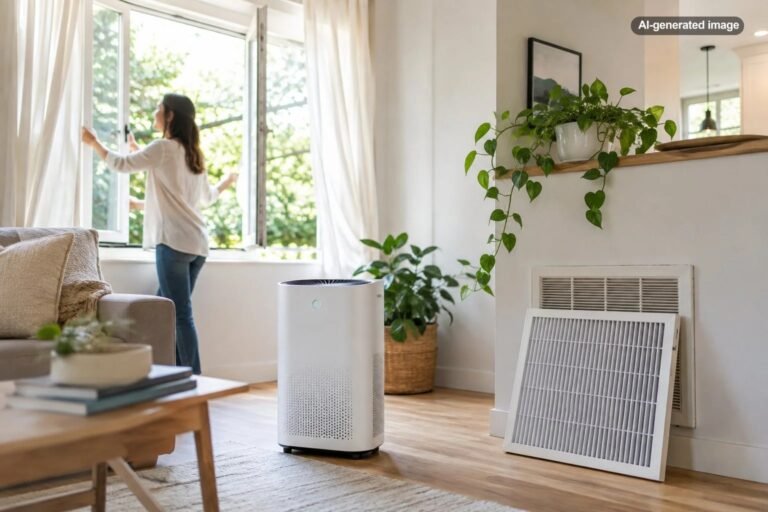
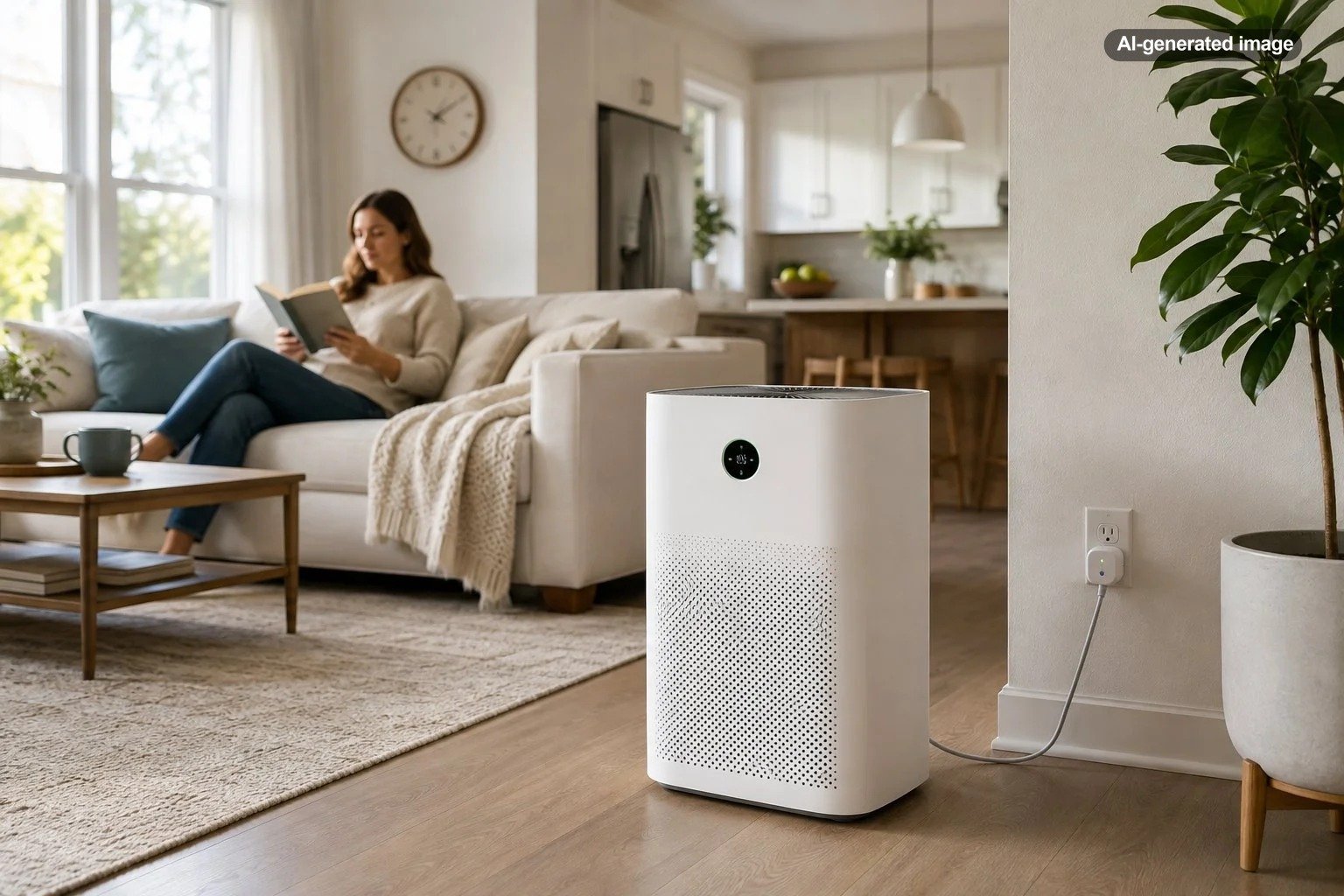
A purifier cannot filter room air effectively if airflow around the unit is badly obstructed. Avoid placing clothing, curtains, furniture, or other objects directly against its intake or clean-air outlet. Follow the manufacturer’s placement guidance because air enters and exits different purifier designs in different directions.
Think about where you spend time as well. A portable room air cleaner is intended to serve a room or defined area, not magically clean an entire house from a distant corner. If your primary concern is nighttime air quality, the bedroom is usually a more logical location than a hallway several rooms away.
Filter maintenance becomes more important with frequent use
The longer a purifier operates, the more air passes through its filters. That makes maintenance part of the continuous-use equation. EPA guidance emphasizes that filters require regular replacement and that an overloaded, dirty filter will not perform well.
Do not assume a universal replacement schedule. Filter life can vary with the purifier, fan speed, indoor particle levels, pets, smoke exposure, and other household conditions. Check the manufacturer’s instructions and filter indicator rather than replacing a filter according to an unrelated model’s schedule.
Before you leave it running all day
- Confirm that the purifier is appropriately sized for the room.
- Choose a fan speed that is quiet enough for extended use.
- Keep the intake and outlet clear of furniture, fabrics, and clutter.
- Check the filter and maintenance instructions for your exact model.
- Use automatic or Eco modes when they suit your household routine.
- Address pollution sources instead of relying on filtration alone.
Do air purifiers replace ventilation or cleaning?
No. Air filtration is only one part of indoor air-quality management. EPA recommends reducing or removing pollutant sources and ventilating with clean outdoor air when appropriate, with filtration serving as a useful supplement.
That means a purifier should not become an excuse to ignore a persistent moisture problem, ongoing smoke source, malfunctioning combustion appliance, or another condition that needs to be corrected directly. Similarly, an air purifier captures airborne material; it does not replace vacuuming, surface cleaning, or other basic household maintenance.
Frequently asked questions
Is it OK to run an air purifier 24 hours a day?
For many portable air purifiers, extended operation is consistent with their intended use, provided the appliance is operated and maintained according to its manufacturer’s instructions. Continuous filtration may be useful when particles are being introduced into the room throughout the day.
Should I turn my air purifier off when I leave the room?
Not necessarily. If you want the purifier to continue filtering that room, leaving it on at a lower or automatic setting can be reasonable. If the room will not be used for a long period and ongoing filtration is not important, turning it down or off can reduce electricity use.
Should an air purifier run while I sleep?
It can. Many people choose a low or sleep setting overnight because it provides ongoing filtration with less fan noise. Make sure the purifier is positioned according to the manufacturer’s instructions and that airflow is not blocked by bedding, curtains, or furniture.
Does running an air purifier longer make the air completely clean?
No. EPA states that no air cleaner or filter removes all indoor air pollutants. Performance also depends on factors such as the pollutant, purifier type, room size, airflow, filter condition, and operating speed.
The practical answer
So, should an air purifier run all day? In many households, yes. Continuous operation at a sensible fan speed can provide steadier filtration than brief, occasional use, especially in occupied rooms where particles are continually entering the air. Automatic and energy-saving modes can make that routine quieter and more convenient.
The better question is not simply how many hours the purifier runs, but whether it is properly sized, well placed, maintained, and used alongside sensible source control and ventilation. Get those details right, and leaving the purifier on can become a quiet background habit rather than another household task to manage.