
How Do You Keep White Towels Looking Like Hotel Towels?
Keeping white towels looking like hotel towels is less about using a secret product and more about controlling four things: detergent buildup, stains, wash temperature, and drying. Start with genuinely white towels, wash them separately from strongly colored or lint-heavy items, use the correct amount of detergent, treat stains promptly, and dry them completely without routinely overloading the machine.
The goal is not simply brilliant whiteness. A good towel should also remain absorbent, pleasantly textured, and fresh after repeated laundering. Chasing brightness with increasingly aggressive washing can shorten a towel’s useful life, so the best routine balances appearance with fabric care.
Start with a white-towel-only laundry routine
White towels are easier to maintain when they have their own laundry routine. Washing them with dark clothing creates opportunities for loose dye, lint, hair, and residue to land on fibers that are supposed to look crisp and clean. It also makes stain treatment harder because a product that is appropriate for a plain white cotton towel may not be appropriate for every colored item sharing the load.
Sort by care instructions as well as color. A thick cotton bath towel and a decorative towel with specialty fibers, embroidery, or trim may require different temperatures or whitening methods. The care label should have the final word on water temperature, drying, and whether bleach is appropriate.
Use enough detergent, but do not automatically use more
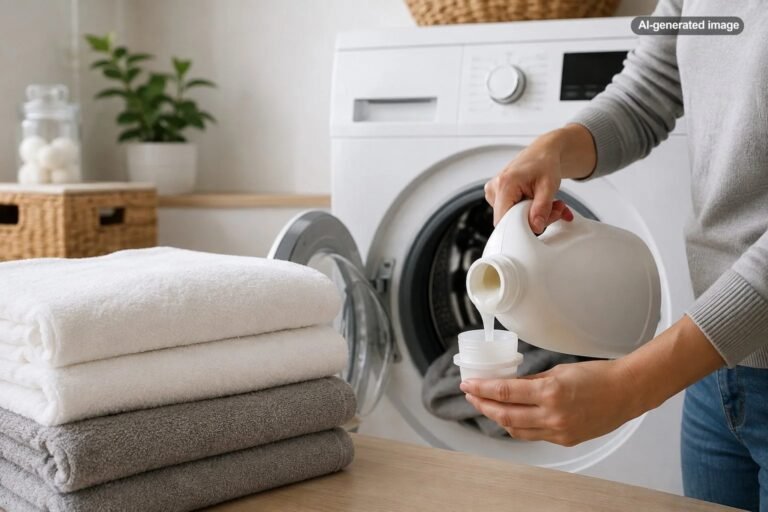
When towels start looking gray or feeling less inviting, it is tempting to add extra detergent. More is not necessarily better. Laundry products are formulated to work at measured amounts, and the American Cleaning Institute advises following product directions and fabric-care instructions. Detergent that does not rinse away effectively can contribute to an undesirable feel or appearance rather than producing a cleaner-looking towel.
Follow the detergent label and account for your washer type, load size, and soil level. Avoid packing the drum so tightly that towels have little room to move. If a normal wash repeatedly leaves towels feeling coated or looking dull, examine the entire routine before simply increasing the detergent dose.
For general laundry guidance, the American Cleaning Institute’s laundry basics provides a useful reminder to sort appropriately, follow labels, and choose laundry products according to the load.
Treat stains before they visit the dryer
Makeup, skin-care products, hair products, and ordinary bathroom mishaps are much more noticeable on white terry cloth. Check towels as they go into the washer and again before transferring them to the dryer. If a mark remains after washing, treat it again rather than assuming dryer heat will somehow finish the job.
Match the treatment to the stain and the towel’s care instructions. For products such as chlorine bleach, never assume that every white textile is automatically bleach-safe. Clorox’s towel-care guidance similarly emphasizes checking care instructions before selecting a whitening treatment.
A practical white-towel routine
- Separate white towels from dark or strongly colored laundry.
- Check for visible stains and pretreat them with a product appropriate for the fabric and stain.
- Read the towel care label and detergent directions.
- Wash without crowding the machine.
- Inspect stubborn marks before machine drying.
- Dry completely, then fold or store only when the towels are fully dry.
Use whitening products selectively
A whitening product can be useful when white towels become dingy, but the correct choice depends on the fiber content and care label. Chlorine bleach is not appropriate for every textile, while non-chlorine laundry products may be better suited to some fabrics. Follow the product label rather than improvising concentrations or combinations.
If you choose chlorine bleach for a compatible white towel, use it according to the bleach manufacturer’s directions and your washing machine instructions. Do not mix chlorine bleach with ammonia, vinegar, acids, or other household cleaners. For towel-specific bleach guidance, see Clorox’s instructions for washing towels with bleach.
Be thoughtful about fabric softener
Fabric softener can make many textiles feel softer, but absorbency matters more for bath towels than softness alone. Some towel-care guidance, including Clorox’s, advises against fabric softener because it can reduce water absorbency. The American Cleaning Institute notes that fabric softeners are designed to alter fabric feel and should be used according to their instructions.
If maximum absorbency is your priority, try a simpler towel routine without routine softener and judge the results over several washes. If you prefer the feel or fragrance of a softener, follow its directions rather than adding an unmeasured amount. The best routine is the one that leaves your particular towels clean, absorbent, and comfortable without unnecessary product buildup.
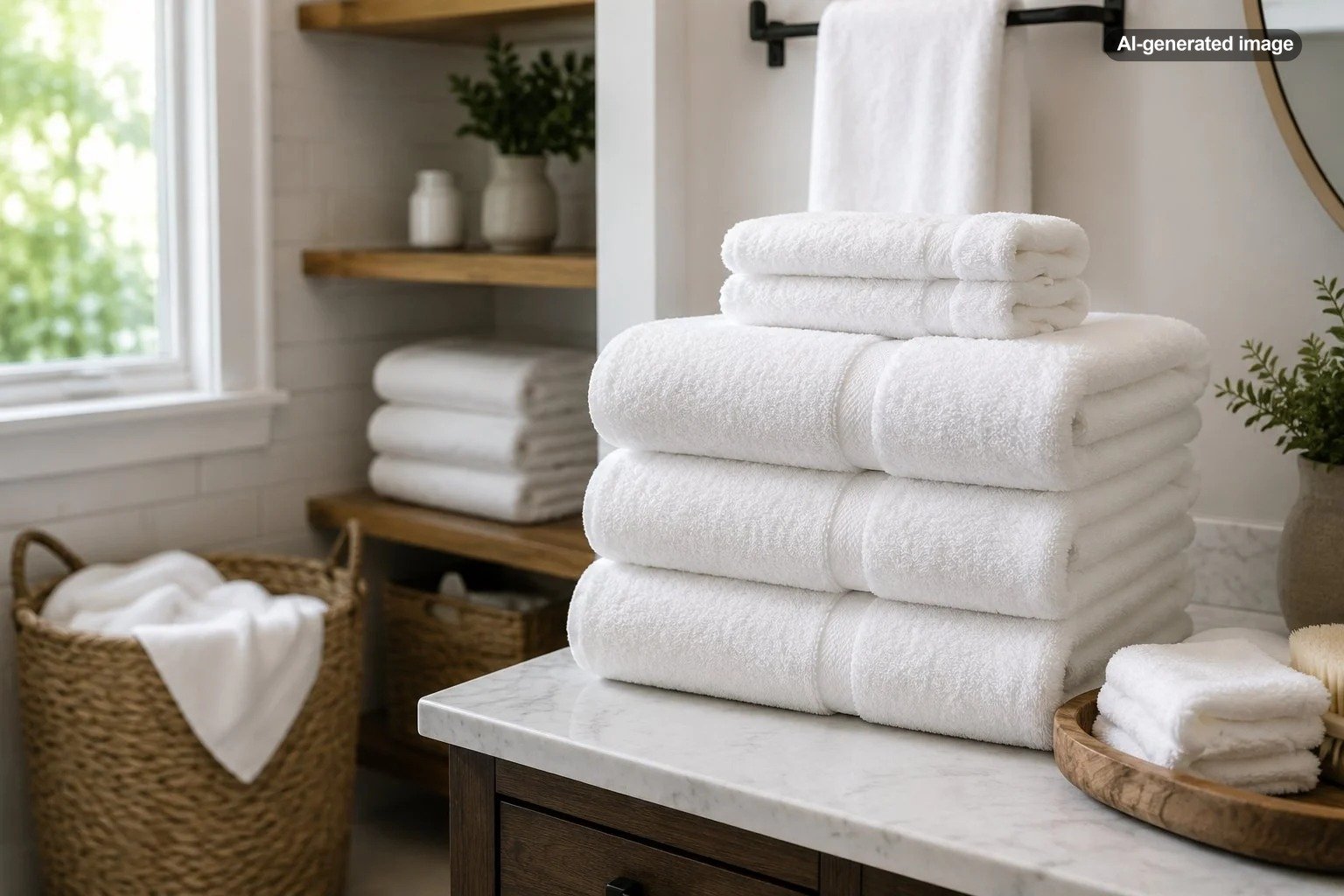
The most convincing hotel-style towel is not merely white; it is clean-looking, absorbent, completely dry, and consistently cared for.
Dry towels completely without baking them unnecessarily
Drying has an enormous effect on how towels feel. Shake towels out before placing them in the dryer so they are not entering as compressed bundles, avoid cramming the dryer, and use the temperature recommended on the care label. Towels should be completely dry before they are folded and placed in a linen closet.
At the same time, extending every cycle far beyond what is needed is not a shortcut to fluffiness. Excessive heat can be hard on textiles over time. If towels routinely require unusually long drying cycles, consider whether the dryer is overloaded and make sure normal dryer maintenance, including lint removal, is being handled according to the appliance manufacturer’s instructions.
Replace the towels when laundering is no longer the problem
Sometimes the laundry routine is fine and the towels are simply showing their age. Repeated use and laundering gradually change textile fibers. Frayed edges, permanent discoloration, persistent roughness, thinning areas, or poor absorbency may indicate that another cleaning experiment will deliver diminishing returns.
Affiliate disclosure: CraneManor.com may earn a commission when you purchase through links on this page. This does not affect the price you pay. Learn more.
If you want a more uniform linen closet, replacing towels in coordinated groups can create that orderly hotel effect immediately. For a straightforward white option, Utopia Towels bath towels are supplied as a four-pack of 100 percent ring-spun cotton bath towels measuring 27 by 54 inches. As with any towel, softness, linting, absorbency, shrinkage, and drying behavior can change after laundering, so follow the product’s care information rather than expecting any new set to remain unchanged.
Make the everyday routine easier to maintain
The most sustainable version of this routine is pleasantly boring. Give wet towels enough air to dry between uses, keep strongly staining products away from your best white linens when practical, maintain a separate hamper section for whites, and deal with visible stains before laundry day turns them into mysteries.
For a guest bathroom, consistency can matter as much as plushness. Matching towels folded the same way, stored without crowding, and replaced before they become visibly worn create a cleaner impression than an assortment of expensive towels maintained inconsistently.
Before your next towel load
- Separate white towels from dark laundry.
- Check every towel for stains before washing.
- Read the textile care label.
- Measure detergent according to its directions.
- Use whitening products only when appropriate for the fabric.
- Skip routine softener if absorbency is suffering.
- Dry completely before storing.
Frequently asked questions
Why do white towels turn gray or dingy?
Dinginess can have several causes, including soils that were not fully removed, laundry-product residue, dye or lint transferred from other items, staining, and ordinary textile wear. Review sorting, detergent measurement, load size, stain treatment, and fabric-care directions before escalating to harsher washing methods.
Should you wash white towels in hot water?
Use the temperature recommended on the towel’s care label and appropriate for the laundry products you are using. Do not assume that the hottest possible setting is correct for every white towel simply because hotels commonly use commercial laundering systems.
Can you bleach white towels every time?
Do not make that decision based on color alone. Check the towel care label and bleach-product instructions. Fiber content, trim, finishes, and other construction details can affect whether chlorine bleach is appropriate.
How do you keep towels fluffy and absorbent?
Avoid overloading the washer and dryer, use laundry products in their directed amounts, consider reducing or eliminating routine fabric softener if absorbency is declining, and dry towels fully according to their care instructions.