Can You Use a Fire Pit During a Burn Ban?
The safe answer is do not assume a fire pit is allowed during a burn ban. Whether you can use one depends on the exact restriction in effect, who issued it, where your property is located, what fuel the fire pit burns, and sometimes whether the flame can be shut off immediately. A wood-burning fire pit is commonly prohibited when outdoor burning is restricted, while some jurisdictions may still allow certain propane or gas appliances. Other bans specifically prohibit propane fire pits too.
That distinction matters because the phrase burn ban is not one universal set of rules. A county, city, fire district, state agency, park, or federal land manager can impose restrictions with different definitions and exceptions. The regulation that applies at your address or destination is the one that counts.
Why the words burn ban are not enough
People often hear that a burn ban has been announced and understandably want a simple yes-or-no answer for the backyard. The problem is that agencies use several types of restrictions, and the details can change as fire conditions worsen or improve.
One order might prohibit outdoor burning and campfires but permit certain pressurized-gas cooking appliances. Another may prohibit every recreational fire, including propane fire rings. Restrictions can also differ between neighboring jurisdictions or between private property and nearby public land.
Recent official restrictions show how significant those differences can be. In June 2026, North Cascades National Park Service Complex prohibited campfires and specifically stated that propane fire pits were not allowed during its ban, although qualifying gas or propane cooking stoves, grills, and lanterns remained permitted. By contrast, Oregon’s Deschutes River State Recreation Area posted 2026 restrictions that allowed liquefied- or bottled-fuel devices with an on/off valve, including propane fire pits, under the conditions stated for that location.
The label on the appliance matters less than the wording of the fire restriction that applies where you plan to use it.
Wood-burning fire pits are usually the easiest call
If your fire pit burns logs, wood chunks, pressed logs, charcoal, pellets, or another solid fuel, the conservative assumption during a burn ban is that you should not use it. Solid fuels can produce embers, sparks, ash, and hot material that may remain capable of causing ignition after the visible flames have died down.
Moving the same fire into a metal bowl, chiminea, masonry pit, tabletop vessel, or permanent backyard feature does not automatically make it exempt. An official restriction may prohibit the type of fire or fuel, not merely fires built directly on the ground.
The same caution applies to an existing patio fire pit that is normally legal and routinely used. A temporary fire restriction can override ordinary recreational-fire rules for as long as the restriction remains in effect.
Propane fire pits require a closer reading
Propane creates the most confusion because a gas flame can generally be extinguished immediately by shutting off the fuel supply. That controllability is why some restrictions make exceptions for certain pressurized-gas devices.
But an exception for propane appliances does not necessarily include propane fire pits. An authority may permit propane cooking stoves while still prohibiting recreational fire features. In June 2026, for example, Lake Roosevelt National Recreation Area prohibited propane campfires as part of its total fire restrictions while allowing self-contained propane or gas cookstoves and lanterns.
That is why reading only a summary such as ‘propane allowed’ can lead to the wrong conclusion. Look for the actual categories used in the order: fire pits, campfires, recreational fires, heating devices, cooking devices, portable appliances, open flames, and liquid petroleum gas devices may be treated differently.
Natural-gas fire pits are not automatically exempt either
A permanently installed natural-gas fire pit may feel more controlled than a portable wood fire, but a fixed installation is not a blanket exemption from temporary fire restrictions. Some orders focus on fuel type, some on open flame, and others on recreational fires regardless of how the fuel reaches the burner.
If the restriction does not clearly address your type of fire feature, contact the agency responsible for the order or your local fire authority. Do not infer permission merely because the fire pit is professionally installed, connected to a permanent gas line, surrounded by masonry, or equipped with a shutoff valve.
How to check whether your fire pit is allowed
What to do
- Identify the authority. Determine whether the restriction comes from your city, county, fire district, state forestry agency, park authority, or federal land manager.
- Read the current order or official notice. Do not rely solely on a neighborhood post, old news story, search snippet, or last year’s rules.
- Identify your fuel. Confirm whether the fire pit uses wood, charcoal, pellets, propane, natural gas, or another fuel.
- Identify the device category. Check whether the order separately discusses recreational fires, fire pits, propane fire rings, cooking appliances, heating appliances, or open flames.
- Check for location-specific conditions. An exception may apply only in designated campsites, irrigated areas, developed recreation areas, or areas cleared of combustible material.
- If the wording is unclear, do not light it. Ask the issuing agency or local fire authority whether your particular device is permitted.
Do not assume your backyard is outside the restriction
Some fire restrictions apply only to particular public lands. Others affect private property within a county, fire district, or state-protected area. A ban announced for a national park does not necessarily govern a house several miles away, and a county restriction may have different rules from adjacent federal land.
The opposite mistake is possible too: being on private property does not necessarily mean you are exempt. If the applicable local order prohibits recreational outdoor fires on private land, owning the property does not override it.
What if the fire pit is on concrete or a paved patio?
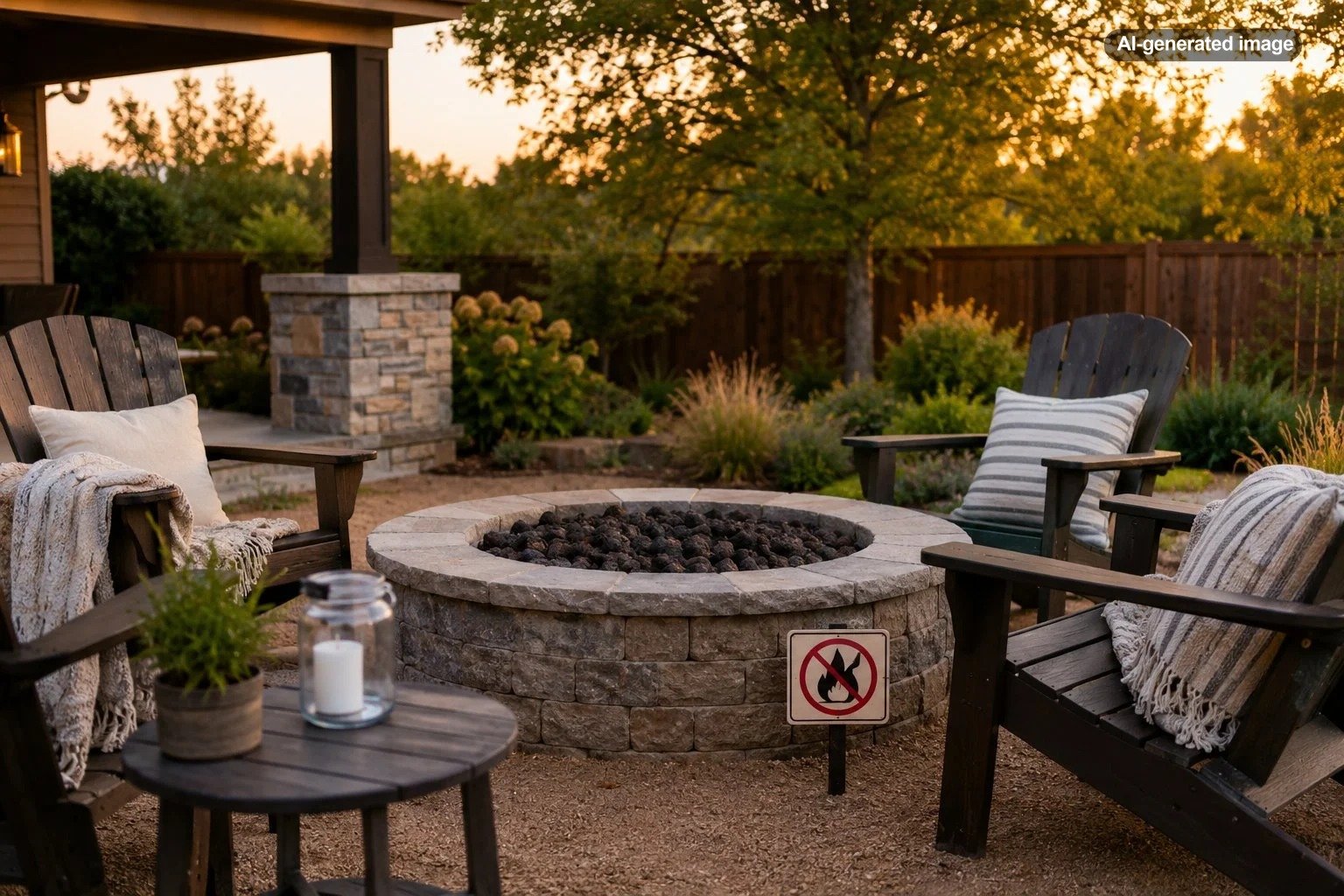
A noncombustible surface can be an important part of normal fire-pit safety, but it does not cancel a burn ban. Restrictions are intended to reduce ignition sources during periods when surrounding vegetation and fuels may be unusually receptive to fire.
Likewise, a spark screen, lid, high masonry wall, wind guard, fireproof mat, or generous clearance does not create an exemption unless the official restriction says that configuration is permitted. Those features may reduce particular hazards in ordinary use, but legal permission during a restriction is a separate question.
Wind can make an otherwise permitted device a poor choice
Permission is not the same as good judgment. Even if a gas appliance is technically permitted, unusually dry, windy, or severe fire-weather conditions may make postponing the fire the more sensible choice. Outdoor cushions, dry leaves, mulch, ornamental grasses, fencing, vegetation, and nearby structures can all become part of the risk picture.
Follow the manufacturer’s operating instructions for the specific appliance, including required clearances and placement. Never move a fire feature closer to a structure or into an enclosed space simply to shelter the flame from wind.
What to use instead during a fire restriction
If your usual fire pit is prohibited, the easiest alternative is often to skip the flame entirely until restrictions are lifted. Patio lighting, rechargeable lanterns, outdoor lamps, blankets on cooler evenings, and a comfortable seating arrangement can preserve much of the atmosphere without creating another ignition source.
Do not substitute candles, tiki torches, charcoal tabletop heaters, or another flame-producing product without checking the order. Restrictions that prohibit fire pits may also prohibit those devices.
Frequently asked questions
Can I use a propane fire pit during a burn ban?
Sometimes, but not universally. Some authorities allow qualifying propane devices with immediate shutoff controls, while others explicitly prohibit propane fire pits or propane campfires. Read the restriction that applies to your location.
Can I use a wood fire pit if it has a spark screen?
Do not assume so. If the order prohibits wood fires, campfires, recreational fires, or solid-fuel fires, adding a screen generally does not change the underlying prohibition.
Does a permanent fire pit get an exemption?
Not automatically. A permanent masonry or gas fire pit can still fall within a temporary prohibition on recreational fires or open flames.
Can I use a fire pit after rain if a burn ban is still active?
Not unless the applicable authority has lifted the restriction or the device is expressly permitted under it. A rain shower does not automatically cancel an official order.
Who should I call if the rule is unclear?
Contact the agency that issued the restriction or your local fire department or fire district. Describe the fuel and type of fire pit rather than simply asking whether ‘propane’ or ‘gas’ is allowed.
The bottom line
During a burn ban, never assume that a fire pit is permitted simply because it is contained, located on a patio, or fueled by propane. Wood and other solid-fuel recreational fires are frequently prohibited, while rules for propane and natural-gas appliances vary significantly.
Find the current official restriction for the exact location, identify how it treats your specific fuel and device, and follow the most restrictive rule that applies. If the language leaves room for doubt, leaving the fire pit off until you receive clarification is a small inconvenience compared with the consequences of an avoidable wildfire.