Can an Air Purifier Be Too Large for a Room?
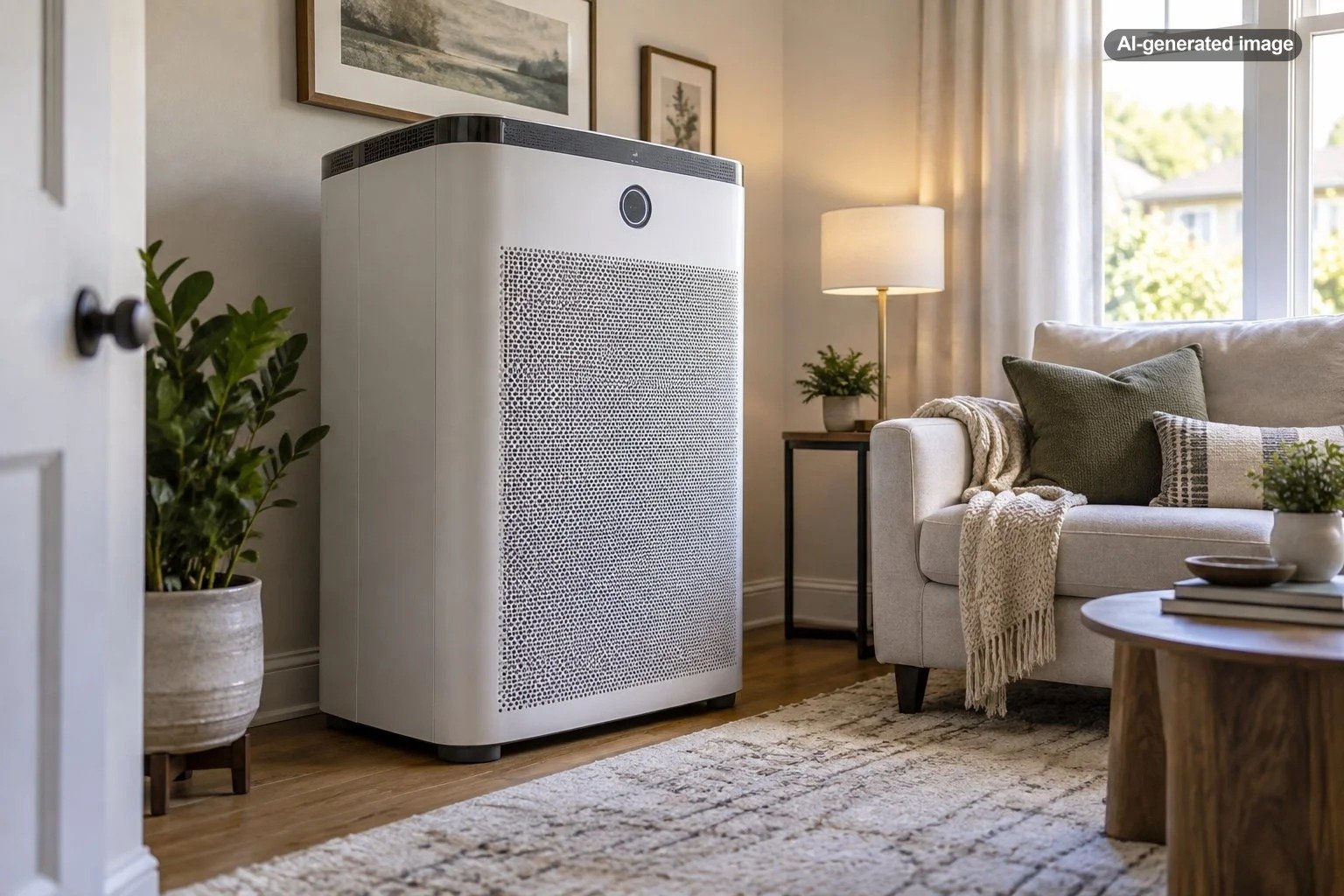
Yes, an air purifier can be larger than a room actually needs, but that is usually an efficiency, comfort, and cost question rather than a problem with air cleaning itself. A portable purifier with more capacity than necessary can still filter a smaller room effectively. In fact, extra capacity may let you run the machine at a quieter fan speed while maintaining useful filtration.
The practical goal is not to find the biggest purifier that will physically fit. It is to choose enough clean-air delivery for the room, then consider noise, energy use, filter costs, placement, and how you intend to operate the machine.
What air purifier size actually means
Air purifier sizing is best understood through Clean Air Delivery Rate, usually abbreviated CADR, rather than through the physical dimensions of the appliance. CADR describes how quickly a purifier delivers filtered air. A higher CADR generally means the purifier can serve a larger space or clean a smaller space more rapidly.
The U.S. Environmental Protection Agency advises choosing a portable air cleaner with a CADR large enough for the room where it will operate. Its sizing guidance, based on an 8-foot ceiling, pairs a 100-square-foot room with a minimum CADR of about 65 cubic feet per minute, 200 square feet with about 130 cfm, 300 square feet with about 195 cfm, and 400 square feet with about 260 cfm.
| Room area | EPA sizing example | What extra capacity may mean |
|---|---|---|
| 100 sq. ft. | About 65 cfm minimum CADR | A higher-CADR unit may run comfortably at a lower setting |
| 200 sq. ft. | About 130 cfm minimum CADR | Moderate oversizing can provide operating flexibility |
| 300 sq. ft. | About 195 cfm minimum CADR | Higher ceilings or adjoining areas may justify more capacity |
| 400 sq. ft. | About 260 cfm minimum CADR | Consider the full air volume and room layout |
Those figures are useful starting points, not universal guarantees. Ceiling height, open doorways, room shape, pollutant sources, purifier placement, and actual fan speed all influence real-world performance.
Why slightly oversizing an air purifier can make sense
A purifier’s highest CADR is generally associated with a high fan setting. That setting may also be the loudest. If you select a machine with some reserve capacity, you may be able to operate it at a lower fan speed during ordinary use without sacrificing as much filtration as you would with a smaller machine running at the same reduced setting.
This can be particularly useful in bedrooms, home offices, nurseries, television rooms, and other places where continuous fan noise matters. EPA guidance also notes that higher fan speeds and longer run times generally increase the amount of air filtered. That means the way you actually use a purifier matters just as much as the maximum number printed on the box.
The best air purifier is not necessarily the largest one; it is the one you can place correctly and comfortably run often enough to do useful work.
Extra capacity can also help in rooms with ceilings higher than the 8-foot height used in common sizing charts. A 200-square-foot room with a 12-foot ceiling contains substantially more air than a 200-square-foot room with an 8-foot ceiling, even though both have identical floor area.
When a purifier starts to feel unnecessarily large
There is no sharp line where a purifier suddenly becomes too powerful for a small room. Instead, oversizing eventually produces diminishing practical benefits. Once the unit already provides ample clean-air delivery, buying dramatically more capacity may mainly add appliance size, cost, filter expense, airflow, and power consumption.
Advantages
- More clean-air capacity in reserve
- Potential to use quieter lower fan settings
- Better flexibility for high ceilings or nearby open areas
- Faster particle removal when higher speed is needed
Tradeoffs
- Larger physical footprint
- Potentially higher energy use
- Possibly higher replacement-filter costs
- More noticeable drafts or fan noise at high speed
ENERGY STAR specifically recommends choosing a model appropriately sized for the room and notes that larger models use more energy. That does not mean every oversized purifier is wasteful in actual use; energy consumption depends on the specific machine and operating speed. It does mean that buying far more capacity than you can use should be a deliberate choice rather than an automatic upgrade.
Measure the space the purifier really serves
Before deciding that a purifier is oversized, define the actual space. For a conventional enclosed room, multiply length by width to calculate square footage. For an open floor plan, EPA recommends considering the entire area the purifier is expected to serve rather than treating one corner as an isolated room.
High ceilings deserve special attention. EPA recommends considering a purifier sized for a larger area when ceilings are above 8 feet. Doorways also matter. A purifier in a bedroom with the door shut has a very different job from the same purifier placed between an open kitchen, dining area, and living room.
Before you decide
- Measure the room’s length and width.
- Account for ceilings higher than 8 feet.
- Decide whether doors will normally be open or closed.
- Compare CADR rather than relying only on marketing language about room coverage.
- Check the purifier’s dimensions and required clearance around air inlets and outlets.
- Consider the fan speed you are realistically willing to use every day.
Do not confuse room coverage with one universal performance number
Room-coverage claims can look dramatically different from one product to another because manufacturers may describe coverage at different numbers of air changes per hour. A purifier may be advertised for a very large area when the calculation assumes the room air is processed only once per hour, while a much smaller coverage figure may correspond to several air changes per hour.
CADR gives shoppers a more standardized way to think about particle filtration. EPA notes that CADR applies to particles, not to gases. If odors, gases, or volatile organic compounds are the main concern, look for a purifier with an appropriate gas-removal medium, such as activated carbon, while recognizing that particle CADR alone does not describe gas-removal performance.
An example of moderate capacity rather than maximum capacity
A medium-capacity purifier can illustrate why the numbers deserve context. Coway lists the Airmega Mighty AP-1512HH with a smoke CADR of 233 cfm and describes different coverage areas depending on how many air changes per hour are expected. It also includes automatic fan control, an air-quality indicator, a timer, a filter-change indicator, and an Eco mode. Those operating features can matter in a smaller room because they give the user options besides simply running the purifier at full speed.
Affiliate disclosure: CraneManor.com may earn a commission when you purchase through links on this page. This does not affect the price you pay. Learn more.
For readers who want that type of automatic operation, a Coway Airmega purifier is one example of a room air cleaner with controls that can make excess capacity more manageable. As with any purifier, room-coverage claims depend on operating conditions and fan speed, so the published CADR and the size of your own room are more useful than assuming a single coverage number tells the entire story.
Placement can matter more than a small sizing mismatch
Even a generously sized purifier will perform poorly if airflow is obstructed. ENERGY STAR recommends following the product manual for placement and keeping the unit away from curtains and other objects that block airflow.
A purifier squeezed behind a sofa, pushed tightly into a corner contrary to its instructions, or surrounded by curtains may not move air through the room as effectively as intended. In a small room, a physically oversized unit can therefore become inconvenient even when its filtration capacity is perfectly acceptable.
How much oversizing is reasonable?
Think in terms of useful margin rather than a precise oversizing percentage. Choosing somewhat more CADR than the minimum suggested for the room can provide flexibility. Choosing a very large machine designed for a major open living area when you only need to serve a tiny closed bedroom may provide little practical benefit beyond what a smaller, quieter, less expensive model could accomplish.
The sensible comparison is between several models that all meet the room’s minimum clean-air requirement. Then compare fan noise, energy consumption, replacement-filter needs, physical dimensions, controls, and the CADR available at the settings you expect to use.
FAQ
Can a powerful air purifier clean a small room too quickly?
A high-CADR purifier can remove airborne particles more rapidly than a lower-CADR unit under comparable conditions. That is not inherently a problem. The practical concerns are usually noise, airflow, energy use, and whether the appliance is larger than necessary for the space.
Should I buy an air purifier rated for a room larger than mine?
Some extra capacity can be useful, particularly for high ceilings or when you prefer lower fan speeds. There is little reason, however, to pay for dramatically more capacity unless another factor in the room actually calls for it.
Is CADR more useful than the advertised square footage?
For particle filtration, CADR is especially useful because it describes clean-air delivery. Advertised coverage figures should still be read carefully because they may be based on different air-change assumptions.
Does a larger air purifier remove odors better?
Not necessarily. CADR ratings describe particle removal. Gas and odor removal depends on the purifier’s gas-removal media and design, such as the amount and type of activated carbon or other sorbent material.
Can one large purifier clean several rooms?
Not as predictably as cleaning one open area. Walls and closed doors restrict air movement. EPA describes portable air cleaners as devices intended to filter a single room or area, so multiple units may be more effective when separate enclosed rooms need filtration.
The bottom line
An air purifier can be larger than a room needs, but moderate oversizing is often perfectly workable. The important question is whether the extra capacity provides a useful benefit, such as quieter operation or accommodation for high ceilings, without imposing unnecessary cost, bulk, energy use, or uncomfortable airflow.
Start with room dimensions and CADR, account for ceiling height and open adjoining spaces, and then choose a purifier you can position correctly and run consistently. That approach is more reliable than treating the largest advertised coverage number as automatically better.