How Often Should Bath Towels Be Replaced?
Bath towels do not have a universal expiration date. For regularly used household towels, a practical expectation is that replacement may become worthwhile somewhere around the two-to-five-year mark, but condition matters far more than a date on the calendar. A towel that still absorbs well, dries properly, smells fresh after laundering, and remains comfortable can stay in service longer. A newer towel that has become thin, stubbornly musty, or ineffective at drying you may deserve an earlier retirement.
The better question, then, is not simply how old the towel is. It is whether the towel is still doing its job.
Why there is no perfect replacement schedule
Two identical towels can age very differently. One might be used every morning, washed several times each week, and tumble-dried repeatedly. Another might sit in a guest bathroom and see a few weekends of use each year. Counting birthdays alone treats those towels as though they have had the same life.
Frequency of use, washing habits, drying conditions, fabric construction, water quality, detergent residue, and the number of towels in your rotation all influence how quickly a towel wears. A household with eight bath towels rotating among two people may put substantially less wear on each individual towel than a household where the same two towels are constantly cycling from shower to washing machine and back again.
That is why a broad lifespan estimate is best treated as a reminder to inspect towels, not a deadline for throwing them away.
The clearest signs that a bath towel should be replaced
Loss of absorbency is one of the most useful tests. A bath towel should remove water efficiently rather than merely pushing moisture around your skin. If a freshly laundered towel has become noticeably less absorbent, first consider whether detergent, fabric softener, dryer-sheet residue, or another laundry issue is coating the fibers. If proper laundering does not restore its performance, the towel may simply be worn.
Persistent odor is another important clue. There is a difference between a towel that smells stale because it was left damp in a heap and one that develops an unpleasant odor quickly even after thorough washing and complete drying. Correct the drying and laundry routine first. If the odor consistently returns despite proper care, replacement can be the simpler answer.
Thinning fabric and flattened loops matter, too. Terry towels depend on their surface loops to provide much of their absorbent area. Years of use and laundering can leave a towel noticeably thinner, less plush, and less effective.
Fraying is mostly a condition issue rather than an emergency. A loose thread does not automatically condemn an otherwise good towel, but unraveling hems, extensive worn patches, holes, or edges that continue deteriorating are reasonable signs that its useful bathroom life is ending.
Before you replace a towel
- Wash it according to its care label.
- Make sure it dries completely between uses.
- Consider whether excess detergent or softening products are affecting absorbency.
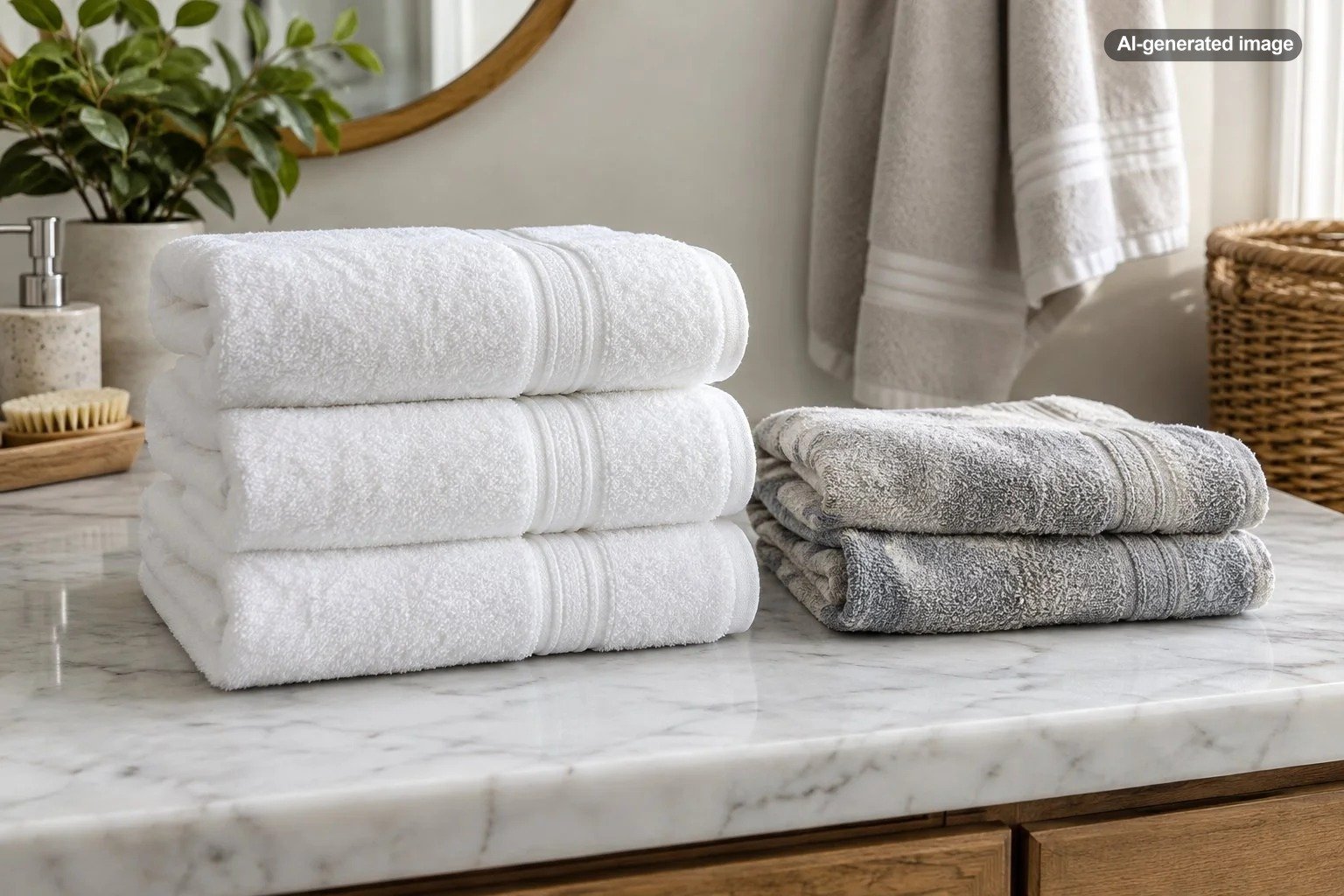
- Compare its thickness and drying performance with a newer towel.
- Check for persistent odor, worn patches, holes, or unraveling hems.
Do old towels automatically become unhygienic?
Age by itself does not make a towel dirty. Laundering frequency and drying conditions are much more relevant to routine cleanliness than whether the towel was purchased last year or several years ago.
Bath towels collect moisture along with skin cells, body oils, and microorganisms during normal use. Damp fabric also creates conditions in which unwanted microbial growth can persist. Regular laundering and allowing a towel to dry thoroughly between uses therefore matter throughout the towel’s life, not merely when it becomes old.
Current household and health guidance varies somewhat on exact washing frequency. A practical approach for many homes is to wash bath towels after several uses and sooner when circumstances warrant it. Towels should be changed more frequently when they remain damp, become visibly soiled, develop odor, are shared, or are used under circumstances where extra hygiene precautions are appropriate.
How your towel rotation changes its lifespan
A larger rotation can extend the calendar life of individual towels because each one experiences fewer wash-and-dry cycles. If four towels are used evenly instead of one towel carrying nearly the entire workload, wear is distributed across the set.
This distinction is particularly useful when comparing primary and guest bathrooms. Everyday towels may gradually lose loft and absorbency from constant use, while guest towels purchased at the same time can remain in excellent condition much longer. There is little reason to replace both sets simply because they share the same purchase date.
Can laundry habits make towels wear out faster?
Yes. Towels endure repeated exposure to water, detergent, agitation, heat, and drying, so laundry habits affect both performance and longevity.
Using more detergent than necessary can leave residue if it does not rinse away effectively. Fabric softeners and some dryer products can also coat fibers and reduce the absorbent quality people expect from bath towels. Meanwhile, consistently aggressive drying conditions can contribute to fiber wear over time.
Follow the towel’s care label rather than assuming every cotton towel should receive the harshest possible wash and dry cycle. Give towels enough room in the machine to wash and rinse effectively, and dry them completely before returning them to the bathroom or linen closet.
Between baths or showers, hang towels where air can circulate through the fabric. A towel spread across a sufficiently wide bar generally has a better chance of drying than one left crumpled on the floor or compressed on a small hook in a humid bathroom.
What if a towel is rough but still absorbent?
Texture is partly a comfort preference. A towel does not necessarily need replacement simply because it no longer feels as plush as it did when new. If it remains absorbent, clean, structurally sound, and pleasant enough for your household, continuing to use it is reasonable.
Before replacing a rough towel, examine your laundry routine. Mineral buildup, excessive detergent, softening-product residue, repeated high-heat drying, and simple fiber wear can all affect how a towel feels. Some causes can be addressed through better care; permanent fiber damage cannot.
Replace towels for lost function, persistent problems, or unacceptable wear, not merely because another calendar year has passed.
What should you do with bath towels that are past their prime?
A towel can leave the bathroom without immediately becoming trash. Clean towels that are no longer attractive or plush enough for bathing may still be useful for drying pets, protecting surfaces during household projects, absorbing minor household spills, cleaning durable surfaces, or keeping near an entryway for wet shoes.
Cutting badly frayed towels into cleaning cloths can also extract more useful life from the fabric. The best second use depends on the towel’s condition. A clean but faded towel has many possibilities; fabric with significant contamination, deterioration, or an odor that cannot be removed is a poorer candidate for reuse.
How to decide whether your towels need replacing today
What to do
- Pull out the bath towels your household actually uses most often.
- Separate towels with holes, extensive fraying, permanent stains, or obvious thinning.
- Wash questionable towels correctly and dry them completely.
- Test whether they still absorb water quickly and feel acceptable against the skin.
- Notice whether an unpleasant odor returns unusually quickly after laundering.
- Replace only the towels whose performance or condition remains poor.
This condition-based approach prevents two opposite mistakes: keeping frustrating towels indefinitely simply because they are technically intact, or discarding perfectly functional towels because they have crossed an arbitrary age threshold.
Frequently asked questions
Is two years too old for a bath towel?
Not necessarily. A two-year-old towel that remains absorbent, clean, intact, and comfortable does not need replacement solely because of its age. Usage and care make a substantial difference.
Should all the towels in a matching set be replaced together?
No. Replace individual towels according to condition unless maintaining a perfectly matched appearance is important to you. Guest towels frequently outlast heavily used everyday towels from the same set.
Does a musty smell mean the towel has to go?
Not immediately. First address laundering and drying. Make sure the towel is washed appropriately and becomes completely dry between uses. Persistent odor that repeatedly returns after proper care is a stronger reason to replace it.
Can worn bath towels still be useful?
Often, yes. Clean older towels can become household utility towels, pet towels, project cloths, or cleaning rags if their condition makes them suitable for those jobs.
What is the simplest rule to remember?
Think in terms of performance rather than expiration. Check frequently used towels periodically, care for them properly, and replace them when absorbency, freshness, comfort, or structural condition has genuinely declined. That keeps the linen closet functional without turning perfectly good towels into unnecessary waste.