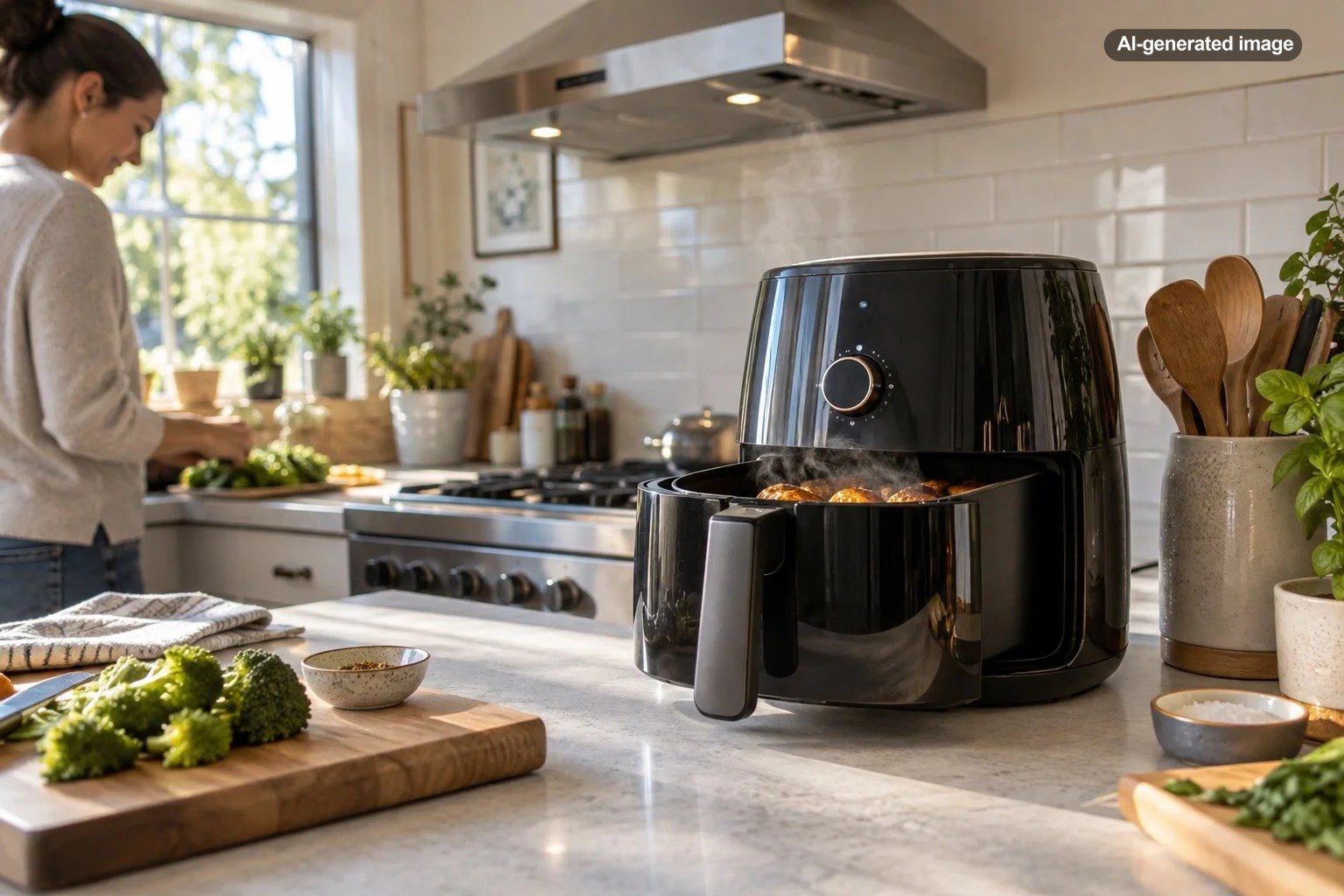
Does Cooking With an Air Fryer Affect Indoor Air Quality?
Yes, cooking with an air fryer can affect indoor air quality. Heating food can release particulate matter, volatile organic compounds, and other airborne byproducts regardless of whether the appliance is an air fryer, oven, skillet, or deep fryer. The more useful question is how much an air fryer contributes compared with other cooking methods and what you can do to limit exposure.
Current research suggests that air frying can produce substantially lower pollution under some cooking conditions than conventional frying, but it is not emission-free. Food type, added fat, cooking temperature, ventilation, accumulated residue, and even the particular experiment being performed can change the results. In other words, an air fryer can be a relatively tidy cooking method without turning your kitchen into a laboratory-grade clean room.
Why an air fryer can change the air in your kitchen
An air fryer is essentially a compact electric convection cooker. It heats food rapidly while a fan circulates hot air around the basket or tray. There is no open gas flame in an electric air fryer, but the food itself can still generate airborne particles and gases as fats, proteins, carbohydrates, seasonings, and residues are heated.
The U.S. Environmental Protection Agency identifies cooking as a source of indoor particulate matter. It also notes that the amount produced depends on factors including the food, cooking method, cooking fat, and whether food is burned. That distinction matters because indoor cooking pollution is not simply an appliance problem. Much of it comes from what happens to the food at high temperatures.
Researchers have specifically measured volatile organic compounds, ultrafine particles, and nitrogen oxides during air-fryer cooking. A 2026 chamber study found that emissions varied substantially among foods. High-fat foods were particularly important: some generated ultrafine-particle concentrations that approached those associated with deep frying in the researchers’ modeling.
Are air fryers cleaner than frying on the stove?
Often, but not under every imaginable combination of food, oil, temperature, and ventilation. A University of Birmingham study published in 2024 compared several methods while cooking chicken breast in a controlled research kitchen. In that experiment, air frying produced far lower peak particulate and volatile-organic-compound concentrations than pan frying, stir-frying, and deep-fat frying.
Other research provides a useful caution against turning that result into a universal rule. A 2023 study comparing a domestic air fryer with pan cooking found that air-fryer emissions could be higher for certain foods and conditions, particularly as oil use changed. The studies used different foods, equipment, protocols, and ways of measuring emissions, so their results are not necessarily contradictory. They show why statements such as ‘air fryers do not pollute indoor air’ are too broad.
| Factor | Likely effect on cooking emissions |
|---|---|
| Higher-fat foods | Can increase particle and VOC emissions as fats heat and break down. |
| Extra cooking oil | May increase emissions, depending on temperature, food, and quantity. |
| Burning or heavy charring | Can sharply increase particulate pollution. |
| Good exhaust ventilation | Helps remove or dilute cooking pollutants. |
| Built-up food and grease residue | Can create additional emissions when reheated. |
Ventilation still matters when you use an air fryer
It is easy to think of an air fryer as a sealed countertop appliance, but it has to move hot air. Basket-style units generally exhaust heated air while they operate, which means cooking emissions can enter the surrounding room.
The EPA recommends ventilation and filtration as practical ways to reduce exposure to cooking-related particulate matter. If you have a range hood that vents outdoors, using it while cooking can help even when the food is being prepared in a countertop appliance nearby. When outdoor conditions are suitable, opening a window or door can also help dilute indoor pollution. A kitchen exhaust fan that actually moves air outdoors is more useful for source removal than a fan that merely circulates room air.
If you use a portable air cleaner, the EPA recommends choosing one appropriately sized for the space and avoiding models that intentionally produce ozone. Homes with central HVAC filtration may also benefit from an appropriately rated filter that the system can accommodate.
Where you place the air fryer can make a practical difference
Airflow around the appliance matters for more than neat countertop styling. Follow the manufacturer’s clearance and placement instructions rather than pushing the unit tightly against a backsplash, wall, cabinet panel, or other object that may obstruct an intake or exhaust opening.
If your kitchen has an effective exhaust hood, placing a countertop appliance where its exhaust can be reasonably captured may help remove cooking pollutants. That does not mean placing the appliance directly on a stovetop or ignoring its required clearances. The correct location is one that respects the appliance instructions, keeps it on a stable heat-appropriate surface, and makes kitchen ventilation useful.
Affiliate disclosure: CraneManor.com may earn a commission when you purchase through links on this page. This does not affect the price you pay. Learn more.
For households shopping for a typical mid-size basket appliance, the Cosori TurboBlaze air fryer is one example of the common countertop format. The model is mentioned here as an appliance-format example, not as a claim that it produces less indoor air pollution than other air fryers.
Cleaning may affect more than appearance and odor
Regular cleaning is especially sensible with an appliance that repeatedly heats grease, crumbs, marinades, and food particles. The EPA recommends routine cleaning of cooking appliances because accumulated residues can burn during later use and add particulate matter to indoor air.
Air-fryer-specific research reinforces that point. In a 2026 study, researchers reported substantially higher ultrafine-particle emissions during empty heating after residue had accumulated in difficult-to-access parts of an air fryer over repeated use. The laboratory conditions do not tell us exactly what will happen in every household appliance, but they do support a simple maintenance principle: old cooking residue is better removed than repeatedly reheated.
What to do
- Empty crumbs and loose food debris after the appliance has cooled.
- Wash removable baskets, trays, and other washable components according to the manufacturer’s instructions.
- Wipe accessible grease or splatter from approved interior surfaces without soaking electrical components.
- Inspect air openings for visible buildup and follow the manual for any permitted cleaning.
- If the appliance develops persistent smoke, unusual odors, electrical symptoms, or damage, stop using it and consult the manufacturer or an appropriate service professional.
Food choices and cooking technique matter too
A basket full of vegetables lightly coated with oil is not chemically identical to a load of fatty meat cooked until heavily browned. Research indicates that food composition can substantially change emissions from an air fryer. Fat content is especially relevant because heated lipids can generate particles and volatile compounds.
That does not mean you need to avoid browned food or treat every whiff from dinner as an emergency. It means routine habits can influence emissions. Use only as much oil as the recipe needs, avoid intentionally burning food, remove old grease and crumbs, and use ventilation when cooking at high temperatures.
The appliance matters, but the food, heat, residue, and ventilation around it matter too.
What if someone in the home is sensitive to cooking pollution?
People with respiratory or cardiovascular conditions, children, and older adults can be more vulnerable to particulate pollution. If cooking repeatedly aggravates symptoms, reducing emissions and improving ventilation is more useful than relying on an appliance label or cooking-method reputation alone.
Start with source control: avoid burning food, clean cooking appliances, and use effective exhaust ventilation. Filtration can supplement those steps. For a household with significant health concerns, personalized medical advice should come from a qualified health professional, while questions about ventilation performance may warrant help from an HVAC or indoor-air-quality professional.
So, should indoor air quality stop you from using an air fryer?
For most households, the evidence does not suggest that air fryers need to be avoided simply because they affect indoor air. Cooking itself affects indoor air, and controlled studies indicate that air frying can be a relatively low-emission method compared with some conventional frying techniques.
The sensible approach is not to look for a perfectly emission-free cooking appliance. Use the air fryer with reasonable ventilation, keep it clean, avoid needless burning or excessive oil, and pay attention to how particular foods behave. Those habits address the variables that research consistently identifies as important while preserving the convenience that makes air fryers useful in the first place.
Frequently asked questions
Does an air fryer produce carbon monoxide?
A normal electric air fryer does not burn gas or another fuel, so it does not create combustion exhaust in the way a gas burner can. Cooking food can still release particles and gaseous compounds, which is why ventilation remains worthwhile.
Should I run the range hood while air frying?
If the air fryer is positioned safely where the hood can help capture cooking emissions, using an outdoor-vented range hood can be beneficial. Always maintain the appliance clearances and placement specified by its manufacturer.
Can an air purifier remove air-fryer pollution?
A properly sized particle-filtering air cleaner can help reduce airborne particles, but it should supplement rather than replace source control and ventilation. Different filtration technologies also vary in their ability to address gases and VOCs.
Why does my air fryer smoke?
Common possibilities include excess fat, grease or residue from previous cooking, loose crumbs, food touching a hot component, or an unsuitable temperature. If normal cleaning and correct use do not resolve persistent smoke, stop using the appliance until the cause is identified.
Sources & further reading
- U.S. Environmental Protection Agency: Sources of Indoor Particulate Matter
- U.S. Environmental Protection Agency: Strategies for Improving Indoor Air Quality While Cooking
- Quantification of VOCs, Nitrogen Oxides, and Ultrafine Particles Emitted by Domestic Air Fryers
- University of Birmingham: Air Fryers Confirmed as Least Polluting Cooking Method
- Particulate Matter and Volatile Organic Compound Emissions Generated from a Domestic Air Fryer