Can a Ceiling Fan Be Too Close to a Wall?
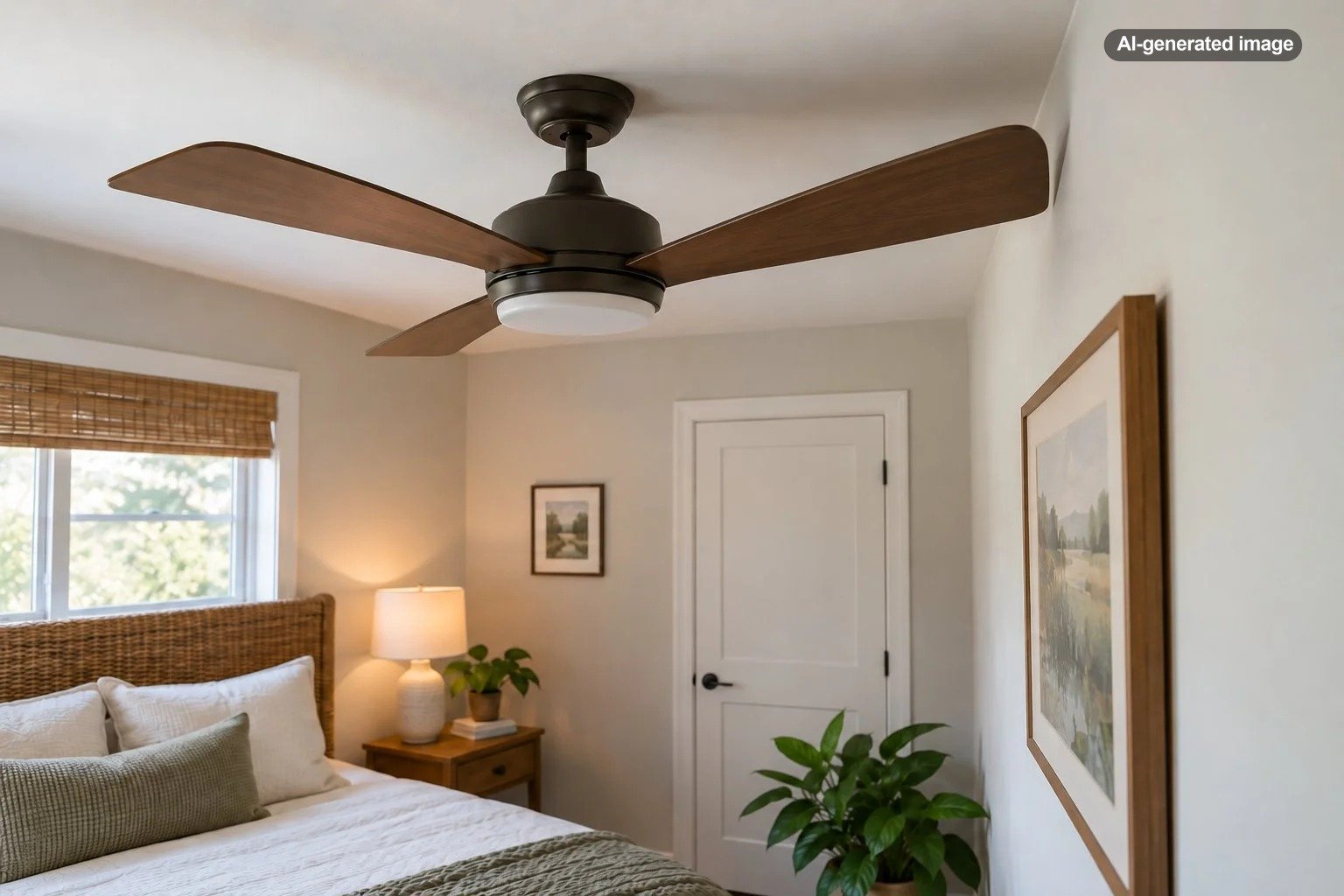
Yes, a ceiling fan can be too close to a wall, even when its blades appear to have enough room to spin. The distance between the blade tips and surrounding walls matters for both safe operation and effective airflow. A fan that fits the ceiling visually may still be poorly positioned for the room, especially near an alcove, tall cabinet, or sloped ceiling.
As a general starting point, allow at least 18 inches between the outermost blade tip and the nearest wall. However, that is not a universal clearance requirement. Some manufacturers specify greater distances, so the installation instructions for your exact fan should determine whether its placement is acceptable.
If you are choosing a fan for a narrow bedroom, evaluating an existing installation, or wondering whether a larger fan will fit, a few measurements can settle the question before it becomes an expensive ceiling modification.
How Close Can a Ceiling Fan Be to a Wall?
ENERGY STAR’s general ceiling fan guidance recommends positioning fan blades at least 18 inches away from surrounding walls. This provides a useful baseline for planning a conventional residential installation.
However, manufacturer instructions may be more restrictive. For example, some Craftmade installation guidance identifies 18 inches as a minimum clearance while recommending 30 inches for improved airflow performance. This distinction matters because a fan can satisfy a basic spacing recommendation without being ideally positioned for comfort.
The practical approach is to treat 18 inches as an initial screening measurement rather than automatic approval for every ceiling fan. If your chosen model specifies 24, 30, or another clearance distance, follow that requirement instead.
| Blade-tip distance from wall | What it means |
|---|---|
| Less than 18 inches | Below common residential guidance; reassess the installation. |
| 18 to 23 inches | May meet general guidance, but confirm the model’s instructions. |
| 24 to 29 inches | Provides additional space, although some models require more. |
| 30 inches or more | Offers generous clearance for many residential fans, subject to model-specific requirements. |
These distances refer to the nearest point of the wall or obstruction and are not substitutes for the manufacturer’s installation instructions. Ceiling height, blade design, mounting method, and nearby architectural features also affect the suitability of the location.
Why Being Too Close to a Wall Matters
Restricted airflow
A ceiling fan creates a moving air pattern rather than simply pushing air straight downward. During typical summer operation, the blades move air downward and outward into the occupied space. Nearby walls interrupt that circulation and alter how air travels around the room.
With limited clearance, the breeze may feel uneven. Someone directly beneath the fan might experience strong airflow while another seating area receives much less. The precise effect depends on the fan’s design, speed, ceiling height, and room geometry.
Moving a fan away from a wall does not automatically make it more efficient, but providing suitable surrounding space helps it operate under the conditions anticipated by its manufacturer.
Potential contact with nearby objects
Wall clearance is also about keeping moving blades away from fixed objects. A fan positioned too close to a wall, structural beam, tall cabinet, or projecting architectural detail may have inadequate space for safe operation.
Clearance becomes especially important when an installation includes irregular ceiling surfaces or nearby objects that extend into the blade sweep. Never assume that a narrow visible gap is acceptable simply because the fan can rotate without immediately striking anything.
Noise and vibration concerns
A fan close to a wall may create noticeable changes in airflow noise. However, persistent wobbling, scraping, clicking, or mechanical rattling should not automatically be blamed on wall proximity.
Loose hardware, blade imbalance, mounting problems, and other mechanical issues can produce similar symptoms. If a fan makes unusual noises or appears unstable, turn it off and have the installation evaluated rather than attempting to correct the problem by increasing its speed or bending its blades.
How to Measure Ceiling Fan Clearance Correctly
One of the most common planning mistakes is measuring from the center of the fan to the wall and treating that distance as the available clearance. The blades extend well beyond the motor housing, sometimes by several feet.
For a standard symmetrical ceiling fan, the blade span represents the diameter of the circular area swept by the rotating blades. Half that diameter is the blade sweep radius.
To estimate wall clearance, subtract that radius from the distance between the fan’s mounting center and the nearest wall.
Measure before installing
- Identify the fan’s blade span. Use the manufacturer’s specifications rather than estimating from the motor housing.
- Divide the blade span by two. This gives the approximate radius of the rotating blade area.
- Measure from the proposed mounting center to the nearest wall. Check every direction, not just the longest dimension of the room.
- Subtract the blade radius. The result is the estimated distance between the blade tips and the wall.
- Check other obstructions. Account for beams, sloped surfaces, tall furniture, and architectural projections.
- Compare the result with the installation manual. Do not proceed if the available clearance falls below the applicable requirement.
Example: A 52-inch ceiling fan
Imagine a 52-inch ceiling fan installed with its center 42 inches from the nearest wall. Its blade sweep radius is 26 inches.
The estimated blade-tip clearance is 42 minus 26, or 16 inches.
That falls below the commonly recommended 18-inch clearance. Moving the mounting center farther from the wall or selecting a smaller fan would be sensible options, provided the final installation follows the model’s instructions.
Now consider a 44-inch fan at the same mounting location. Its radius is 22 inches, leaving approximately 20 inches between the blade tips and the wall. That clears the general 18-inch guideline, although the exact model may still require additional space.
This comparison shows why even a modest reduction in blade span can make a meaningful difference in a narrow room.
What If the Room Is Too Narrow for the Fan?
A narrow room does not automatically rule out a ceiling fan. It simply makes the relationship between blade span and wall clearance more important.
Consider a room measuring 8 feet wide, or 96 inches. If a fan is centered across the width, its mounting point is 48 inches from each side wall.
With a 52-inch fan, the blade radius is 26 inches, leaving 22 inches of clearance on either side. That exceeds the general 18-inch guideline but would not satisfy a model requiring 30 inches.
A 36-inch fan would leave 30 inches of clearance on either side in the same room. This may make it a more practical candidate where the selected model needs additional spacing.
Keep in mind that these calculations assume the room has straight, unobstructed walls and that the fan is centered. Built-in cabinetry, sloped ceilings, and structural projections can change the available clearance considerably.
Does a Ceiling Fan Have to Be Centered in the Room?
No. Centering a ceiling fan is a useful starting point, but it is not always the best position for a room’s layout or primary activities.
In a symmetrical bedroom, centering the fan may provide balanced airflow and a visually orderly ceiling. In a large living room with one frequently occupied seating area, positioning the fan over that area may provide better comfort than centering it in the entire room.
The important distinction is that changing the mounting location must not compromise clearance or safe support. An offset installation still needs adequate blade-to-wall distance, proper mounting hardware, and compliance with the manufacturer’s instructions.
Do not assume an existing ceiling light box is suitable for supporting a rotating ceiling fan. A qualified electrician can determine whether a fan-rated support box or other approved mounting arrangement is required.
What about ceiling fans near corners?
Corners introduce two nearby walls instead of one. A fan mounted close to a corner must maintain its required clearance from both surfaces.
Measure the shortest horizontal distance from the blade sweep to each wall independently. A fan that has generous clearance on one side may still be too close to the perpendicular wall.
What about sloped ceilings?
Vaulted and sloped ceilings require additional care because the ceiling surface may approach the rotating blades at an angle. A measurement taken along the floor plan does not fully describe the available space.
The appropriate mounting adapter, downrod, allowable ceiling slope, and blade clearances are model-specific. Consult the manufacturer’s documentation before selecting a mounting arrangement.
Wall Clearance Is Not the Only Measurement That Matters
A ceiling fan needs adequate space below its blades as well as around them. ENERGY STAR recommends installing fan blades at least 7 feet above the floor, with a blade height of approximately 8 to 9 feet preferred when ceiling height permits.
That vertical clearance helps keep the moving blades away from occupants. In rooms with relatively low ceilings, a manufacturer-approved low-profile fan may be preferable to a conventional model with a longer downrod.
Distance from the ceiling also affects airflow. A fan mounted very close to the ceiling may have less room to draw air into the blade area. Exact overhead spacing depends on the fan design and the mounting configuration approved by its manufacturer.
Do not improvise by shortening an incompatible downrod, modifying blade geometry, or using unsupported mounting hardware to gain a few extra inches.
What to Do If Your Existing Ceiling Fan Is Too Close to a Wall
If a fan is already installed and the blade tips appear uncomfortably close to a wall, start by identifying the exact model and checking its installation requirements.
Turn the fan off and allow it to stop completely before taking measurements. Determine the closest distance between the blade sweep and the surrounding surfaces, then compare that with the manufacturer’s specified clearances.
If the fan does not meet the applicable instructions, avoid continued operation until the problem is corrected. Depending on the room, possible solutions include replacing it with a smaller compatible fan or relocating the mounting position.
Relocation is not simply a matter of shifting the decorative canopy a few inches. A new position may require changes to ceiling support, electrical wiring, the outlet box, and surrounding finishes. Those requirements should be assessed by a qualified electrician or installer.
Never trim the blades to make a fan fit. Altering blade length or shape can affect balance, mechanical behavior, and the manufacturer’s intended operating characteristics.
Common Mistakes When Planning Ceiling Fan Placement
Several seemingly small decisions can lead to an awkward or unsuitable installation.
- Choosing the fan based only on room square footage. Floor area matters, but a long, narrow room may require a different fan size from a square room with the same area.
- Measuring from the motor instead of the blade tips. The full rotating diameter determines the needed side clearance.
- Ignoring tall or projecting objects. Beams, cabinets, and other fixed features may matter as much as the walls themselves.
- Assuming every fan follows the same 18-inch rule. Manufacturer-specific clearance requirements can be greater.
- Prioritizing symmetry over usable space. A beautifully centered fan is not a good installation if it violates required spacing.
- Overlooking ceiling height. Sufficient side clearance does not compensate for inadequate blade height above the floor.
A carefully chosen fan should fit the room’s physical constraints before its finish, blade color, or decorative style enters the decision.
Frequently Asked Questions
Can a ceiling fan be 12 inches from a wall?
For a conventional residential fan, 12 inches of blade-tip clearance falls below ENERGY STAR’s general 18-inch guidance. Do not assume that distance is acceptable. Check the exact manufacturer’s instructions and choose a different location or model if the applicable clearance cannot be maintained.
Is 18 inches enough clearance for every ceiling fan?
No. Eighteen inches is a commonly published general minimum, but some manufacturers specify greater spacing. The installation requirements for your specific fan take priority over general recommendations.
Can I install a larger fan if it technically fits?
Only if the larger model meets all required clearances and mounting conditions. Having enough room for the blades to rotate is not, by itself, sufficient. A slightly smaller fan may be more appropriate when the room is narrow or has nearby architectural obstructions.
Will a fan near a wall damage the wall?
Simply moving air near a wall does not normally damage it. The more serious concern is inadequate clearance that could allow contact with the wall or a nearby object. Unusual vibration, scraping, or visible instability warrants prompt attention.
Can I move a ceiling fan a few inches without rewiring?
Not necessarily. The fan must be supported by an approved mounting assembly at its actual installation location. Moving the fan may require relocating or modifying its electrical supply and structural support. A qualified electrician can assess what the existing ceiling arrangement allows.
The Bottom Line
A ceiling fan can absolutely be too close to a wall, and the critical measurement is the space between the blade tips and the nearest obstruction. Start with the widely used 18-inch guideline, then verify the exact manufacturer’s requirements before installing or continuing to use the fan.
For a narrow room, a smaller blade span or better mounting position is often more sensible than squeezing a large fan into an inadequate space. The best installation is not simply the one that fits the ceiling. It is the one that provides the required clearance, secure support, and comfortable airflow for the room.
Sources & Further Reading
- ENERGY STAR: Ceiling Fan Basics – General recommendations for fan size, wall clearance, and mounting height.
- U.S. Department of Energy Building America Solution Center: Ceiling Fans – Guidance on airflow, fan selection, and installation clearances.
- Kichler Lighting: Lighting FAQs – Manufacturer guidance on ceiling fan sizing, placement, and wall clearance.
- Craftmade Rosalie Installation Manual – Model-specific example distinguishing minimum wall clearance from recommended spacing for improved airflow.