What MERV Rating Is Best for a Home With Allergies?
For a home where reducing airborne allergens is a priority, MERV 13 is a useful target if the HVAC system can accommodate it. The U.S. Environmental Protection Agency recommends choosing a furnace or central HVAC filter rated at least MERV 13, or the highest rating the system’s fan and filter slot can handle. That last part matters: the best filter is not simply the one with the biggest number.
MERV, short for Minimum Efficiency Reporting Value, describes how effectively an air filter captures particles in specific size ranges. Higher ratings generally mean better particle capture, but filtration also has to work as part of the actual heating and cooling system. Filter dimensions, airflow resistance, equipment design, replacement frequency, and how often the HVAC fan operates all affect the practical result.
What a MERV rating actually tells you
MERV ratings are based on a standardized method for comparing a filter’s ability to capture particles between approximately 0.3 and 10 microns. The scale is useful because household airborne particles do not all behave the same way. Larger particles are generally easier for a filter to capture than very small ones.
The EPA’s MERV performance table illustrates an important distinction. A MERV 8 filter is evaluated for particles down to the 1-to-3-micron range, while MERV 11 begins demonstrating measurable efficiency in the smaller 0.3-to-1-micron range. MERV 13 increases efficiency across these particle-size groups and must demonstrate at least 50 percent average capture efficiency for the smallest 0.3-to-1-micron test range.
| Filter range | Practical role in a home | What to consider |
|---|---|---|
| MERV 8 | Common general-purpose residential filtration | Captures many larger particles but is less efficient with smaller airborne particles |
| MERV 11 | A meaningful step up in particle filtration | Can be a practical option when a system cannot comfortably accommodate MERV 13 |
| MERV 13 | Strong residential particle filtration and the EPA’s recommended upgrade target | Confirm compatibility with the HVAC system and filter slot |
| MERV 14-16 | Higher particle-capture efficiency | Greater efficiency does not mean every residential system is designed for these filters |
Why MERV 13 is often the practical target
Allergy concerns tend to shift the goal from merely protecting HVAC equipment toward reducing more airborne particles circulating through living spaces. That makes filtration efficiency more important. The EPA advises selecting a MERV 13 filter, or as high a rating as the system can accommodate, when upgrading residential furnace or HVAC filtration.
MERV 13 also occupies a useful middle ground. It captures smaller particles substantially more efficiently than lower-rated filters without automatically requiring the specialized equipment associated with true HEPA filtration. A central residential system should not be assumed to accept a HEPA filter simply because greater filtration sounds desirable.
The goal is not the highest MERV number you can buy; it is the highest effective filtration your HVAC system can properly support.
That distinction helps avoid a surprisingly common mistake: choosing a filter based only on the number printed on the package. A filtration upgrade has to work with the blower, return-air arrangement, filter cabinet, duct system, and other equipment characteristics.
Can a MERV rating be too high for your HVAC system?
Potentially, yes. Higher-efficiency filters can create more resistance to airflow than a less restrictive filter, although actual resistance also varies with filter design, dimensions, surface area, thickness, and condition. A high MERV rating by itself does not tell you exactly how a particular filter will behave in a particular system.
The EPA notes that most furnaces and HVAC systems can accommodate MERV 13 without equipment problems when filters are replaced frequently, but it also recommends consulting an HVAC professional when compatibility is uncertain. Older systems, unusual filter arrangements, undersized return ducts, or existing airflow problems deserve particular attention before increasing filtration resistance.
Filter fit matters almost as much as the rating
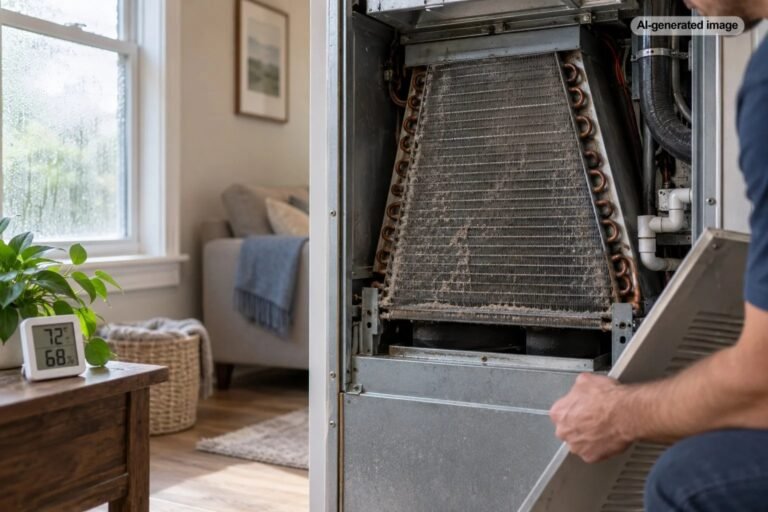
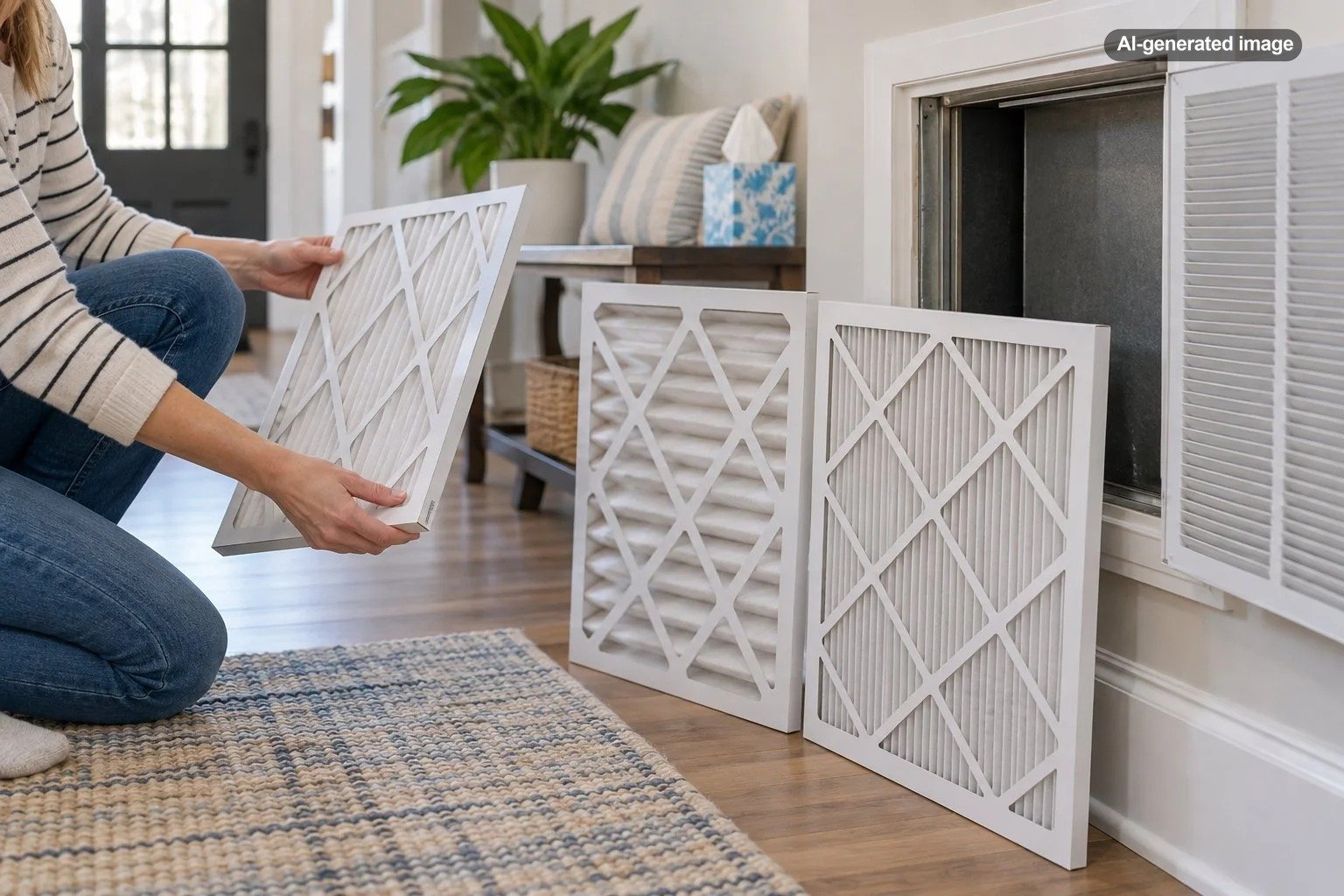
A highly rated filter cannot perform as intended if a substantial amount of return air slips around its edges. The filter should fit the intended rack or cabinet snugly without being bent, crushed, or improvised into place. Residential filters are sold in multiple widths, lengths, and thicknesses, so matching the equipment’s required dimensions is essential.
Thickness deserves special attention. A deeper pleated filter can offer substantially more filter surface area than a thin filter, but a home must have a cabinet designed to accept that depth. A 4-inch or 5-inch filter is not an automatic replacement for a 1-inch filter with the same nominal length and width.
How often should you replace an allergy-focused filter?
There is no universal replacement interval that fits every household and every filter. The EPA advises regular replacement and following the filter manufacturer’s maintenance guidance. How quickly a filter loads depends on factors such as its construction, HVAC runtime, indoor particle levels, pets, outdoor conditions, renovation activity, and other household circumstances.
A heavily loaded filter will not continue performing as though it were new. For that reason, households upgrading filtration should also establish a realistic inspection and replacement routine instead of installing a higher-rated filter and forgetting about it.
Before you decide
- Check the HVAC equipment documentation for filter requirements.
- Confirm the exact filter dimensions and allowable thickness.
- Use MERV 13 when the system can properly accommodate it.
- If MERV 13 is unsuitable, use the highest appropriate efficiency the system supports.
- Make sure the filter fits snugly rather than allowing air to bypass it.
- Follow the filter manufacturer’s replacement guidance and inspect it regularly.
- Ask a qualified HVAC professional to assess compatibility if the system’s requirements are unclear.
Remember that the HVAC filter only works when air passes through it
Central HVAC filtration is not continuously cleaning every room simply because a filter is installed. The system filters circulating air while the blower is operating. The EPA notes that typical residential HVAC systems often operate only when heating or cooling is needed, so actual filtration depends partly on runtime.
Running a blower for longer periods can increase the amount of air that passes through the filter, but there are tradeoffs. Longer operation uses more electricity, and the EPA notes that extended fan operation can affect humidity control in some cooling-season situations. This is another reason an allergy-oriented air-quality strategy should be broader than simply buying a more efficient filter.
Do you still need a portable air cleaner?
Possibly. Central filtration and portable air cleaning solve related but somewhat different problems. An HVAC filter works on air traveling through the home’s central system. A properly sized portable air cleaner can provide additional particle filtration within a particular room or area, such as a bedroom where someone spends many hours.
For a portable unit, MERV is generally not the main comparison metric. The EPA recommends considering the unit’s clean air delivery rate, or CADR, and choosing capacity appropriate for the room size. HEPA filtration is common in portable air cleaners and should not be confused with simply installing an extremely restrictive filter in a standard residential HVAC cabinet.
Filtration is only one part of managing indoor allergens
No HVAC filter removes every pollutant from a home. The EPA describes filtration as a supplement to two other important indoor-air strategies: reducing pollutant sources and ventilating with clean outdoor air when appropriate. A better furnace filter therefore should not be treated as a cure-all for an indoor air-quality problem or as medical treatment for allergies.
If symptoms are persistent or significant, decisions about diagnosis or treatment belong with an appropriate healthcare professional. From the home’s side of the equation, the useful goal is more modest: reduce airborne particles where practical while keeping the HVAC system operating as designed.
Frequently asked questions
Is MERV 8 enough for a home with allergies?
MERV 8 provides useful general filtration, particularly for larger particles, but it is less efficient than MERV 13 at capturing smaller particles. If improving particle filtration is the priority and the HVAC system can accommodate it, the EPA recommends at least MERV 13 or the highest suitable rating the system supports.
Is MERV 11 good for allergies?
MERV 11 captures smaller particles more efficiently than MERV 8 and can be a sensible step up when MERV 13 is not appropriate for the equipment. The correct choice still depends on HVAC compatibility rather than the MERV number alone.
Is MERV 13 too restrictive?
Not necessarily. The EPA states that most furnaces and HVAC systems can accommodate MERV 13 when filters are replaced frequently, but individual systems differ. Consult the equipment documentation or a qualified HVAC professional when you are uncertain.
Should I install the highest MERV filter available?
No. Higher capture efficiency is useful only when the system can properly operate with the filter. Extremely high-efficiency filtration may require equipment designed or modified for the additional filtration demands.
Will a better HVAC filter eliminate allergies?
No. A more efficient filter can reduce airborne particles passing through the HVAC system, but it cannot remove every pollutant or address every possible source of allergy symptoms. Filtration is best treated as one part of an overall indoor-air strategy.