How Far Should a TV Be From a 75-Inch Screen?
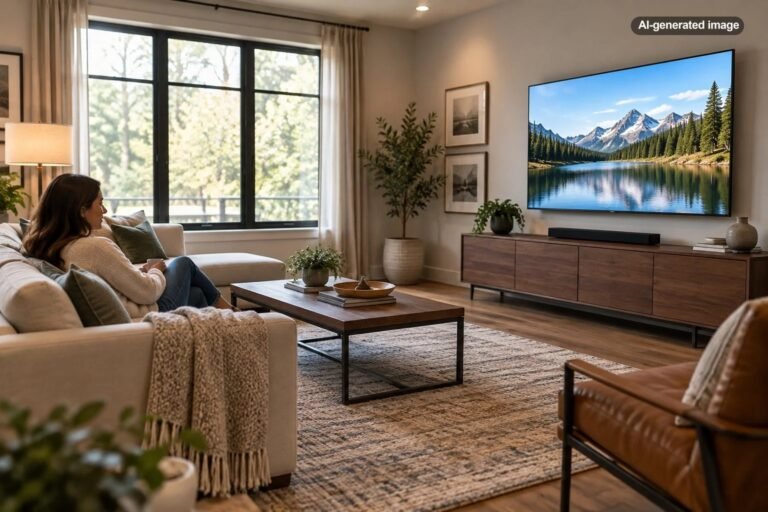
For most rooms, a comfortable starting point for a 75-inch TV is about 7.5 to 10 feet from the screen. Sit toward the closer end if you want a movie-theater feel or play immersive games; move toward the farther end if you mainly watch casual television and prefer seeing the entire picture with less eye movement.
There is no single mandatory distance, especially with a modern 4K television. Picture resolution, viewing habits, furniture placement, screen height, and personal comfort all matter. The useful goal is not to obey one magic number. It is to make a large screen feel involving without making it feel like the front row at a movie theater.
Why a 75-inch TV can work closer than you might expect
Older television-sizing advice often encouraged people to sit surprisingly far from large screens. That made more sense when lower-resolution pictures could reveal softness, pixel structure, or other imperfections at close range. With a good 4K source on a 4K television, sitting closer can make better use of the available detail.
The more useful consideration is how much of your field of view the television occupies. A viewing angle around 30 degrees produces a relatively relaxed experience suitable for mixed television use. A wider angle around 40 degrees feels more immersive and is often appealing for movies and cinematic games.
For a 75-inch 16:9 screen, those approaches translate roughly to the following distances:
| Viewing style | Approximate distance | Best suited to |
|---|---|---|
| Immersive | About 7.5 feet | Movies, cinematic gaming, dedicated media rooms |
| Balanced | About 8 to 9 feet | Mixed streaming, sports, movies, and gaming |
| Relaxed | About 10 feet | Everyday television and viewers who prefer a less dominant screen |
These are useful starting points rather than boundaries. Moving a sofa six or twelve inches can noticeably change how a television this large feels.
Measure from your eyes, not from wall to wall
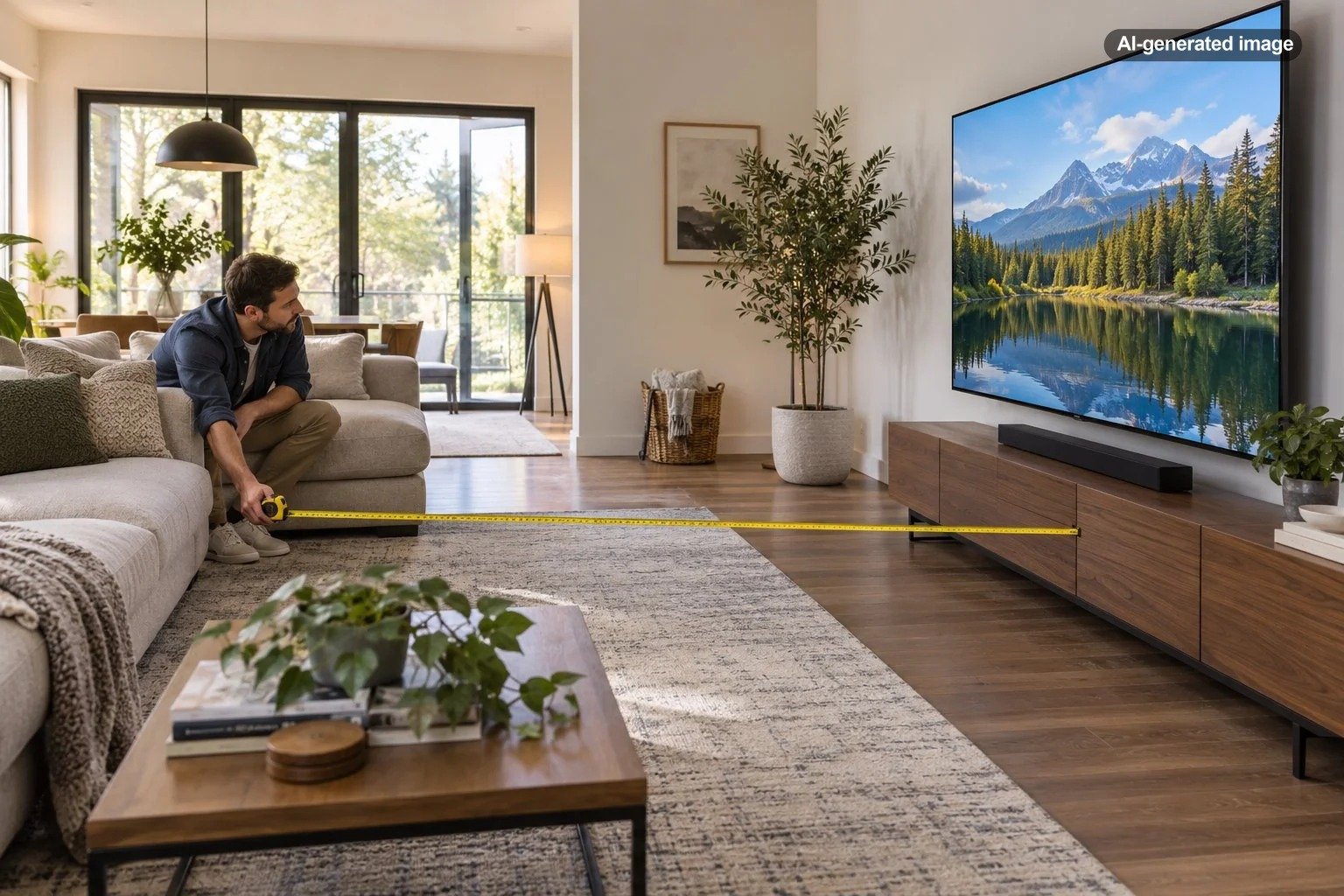
A common mistake is saying a room is 12 feet deep and assuming that means the viewing distance is 12 feet. Furniture, walkways, consoles, and the depth of the sofa reduce the actual distance considerably.
Sit normally in the primary viewing position and measure from approximately where your eyes are to the plane of the screen. If the television is mounted several inches in front of the wall, include that difference too. A nominal 12-foot room may easily produce an actual viewing distance of 9 or 10 feet.
What to do
- Sit in the seat you use most often.
- Measure from your eye position to the television screen.
- Compare that measurement with the roughly 7.5-to-10-foot starting range.
- If possible, temporarily move the seating closer or farther away before committing to permanent furniture or mounting decisions.
At 10 feet, a 75-inch television feels comfortably large
A viewing distance around 10 feet is a particularly practical fit for a 75-inch screen. The television remains visually substantial, but the picture is unlikely to dominate the room quite as aggressively as it will from closer seating.
This distance often suits multipurpose living rooms where television is only one part of the space. It can also be easier for households in which different people have different preferences: the screen is still large enough to feel impressive, while viewers who dislike sitting close to a television are less likely to feel crowded by it.
At 7 to 8 feet, expect a much more immersive picture
Moving a 75-inch screen to roughly 7.5 or 8 feet from your eyes substantially increases its visual presence. For movies and games, that can be exactly the point. Fine details become easier to appreciate and the screen fills more of your vision.
For news programs, talk shows, or other viewing where you prefer a calmer presentation, the same arrangement may feel larger than necessary. Subtitles, score graphics, game interfaces, and other information near the edges of the picture are also worth considering because a wide field of view can require more eye movement.
Screen height matters almost as much as distance
A 75-inch television is physically tall enough that mounting height becomes especially noticeable. A large screen placed high above a fireplace may be farther away than one on a low console, yet still feel less comfortable because viewers must look upward for long periods.
In a typical seated arrangement, aim to keep the central portion of the screen reasonably close to the viewer’s natural forward sightline. Exact placement depends on seating height and the room, but the principle is simple: avoid making viewers crane their necks to watch ordinary television.
If the television must sit higher because of cabinetry, architecture, or a fireplace, additional viewing distance can make the upward angle feel less pronounced. That does not automatically make a very high installation ideal, however.
Room layout can matter more than the mathematical ideal
Sometimes the theoretically perfect sofa location is simply a terrible place for a sofa. It may block a doorway, squeeze a walkway, divide an open-plan room awkwardly, or leave the rest of the furniture floating without purpose.
In those cases, prioritize a room that functions well and then adjust the television setup within a reasonable range. A 75-inch screen at 9.5 feet in a sensible furniture plan is usually a better outcome than forcing the sofa to exactly 8 feet because a formula suggested it.
Is a 75-inch TV too big for a small room?
Not necessarily. A large TV can work surprisingly well in a modest room if the seating distance is comfortable and the screen does not interfere with doors, windows, furniture, or circulation.
Visual scale matters too. A 75-inch television on a narrow wall can overwhelm nearby furniture, while the same screen on a broad wall with a proportionate media console may look perfectly composed. Before buying or mounting, use painter’s tape to outline the approximate screen footprint on the wall. Then view the outline from the sofa and from the room’s entrance.
Remember that the advertised 75-inch measurement describes the screen diagonal, not its width. Actual exterior dimensions vary by model because bezel and stand designs differ, so check the dimensions of the specific television when planning cabinetry or wall clearance.
What if your sofa is more than 10 feet away?
A 75-inch television will still be entirely watchable beyond 10 feet. It will simply occupy less of your field of view, making the experience feel less enveloping. That may be exactly what you want in a large family room where conversation, entertaining, and architecture matter as much as television.
If you are substantially farther away and want a theatrical effect, a larger display may better match the room. On the other hand, there is no reason to increase screen size solely because a chart says you should. Personal preference remains an important part of the decision.
The best viewing distance is where the screen feels intentionally large, not merely large.
How to find your best distance before mounting the TV
If you have flexibility, experiment before drilling holes or arranging a room around a permanent installation. Place the television temporarily on an appropriate stand, or mark its proposed position on the wall and test the room from different seating locations.
Before you decide
- Measure from your eyes to the screen rather than from wall to wall.
- Start near 8 to 10 feet for general use.
- Try roughly 7.5 to 8 feet if movie immersion is the priority.
- Check whether subtitles and information near the screen edges remain comfortable to follow.
- Consider screen height as well as distance.
- Protect normal walking paths and sensible furniture placement.
- Outline the screen on the wall before committing to a mount or built-in cabinet.
Frequently asked questions
Is 8 feet too close for a 75-inch 4K TV?
For many viewers, no. Eight feet creates an immersive picture on a 75-inch 4K television and can work particularly well for movies and gaming. People who prefer a more relaxed viewing experience may prefer 9 or 10 feet.
Is 12 feet too far from a 75-inch TV?
It is not too far to watch comfortably, but the television will appear less immersive. If cinematic impact is important, you may prefer moving the seating closer or considering a larger screen if the room allows it.
Should a 75-inch TV be farther away for sports?
Not necessarily. Many people enjoy sports within the same general viewing range. A slightly farther position can make it easier to take in the entire field, court, score graphics, and other information at once, while sitting closer increases the sense of scale.
Does 4K change how close you can sit?
Yes. Higher-resolution 4K images generally support closer viewing than older lower-resolution television formats because fine picture structure is less apparent at normal living-room distances. The remaining question is primarily how large you want the image to feel.
What is the simplest starting point?
If you are arranging a room around a 75-inch 4K television and do not yet know your preference, place the primary seating about 9 feet away. From there, move closer for more immersion or farther away for a calmer view. That small experiment is usually more useful than treating any single viewing-distance formula as an absolute rule.