How Far Should a TV Be From a 65-Inch Screen?
For most living rooms, the ideal viewing distance from a 65-inch TV is approximately 6.5 to 9 feet, measured from the screen to your seated eyes. Sit around 6.5 to 7.5 feet away for a more immersive movie experience, or closer to 8 to 9 feet for relaxed everyday viewing. With a modern 4K television, sitting closer than older TV placement rules suggest can work beautifully.
But there is no single perfect measurement. Your screen resolution, favorite programs, furniture layout, eyesight, and viewing habits all influence what feels comfortable. A 65-inch television can work in a surprisingly modest living room, provided the seating and screen placement make sense together.
What Is the Best Viewing Distance for a 65-Inch TV?
A useful way to choose your seating distance is to consider how much of your field of vision the television occupies. A screen that fills more of your view creates a cinematic experience. A screen that occupies less of your view can feel easier to watch casually, particularly when several people share the room.
Research and testing publication RTINGS explains that a horizontal viewing angle of about 30 degrees provides a practical baseline for mixed television use. A wider angle of approximately 40 degrees creates a more immersive experience. For a standard 65-inch widescreen television, those angles correspond to roughly 8 feet 10 inches and 6 feet 6 inches, respectively.
| Distance from screen | Viewing experience | Best suited for |
|---|---|---|
| 5-6 feet | Very immersive; screen dominates your view | Viewers who strongly prefer sitting close |
| 6.5-7.5 feet | Cinematic and immersive | Movies, detailed games, 4K entertainment |
| 8-9 feet | Balanced and relaxed | Everyday television, sports, mixed use |
| 10-12 feet | Less immersive; fine details appear smaller | Open-plan rooms and casual background viewing |
These distances are useful reference points rather than strict boundaries. If your favorite chair sits 10 feet away, you do not necessarily need a larger television. You may simply notice less fine detail and a smaller apparent picture than someone seated closer.
Why 4K Resolution Changes the Distance
Older television placement advice often recommended sitting farther from large screens. That made sense when displays had lower resolutions and individual pixels were easier to distinguish. A modern 4K display contains substantially more pixels than a conventional 1080p screen, making closer seating more practical.
Sony’s official television guidance recommends a minimum distance of approximately 1.5 times the vertical screen height for 4K viewing. For a typical 65-inch 16:9 television, that works out to approximately 4 feet. This is a resolution-based reference distance, however, not necessarily the most comfortable place to spend an entire evening watching television.
At 4 feet, a 65-inch screen occupies a very large portion of your vision. Some viewers may enjoy that intensity for specific games or cinematic content, but others will find themselves frequently shifting their gaze or turning their heads to follow the action.
For most households, viewing angle and personal comfort matter more than the closest distance at which 4K pixels disappear. That distinction explains why a technical minimum can be much shorter than the practical seating recommendation.
How to Measure the Correct Distance From Your Couch
One of the most common placement mistakes is measuring from the television wall to the back of the couch. That is not where anyone actually watches the screen.
The meaningful measurement runs from the front surface of the TV to your eyes while you are sitting in your normal viewing position. The difference can be considerable, especially with deep sofas, reclining furniture, or wall-mounted televisions.
How to measure your setup
- Sit where you normally watch. Settle into your usual position rather than sitting unusually upright.
- Locate your eye position. Have someone help measure from approximately where your eyes are while seated.
- Measure to the screen. Use a tape measure or laser distance measurer to find the distance from your eyes to the display surface.
- Compare with the target range. For everyday use, begin by aiming for approximately 8 feet.
- Test real content. Watch a familiar show, a movie scene, and any games you frequently play before changing the furniture arrangement permanently.
If the sofa is already in place, experiment with a movable chair at several distances. This provides a much better sense of comfort than relying exclusively on measurements or a room-design diagram.
Should You Sit Closer for Movies and Gaming?
Your preferred entertainment makes a meaningful difference. Someone who primarily watches movies may appreciate a closer viewing position than someone who leaves a news channel running while cooking or entertaining guests.
Movies and Streaming
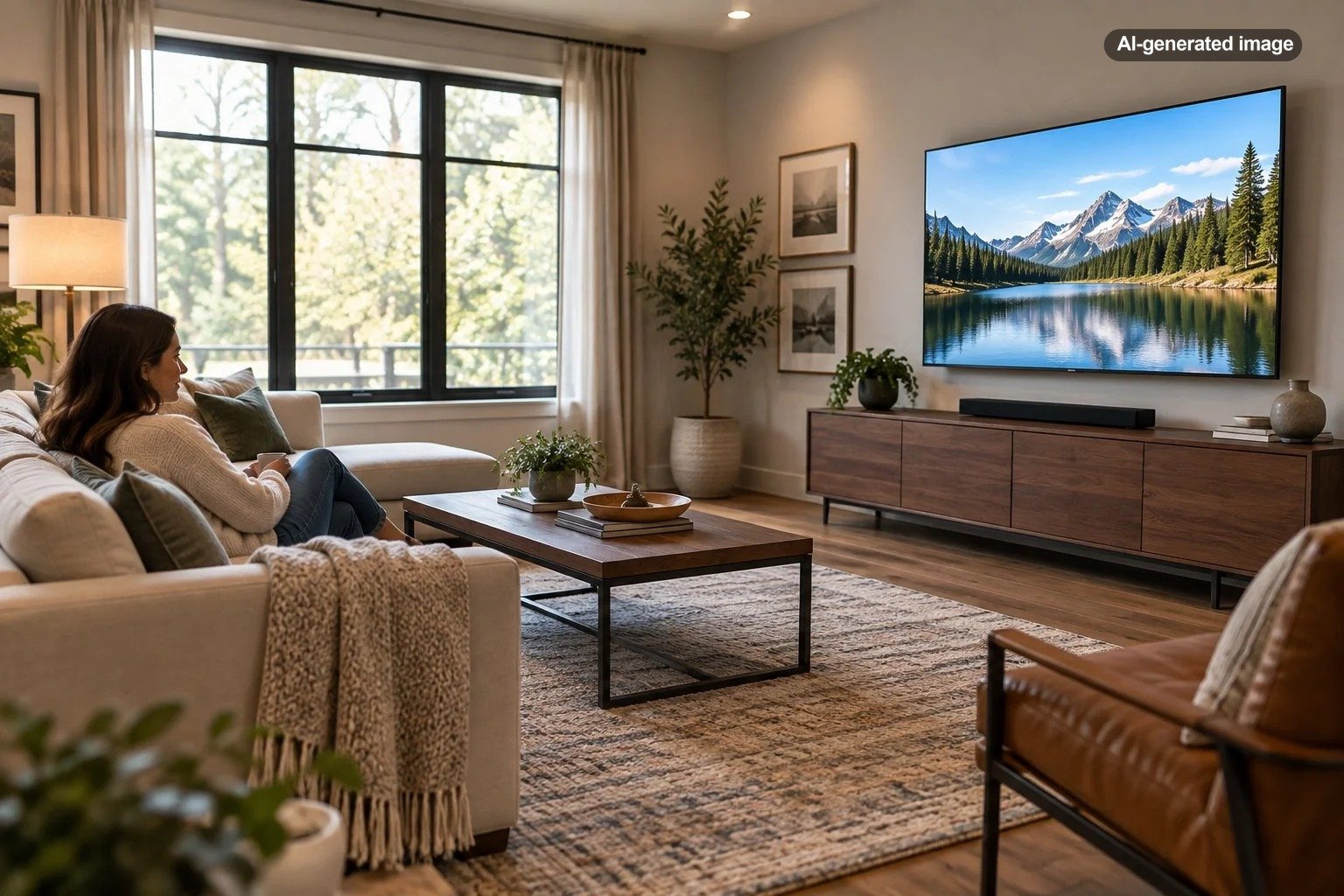
For movie nights, a viewing distance of about 6.5 to 7.5 feet can make a 65-inch television feel notably more immersive. Large landscapes, close-up performances, and detailed cinematography become more prominent because the image occupies more of your field of vision.
This arrangement works particularly well for viewers who enjoy watching films with the room lighting dimmed and their attention focused on the screen. However, poorly compressed streaming content may reveal more visible artifacts when viewed from close range.
Sports and Everyday Television
Sports broadcasts and general television programming often benefit from a slightly more relaxed seating position. Around 8 to 9 feet allows the entire picture to remain comfortably within view while leaving space for conversation and other living room activities.
A wider seating arrangement may also make practical sense when multiple people watch together. The main couch can occupy the preferred distance while secondary chairs sit slightly farther away.
Video Games
For immersive adventure or racing games, sitting around 6.5 to 7.5 feet from a 65-inch display can create an engaging experience. Games with small interface text, maps, or detailed menus may also benefit from closer seating, provided the overall image remains comfortable to scan.
Fast-paced competitive games introduce another consideration: screen size and distance can influence how easily players monitor action across the entire display. Some gamers prefer a slightly greater distance so peripheral information is easier to follow without repeatedly moving their eyes.
Does a 65-Inch TV Work in a Small Living Room?
Yes. A 65-inch television can work well in a small living room, apartment, or condo, especially when the screen has 4K resolution. The room’s total square footage matters less than the actual distance between the primary seating position and the display.
Consider a living room where the sofa sits 7 feet from the television. That arrangement falls comfortably within the immersive range for a 65-inch screen. The display may look substantial on the wall, but that does not automatically make it too large for the room.
Now consider a narrow room where the seated viewing position is just 5 feet from the display. The same television can still be enjoyable, but the image will occupy considerably more of the viewer’s visual field. Some households will welcome the effect; others may prefer a smaller screen or a different furniture arrangement.
In small rooms, consider the visual weight of the entire entertainment arrangement. An enormous media console, oversized speakers, or crowded shelving can make a wall feel more imposing than the television itself. A restrained furniture arrangement often helps a large screen feel more intentional.
How High Should You Mount a 65-Inch TV?
Viewing distance is only half of the comfort equation. Mounting height also influences how naturally your eyes and neck align with the picture.
A practical starting principle is to place the center of the television near seated eye level. For many living rooms, this creates a more natural viewing posture than mounting the screen near the ceiling.
A typical 65-inch 16:9 screen is approximately 32 inches tall. Its center is therefore about 16 inches above its bottom edge. If the desired screen center is 42 inches above the floor, the bottom of the visible display would sit approximately 26 inches above the floor. The television’s frame, stand, and mounting hardware can affect actual placement.
These numbers are examples, not universal installation measurements. Your seating height, posture, recline angle, furniture, and television dimensions should determine the final position.
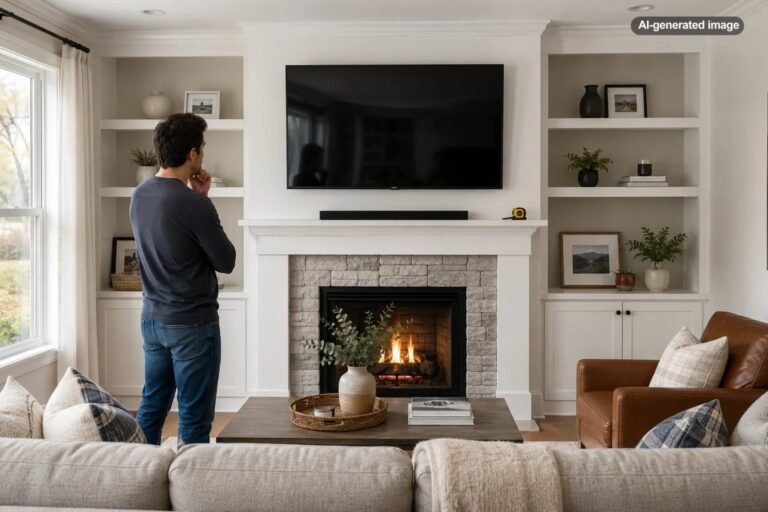
Mounting above a fireplace can create a more elevated viewing angle than intended. Before choosing that location, evaluate seated comfort, manufacturer placement instructions, and possible heat exposure. A mounting position that looks symmetrical while standing may feel awkward from the couch.
For wall-mounted installations, use mounting hardware appropriate for the television and wall construction. Follow the television and mount manufacturers’ requirements, and seek qualified installation help when wall structure or anchoring is uncertain.
Common Mistakes When Positioning a 65-Inch TV
Even a technically appropriate viewing distance can feel wrong when other parts of the room are working against it. A few placement details deserve attention before committing to a final arrangement.
Placing the Couch Too Far Away
At 12 feet, a 65-inch display can still provide a perfectly watchable picture, but the cinematic effect is reduced. Fine details and small on-screen text become harder to appreciate. If the room permits, moving the main seating forward can improve the experience without requiring a different television.
Ignoring Windows and Glare
Strong reflections can be more distracting than a slightly imperfect viewing distance. Position the screen to minimize reflections from windows and bright lamps. Adjustable shades, thoughtful lamp placement, and appropriate ambient lighting often make a substantial difference.
Centering the TV on the Wall Instead of the Seating
A television centered perfectly between two architectural features may look balanced, but that position is not necessarily ideal for watching. If the primary sofa sits off to one side, viewers may spend hours looking diagonally across the room.
Whenever possible, organize the principal viewing position around a comfortable sightline. A room can still look thoughtfully designed without strict architectural symmetry.
Forgetting About Recliners and Multiple Seats
A reclining seat changes the viewer’s eye position and viewing angle. Sectional sofas also create different distances for different occupants. Measure the main viewing locations rather than assuming every person has the same perspective.
What If Your Seating Distance Cannot Change?
Many living rooms have fixed constraints. Doorways, circulation paths, windows, built-in cabinetry, and electrical outlets may limit where furniture can go. Fortunately, a less-than-ideal measurement does not mean the arrangement has failed.
If you sit closer than 6.5 feet: Try the position before making changes. A 4K screen may still look sharp, but pay attention to whether you constantly scan the image, experience discomfort, or find large on-screen movements overwhelming. Adjust the seating position if the experience feels tiring.
If you sit farther than 9 feet: Consider whether you actually miss image detail or struggle to read subtitles. If not, there may be little reason to rearrange the room. If the screen consistently feels small, bringing seating forward or eventually choosing a larger display may be worth considering.
If the TV is mounted too high: Reassess the mounting position before purchasing additional furniture. A lower display often provides a more comfortable viewing angle than trying to compensate with an unusually deep recline.
If multiple people have different preferences: Prioritize a sensible central seating distance and allow secondary chairs to offer closer or more relaxed alternatives.
Before you finalize the layout
- Measure from seated eyes to the screen, not from wall to wall.
- Test the main seating position at approximately 8 feet when possible.
- Check that subtitles and interface text are comfortable to read.
- Look for glare during both daytime and evening viewing.
- Confirm that screen height feels natural while seated.
- Preserve comfortable walkways and everyday furniture use.
Frequently Asked Questions
Is 10 feet too far for a 65-inch TV?
No. Ten feet is a reasonable distance for casual viewing, although it is farther than the commonly recommended immersive range. Movies and games may appear less engaging, and fine details will be less noticeable than at 7 or 8 feet. If the picture looks comfortably sized to you, there is no obligation to move closer.
Is 6 feet too close for a 65-inch 4K TV?
Not necessarily. Six feet is closer than the approximately 6.5-foot distance associated with a 40-degree cinematic viewing angle, but it is well beyond Sony’s approximate resolution-based minimum of 4 feet. The deciding factor is whether you find the large viewing angle comfortable over time.
How wide is a 65-inch television?
A standard 65-inch television with a 16:9 screen has a visible display approximately 56.7 inches wide and 31.9 inches tall. The complete television may be slightly larger because of its frame. Always check the specific model’s dimensions before choosing cabinetry or a wall location.
Should a 65-inch TV be mounted or placed on a stand?
Either arrangement can work. Wall mounting can free up furniture space and allow precise placement when installed correctly. A stand may be easier to reposition and can accommodate a media console with additional storage. Choose based on safe support, manufacturer requirements, viewing height, and how often you expect to change the room layout.
What is the best distance for watching sports on a 65-inch TV?
Approximately 8 to 9 feet is a practical starting point for sports and mixed viewing. It provides a broad view of the action without creating the intense, screen-filling effect associated with closer cinematic seating. Adjust according to eyesight, room conditions, and personal preference.
The Bottom Line
For a 65-inch 4K television, 6.5 to 9 feet is a useful viewing-distance range. Around 7 feet favors immersive movies and gaming, while approximately 8 to 9 feet offers a balanced experience for everyday television.
If you want one number to begin with, choose 8 feet and adjust from there. Measure from your eyes to the display, keep the screen at a comfortable height, and account for glare and furniture placement. The best arrangement is not necessarily the one that matches a diagram perfectly. It is the one that lets the television feel naturally integrated into a room you enjoy using.